How to choose a under sink water filter
Choose an under sink filter by contaminant, cartridge cost, and faucet fit. See housing sizes, certifications, and the $60-$400 equipment range.
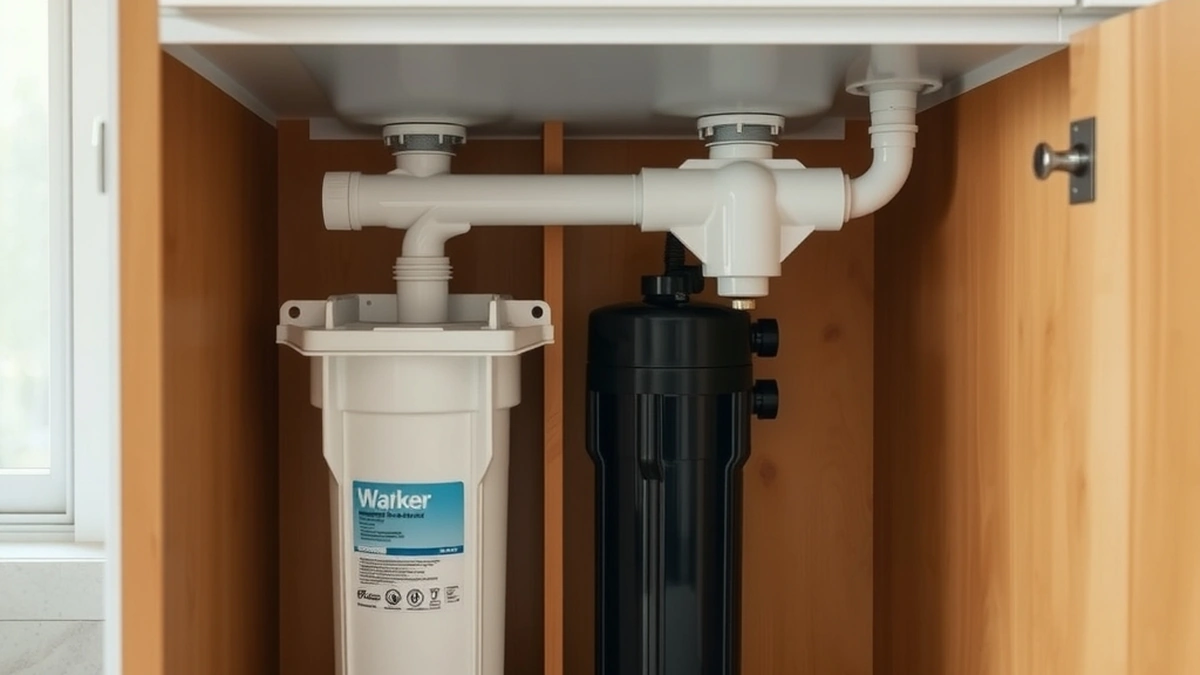
Choose an under sink filter by matching the cartridge to a named contaminant, then check cartridge cost and whether the housing fits your cabinet. Expect $60-$400 for the system and $40-$120 per year in cartridges.
- Equipment
- $60 - $400
- Annual cartridges
- $40 - $120
- Cartridge life
- 6 - 12 months
- Typical flow
- 0.5 - 1.5 GPM
- Faucet hole
- 7/8 inch
Some links on this page are affiliate links.If you buy through them we may earn a commission at no extra cost to you. We do not accept payment for rankings. Read the full disclosure.
Choose an under sink water filter by the contaminant you need to remove, then by cartridge cost and cabinet fit. A two-stage carbon system at $60-$400 handles most kitchens and runs $40-$120 a year. Anything beyond that should be justified by a lab number.
Start with what is in the water
An under sink water filter is a point-of-use device in the kitchen cabinet, feeding a dedicated faucet. It treats drinking and cooking water, not the whole house.
The cartridge decides what it removes. A carbon block handles chlorine, taste, odor, and some lead if certified. A sediment stage handles particles. A specialty stage handles arsenic, nitrate, or PFAS.
Without a test, you are buying a cartridge for a problem you have not identified. A $40-$150 lab panel or a certified home kit gives you the three or four numbers that matter.
If the water is municipal, the utility’s annual quality report covers most of it. If it is a well, test it yourself, because nobody else is.
Carbon block versus granular
| Media | Contact | Flow | Cost | Best for |
|---|---|---|---|---|
| Carbon block | High | Lower | $20 - $60 | Chlorine, lead, cysts |
| Granular (GAC) | Lower | Higher | $10 - $35 | Taste and odor |
| Catalytic carbon | High | Lower | $30 - $80 | Chloramine |
| Specialty media | Varies | Lower | $40 - $120 | Named contaminant |
A block is denser, so water spends longer in contact with the carbon and removal is more consistent. A GAC cartridge flows faster and costs less, and it is the right choice when taste is the only issue.
For most kitchens, a block is the better default. Carbon block versus GAC explains the pore structure difference in more detail.
Certification, the only real claim
Look for an NSF/ANSI standard number on the cartridge or box. Standard 42 covers aesthetic effects such as chlorine and taste. Standard 53 covers health effects including lead and cysts. Standard 401 covers emerging contaminants such as pharmaceuticals.
A cartridge that says “removes 99 percent of contaminants” without a standard number has no verified claim behind it. That is not a reason to assume it is fraudulent; it is a reason to prefer one that was tested.
Match the standard to the concern. A filter certified only under 42 does not make a lead claim, no matter what the box says.
Fit, flow, and cabinet space
Measure the cabinet before buying. A two-stage system needs about 14 inches of height below the shelf and 4 inches of clearance in front for cartridge removal.
Check the faucet hole. A standard drinking water faucet needs 7/8 inch. If the sink has a fourth hole with a soap dispenser, reuse it. If not, drilling stone requires a diamond bit.
Flow at the faucet is usually 0.5-1.5 GPM. A 1/4-inch line delivers about 0.6 GPM at 50 psi; a 3/8-inch line roughly doubles it.
Pressure matters too. Most units are rated for 20-80 psi. Above 80 psi, add a regulator at $25-$40.
What it costs to own
A single-stage carbon system at $80 with a $25 cartridge every 9 months costs $80 + ($33 × 3) = $180 over three years.
A two-stage system at $250 with a $60 annual cartridge set costs $250 + ($60 × 3) = $430 over three years.
An under sink RO at $300-$900 installed with $60-$150 per year in filters costs $600 + ($105 × 3) = $915 over three years, and removes 80-95 percent of dissolved solids.
The jump in capability is real, and so is the jump in cost. A carbon filter handles taste; RO handles dissolved contaminants.
When to skip the under sink unit
If hardness is the complaint, a softener is the tool. If bacteria is the concern, UV or well disinfection is the tool. If the whole house tastes like chlorine, a point-of-entry filter covers showers and laundry too.
An under sink unit is for drinking water at one tap. That is a narrow job, and it does it well.
If the water is very hard, a softener ahead of the filter extends cartridge life, because scale blinds carbon blocks faster than chlorine exhausts them.
A buying sequence
- Test the water and name the contaminant you want removed.
- Match the certification standard to that contaminant.
- Choose block or granular based on flow and contact needs.
- Measure cabinet height, width, and faucet hole.
- Compare cartridge price and local availability, not just the unit price.
- Confirm the housing accepts standard 10-inch cartridges if you want cheap replacements.
What to ignore
Ignore systems priced by “stages” alone. A four-stage unit with tiny cartridges is not better than a two-stage unit with real media volume.
Ignore proprietary cartridge designs unless the unit is exceptional. A $180 system with $70 cartridges costs more over five years than a $300 system with $20 cartridges.
Ignore any flow claim above 2 GPM on a 1/4-inch line. The tubing, not the filter, sets the ceiling.
Ignore a system that hides its cartridge price until checkout. The first purchase is the cheap part; five years of cartridges is the real cost, and sellers who obscure it know that.
For installation, under sink water filter installation covers the tee and faucet, and under sink water filter cost breaks out the price bands. “”
Frequently asked questions
What is the best type of under sink water filter?
A two-stage system with a sediment pre-filter and a carbon block covers most needs. Add a specialty stage only when a lab report names a contaminant the carbon block cannot hold.
How much does an under sink water filter cost?
Sixty to four hundred dollars for the system and forty to one hundred twenty dollars per year in cartridges. Installation is free if you do it yourself or $100-$250 with a plumber.
How do I know which contaminants a filter removes?
Check the NSF/ANSI certification listing. Standard 42 covers taste and chlorine, 53 covers lead and cysts, and 401 covers emerging contaminants. Package claims without a standard are marketing.
Will an under sink filter fit my cabinet?
Most two-stage systems need about 14 inches of height and 4 inches of clearance in front. Measure before buying, especially in a sink base with a disposal.
Do under sink filters need a drain?
No, unless it is a reverse osmosis system. Carbon and sediment filters run on supply pressure and send nothing to drain.
How often do under sink cartridges need changing?
Every 6-12 months for carbon and every 3-6 months for a sediment pre-stage. Change sooner if flow drops or taste returns.
Sources
Some links are affiliate links.If you buy through them we may earn a commission at no extra cost to you. We do not accept payment for rankings. Read the full disclosure.