
Well water filtration system
Well water needs staged filtration matched to the lab report. See the order for sediment, iron, sulfur, carbon, and UV, with installed costs for each.
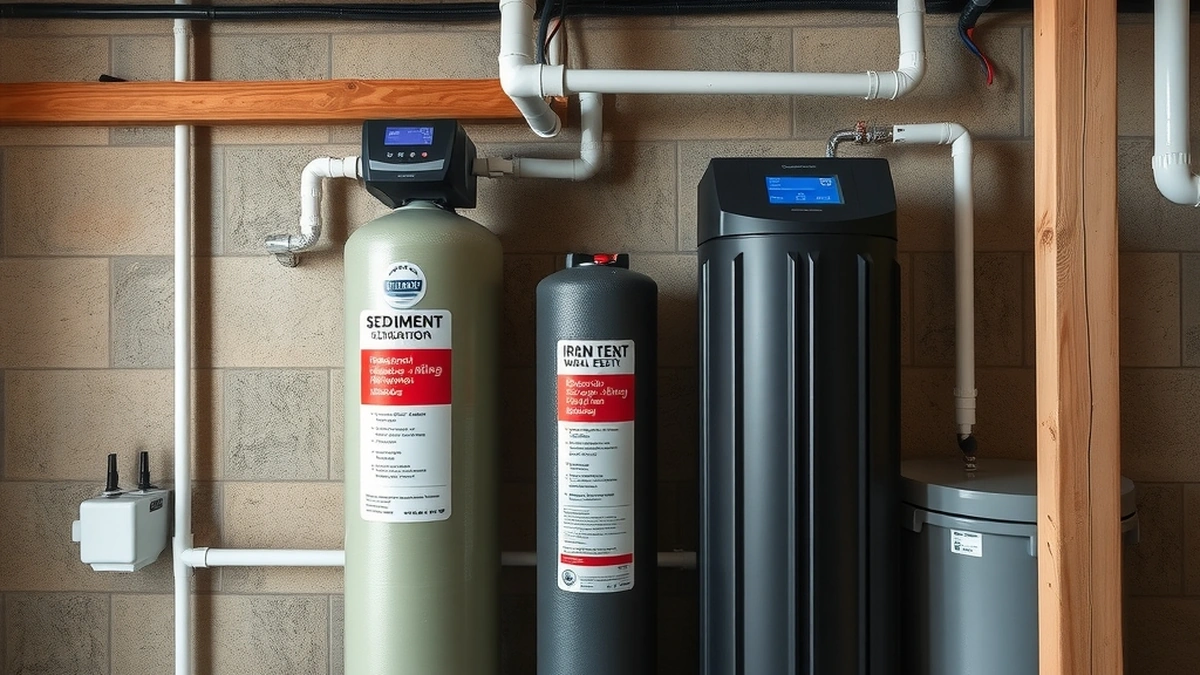
A well water filtration system is a staged train: sediment, iron or sulfur removal, softening, carbon, and UV, ordered by the lab report. Each stage costs $500 to $3,000 installed, and the sequence matters more than the brand of any single unit.
- Sediment and carbon
- $500 - $1,800 installed
- Iron filter
- $800 - $2,500 installed
- Sulfur filter
- $1,000 - $3,000 installed
- Softener
- $1,200 - $4,500 installed
- Lab test
- $40 - $150
Some links on this page are affiliate links.If you buy through them we may earn a commission at no extra cost to you. We do not accept payment for rankings. Read the full disclosure.
A well water filtration system is designed from a lab report, not from a catalog. The report names the contaminants, and the contaminants set the stages, the order, and the cost. Without it, you are buying equipment that may address a problem you do not have while missing the one you do.
Start With the Test
A private well has no utility report, so the lab panel is the only source. A basic panel at $40 to $150 covers hardness, iron, manganese, pH, nitrate, and bacteria. Add arsenic, uranium, or PFAS if you are in a region where they are known.
Test annually for bacteria and nitrate at minimum. Test again whenever the water changes: after heavy rain, after a long dry spell, after any work on the well, or when a smell or colour appears.
The test result drives everything. Iron at 5 ppm needs an iron filter. Sulfur odour needs oxidation. Hardness at 14 GPG needs a softener. Nitrate at 12 mg/L needs reverse osmosis at the tap. One panel, four different answers.
The Standard Stage Order
| Position | Stage | Removes | Installed cost |
|---|---|---|---|
| 1 | Sediment | Sand, grit, turbidity | $500 - $1,800 with carbon |
| 2 | Iron filter | Iron, manganese | $800 - $2,500 |
| 3 | Sulfur treatment | Hydrogen sulfide | $1,000 - $3,000 |
| 4 | Softener | Hardness | $1,200 - $4,500 |
| 5 | Carbon | Taste, odour, organics | $500 - $1,800 |
| 6 | UV | Bacteria, viruses | $700 - $1,800 |
Not every house needs every stage. A well with clean, soft water needs only a sediment filter and a UV lamp. A well with iron, sulfur, and 18 GPG hardness needs most of the list.
Why the Order Is Fixed
The order is a protection chain.
- Sediment protects the iron filter’s media from grit and the UV sleeve from film.
- Iron removal protects the softener resin, which cannot regenerate iron above 2 to 3 ppm.
- Softening protects the carbon block from scale and the water heater from buildup.
- Carbon protects the UV sleeve from organics and improves taste.
- UV is last because light cannot penetrate particles or film.
Move one stage and the chain breaks. A softener ahead of an iron filter will foul its resin permanently. A UV lamp ahead of sediment will shine through turbidity and do nothing.
Matching Stages to Symptoms
| Symptom | Likely cause | Stage |
|---|---|---|
| Orange stains, metallic taste | Iron | Iron filter |
| Rotten egg smell | Hydrogen sulfide | Oxidation plus carbon |
| White scale, soap scum | Hardness | Softener |
| Blue-green stains | Low pH, corrosive water | Neutralizer |
| Cloudy or gritty water | Sediment | Sediment filter |
| Yellow tint that will not settle | Tannins | Anion exchange |
| Positive bacteria test | Microbial | UV, after shock chlorination |
That table is a starting point, not a diagnosis. Iron bacteria, for example, produces a smell and a slime that a standard iron filter handles differently from dissolved iron. The lab report distinguishes them.
There is one more distinction worth making: a filter and a treatment system are not the same purchase. A cartridge housing removes particles and chlorine. An iron filter, a softener, and a UV unit are appliances with valves, drains, and power requirements. Budgeting for the filters and then discovering the appliance costs is how a $600 plan becomes a $6,000 project.
What It Costs to Run
Consumables track the stages. Sediment cartridges every 3 to 6 months at $10 to $40. Carbon every 6 to 12 months at $25 to $60. Salt for the softener at $120 to $400 per year. UV lamp every 12 months at $30 to $90. Iron filter media every 5 to 10 years, several hundred dollars.
A full chain on a hard, iron-bearing well commonly runs $4,000 to $9,000 installed. Annual consumables land around $300 to $700.
That is a real number, and it is the reason testing first matters. A $150 panel can save $2,500 on equipment you do not need.
Five Steps to Specify a System
- Pull a lab panel and keep the results.
- List the contaminants in order of severity.
- Assign a stage to each using the table above.
- Order the stages as sediment, iron, sulfur, softener, carbon, UV.
- Confirm flow, drain, and power for each backwashing unit before buying.
Maintenance That Keeps It Working
Test the water annually. Change cartridges on the printed interval. Replace the UV lamp every 12 months even though it still glows. Add salt before the brine tank empties rather than after.
Backwash iron and carbon filters on the schedule the valve specifies. A filter that never backwashes becomes a clogged bed that channels water past the media.
And keep the test history. A well that was clean for ten years and suddenly shows bacteria is telling you something about the casing, the grout, or the water table, and the trend is only visible if you have the older results.
One final caution on sequencing a purchase: install the stage that fixes the worst problem first, then live with the water for a month and retest. A well with iron and hardness often feels completely different after the iron filter alone, and the softener decision is easier once the iron is gone. Buying everything at once, before the effect of the first stage is known, is how households end up with an oversized system.
The layout is covered in well water system layout, the cost side in well water treatment cost, and the testing detail in well water testing.
Frequently asked questions
What does a well water filtration system need to remove?
It depends on the lab report: sediment, iron, manganese, sulfur, hardness, and bacteria are the common targets, with arsenic, nitrate, and uranium in some regions.
In what order should well water filters be installed?
Sediment first, then iron or sulfur removal, then softening, then carbon, then UV last, so each stage protects the one after it.
How much does a well water filtration system cost?
A basic sediment and carbon system runs $500 to $1,800 installed, an iron filter $800 to $2,500, sulfur treatment $1,000 to $3,000, and a softener $1,200 to $4,500.
Do I need a softener if I have a filter?
If the report shows hardness above 7 GPG, yes, because filtration removes particles and odour but leaves the calcium and magnesium that cause scale.
How often should well water be tested?
At least annually for bacteria and nitrate, and any time the water changes colour, smell, or taste, since wells can shift after heavy rain or a change in the water table.
Can I filter well water without testing it?
You can install equipment, but you cannot know whether it addresses the actual problem, and treating for iron when the issue is sulfur wastes money.
Sources
Some links are affiliate links.If you buy through them we may earn a commission at no extra cost to you. We do not accept payment for rankings. Read the full disclosure.


