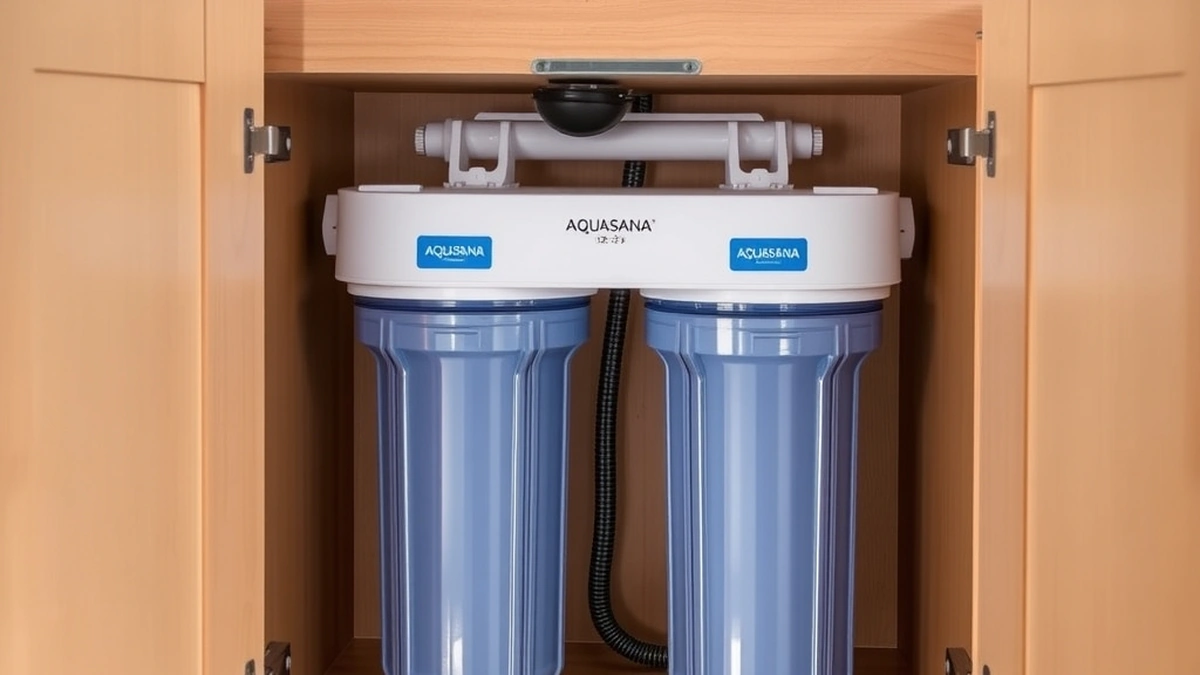
Activated carbon water filter
How activated carbon removes chlorine, taste, and organic compounds, what GAC and block media each do, and what carbon cannot treat.

An activated carbon water filter removes chlorine, taste, odour, and many organic compounds by adsorption. Granular carbon suits whole-house tanks and block carbon suits point-of-use housings, costing $500 to $1,800 installed with $80 to $300 a year in cartridges.
- Whole-house installed
- $500 - $1,800
- Cartridge per year
- $80 - $300
- Removes
- Chlorine, taste, organics
- Does not remove
- Hardness, nitrate, bacteria
- Change interval
- 6 - 12 months
Some links on this page are affiliate links.If you buy through them we may earn a commission at no extra cost to you. We do not accept payment for rankings. Read the full disclosure.
An activated carbon water filter removes chlorine, taste, odour, and many organic compounds by adsorption. It is the workhorse of residential water treatment, and it is also the most misunderstood: carbon does not soften, does not remove nitrate, and does not disinfect.
How Adsorption Works
Activated carbon is carbon that has been processed to create an enormous internal surface area, typically hundreds of square metres per gram. Contaminants bind to that surface as water passes.
The activation matters. Heating carbon with steam or chemicals opens millions of pores, and the pore structure determines what the carbon can capture. Smaller pores suit small molecules like chlorine; larger pores suit bigger organic compounds.
Adsorption is not filtration. A carbon block also filters particles because it is a solid matrix, but the chemical removal is a surface phenomenon, and the surface fills up. That is why carbon has a capacity and why cartridges need changing.
Contact time is the other variable. Water has to dwell against the carbon long enough for the compounds to bind, so a cartridge rated for 2 gallons per minute removes less at 4 gallons per minute. Oversizing the flow through a small cartridge is one of the quiet ways a carbon filter underperforms its rating.
GAC vs Carbon Block
| Feature | Granular (GAC) | Block |
|---|---|---|
| Form | Loose granules | Extruded solid |
| Contact time | High | Moderate |
| Flow | Higher | Lower |
| Particulate retention | Poor | Good |
| Channeling risk | Yes | No |
| Best for | Whole-house tanks, taste | Under-sink, RO pre-filter |
Granular carbon in a tank gives long contact time and handles high flow, which is why whole-house carbon tanks use it. The weakness is channeling: water finds a path through the bed and bypasses much of the media.
Block carbon is extruded into a solid cylinder with a binder. Flow is lower, but there is no channeling, and the block also acts as a fine particulate filter. That is why every reverse osmosis system uses a block pre-filter.
The practical split is simple: tanks and large housings get granular media because they need flow, and small cartridges get blocks because they need predictable contact and no bypass. A block in a whole-house tank would restrict flow; granular in a small cartridge would channel.
What It Removes
| Contaminant | Carbon performance |
|---|---|
| Chlorine | Yes |
| Chloramine | Catalytic carbon only |
| Taste and odour | Yes |
| Volatile organics | Yes |
| Pesticides | Some |
| Pharmaceuticals | Some |
| Lead | Only with added media |
| Nitrate | No |
| Hardness | No |
| Bacteria | No |
The chloramine row is a common trap. Utilities that use chloramine instead of free chlorine require catalytic carbon, which is a different media. Standard carbon passes chloramine largely unchanged, and a household that switches utilities may find its filter stops working.
What It Costs
A whole-house carbon system installed runs $500 to $1,800. Under-sink carbon runs $150 to $500. Cartridges run $80 to $300 per year for whole-house and $40 to $120 for under-sink.
A ten-year figure for a $700 whole-house system with $140 per year: $700 + $1,400 = $2,100, or $210 per year.
That is an estimate from published ranges. The consumable line dominates, which is why cartridge price and availability matter more than the housing brand.
The ten-year number is also the right way to compare carbon against reverse osmosis. Carbon is cheaper to buy and cheaper to run, and it removes a narrower set of contaminants. The choice follows the lab report, not the price.
Where Carbon Belongs in a Chain
Carbon is almost always preceded by sediment and followed by softening, UV, or a membrane.
Sediment first protects the carbon from grit. Carbon before a softener removes chlorine, which would otherwise degrade the resin over years. Carbon before an RO membrane is mandatory, because chlorine destroys the polyamide layer.
| Position | Stage | Protects |
|---|---|---|
| 1 | Sediment | Carbon |
| 2 | Carbon | Resin, membrane |
| 3 | Softener | Heater, fixtures |
| 4 | UV | Final barrier |
The order is described in well water system layout, and the comparison with block media is in carbon block versus GAC.
Five Steps to Choose
- Test the water and identify the contaminants.
- Check whether the utility uses chlorine or chloramine.
- Choose GAC for whole-house tanks, block for point-of-use.
- Size the housing to the flow.
- Set a change schedule and write it on the housing.
Maintenance
Change every 6 to 12 months, or sooner if taste returns. A carbon cartridge that has passed its life may release adsorbed material, so the interval is not a suggestion.
A carbon bed that sits too long can support bacterial growth. That is why carbon is not a microbiological barrier and why a well with bacteria needs UV after the carbon, not instead of it.
If taste returns before the interval, the water carries more chlorine or organics than the rating assumed, and a larger housing or a shorter interval is the fix.
What Carbon Is Not
It is not a softener. It is not a reverse osmosis membrane. It is not a disinfectant. It is a taste and chlorine treatment that also removes a useful range of organic compounds, and it does that job well when the cartridge is current.
Households that expect more from it usually bought it for the wrong reason. A carbon filter will not fix hard water, will not remove nitrate, and will not make well water safe without testing. It will make treated municipal water taste clean, which is what most people actually wanted.
For the whole-house version, see whole house water filtration. For the filter format comparison, filter filtration water covers media types, and water filter system covers staging.
Frequently asked questions
What does an activated carbon filter remove?
Chlorine, chloramine with catalytic media, taste and odour compounds, many volatile organic compounds, and some pesticides and pharmaceuticals, by adsorption onto the carbon surface.
What is the difference between GAC and carbon block?
Granular activated carbon is loose media in a tank or cartridge with high contact time but a risk of channeling, while block carbon is extruded into a solid with lower flow and better particulate retention.
Does activated carbon remove lead?
Standard carbon does not; some block cartridges are certified for lead reduction through added media, and the certification listing names the specific model.
How often should a carbon filter be changed?
Every six to twelve months for whole-house and under-sink cartridges, and sooner if taste returns or the rated volume is reached.
Can carbon filters remove hardness?
No. Calcium and magnesium pass through carbon, so hardness requires a softener or reverse osmosis.
Do carbon filters remove bacteria?
No, and a carbon bed that is left too long can support bacterial growth, which is why carbon is not a microbiological barrier.
Sources
Some links are affiliate links.If you buy through them we may earn a commission at no extra cost to you. We do not accept payment for rankings. Read the full disclosure.