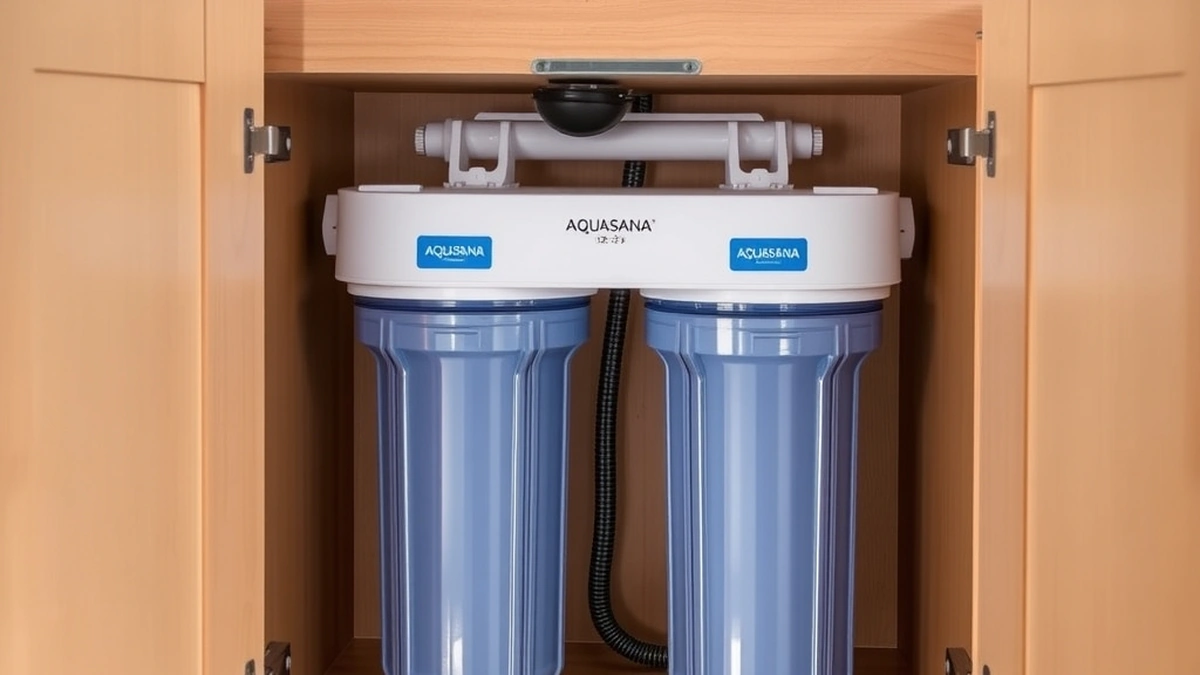
alkaline water filter installation: what it involves
Alkaline filter installation takes 20-60 minutes for an under-sink cartridge, or 1-2 hours for an ionizer with power. See plumbing, pH setup, and cost.

Alkaline water filter installation takes 20-60 minutes for an under-sink mineral cartridge and 1-2 hours for a powered ionizer. It connects to the cold supply, needs no drain unless the unit has a reject stream, and costs $100-$2,000 installed.
- Cartridge install
- 20 - 60 minutes
- Ionizer install
- 1 - 2 hours
- Parts cost
- $60 - $400
- Ionizer cost
- $800 - $2,000
- Cartridge life
- 6 - 12 months
Some links on this page are affiliate links.If you buy through them we may earn a commission at no extra cost to you. We do not accept payment for rankings. Read the full disclosure.
Alkaline water filter installation takes 20-60 minutes for an under-sink mineral cartridge and 1-2 hours for a powered ionizer. The cartridge version is the same job as any point-of-use filter: a supply tee, tubing, and a faucet. The ionizer adds power and a drain line.
Two devices share the name
An alkaline water filter is usually one of two things. The first is a cartridge containing calcite, magnesite, or a mineral blend that dissolves into the water and buffers pH upward. The second is an electrolysis unit, often called an ionizer, that splits the incoming stream into alkaline and acidic fractions.
The installation differs completely. A cartridge is passive, needs no power, and produces no waste. An ionizer needs a 120V outlet, a diverter or dedicated faucet, and a drain for the acidic stream.
Both are point-of-use devices. Neither treats a whole house, and neither is a substitute for filtration of sediment, chlorine, or metals.
The three formats, priced
| Format | Installed cost | Power | Drain | Best for |
|---|---|---|---|---|
| Under-sink mineral cartridge | $60 - $400 | None | None | One tap, simple pH bump |
| Countertop ionizer | $800 - $2,000 | 120V | Small line | Rental kitchens, no plumbing |
| Under-sink ionizer | $1,200 - $2,500 | 120V | Yes | Dedicated faucet, higher flow |
| Whole-house calcite tank | $800 - $2,000 | None | Backwash drain | Low pH throughout the house |
That last row is a different product: a backwashing neutralizer tank that raises pH for every tap and protects plumbing from acidic water. It is the right tool when pH is below 6.5 and copper pipes are at risk. The cartridge and ionizer formats treat drinking water at one faucet.
Plumbing for the cartridge version
The cartridge install mirrors an under-sink filter. Shut off the cold valve, fit a 3/8-inch tee, mount the housing or inline cartridge on a bracket, and run 1/4-inch tubing to a dedicated faucet.
Two details matter. First, flow direction: most cartridges are directional, and reversing them pushes media into the outlet and clogs the faucet screen. Second, flush time: calcite media sheds fines for the first few minutes, so run 2-5 minutes to drain before drinking.
If the cartridge sits after a carbon stage, pH rise is more predictable because chlorine has been removed. If it sits first, chlorine attacks the media and shortens its life.
Plumbing and power for an ionizer
An ionizer needs three connections: cold supply in, alkaline out to a faucet, and acidic out to a drain. The drain line is 1/4-inch tubing run to a saddle on the trap, and it must slope continuously.
Power is the gating item. Most units draw 100-300 watts during operation and need a grounded outlet within cord reach. A cabinet with no outlet means an electrician at $150-$350.
Some units include a pre-filter housing that must be installed ahead of the ionizer to protect the plates. That housing adds 15-20 minutes and a cartridge change every 6-12 months.
Six steps for a cartridge install
- Test pH, hardness, and alkalinity so you know the starting point.
- Shut off the cold supply and bleed pressure at the faucet.
- Fit the supply tee and mount the cartridge or housing bracket.
- Connect inlet and outlet tubing, observing the flow arrow.
- Open the valve, check for leaks, and flush 2-5 minutes.
- Re-test pH after a week of use to confirm the actual shift.
What it changes and what it does not
Calcite raises pH by dissolving calcium carbonate. That means it also raises hardness slightly, typically 1-3 grains per gallon depending on the media volume and the water’s CO2 content. If a softener sits downstream, it will see a small additional load.
An ionizer raises pH in the alkaline stream but produces acidic water as a byproduct, which is why the drain line exists. Output pH depends on source alkalinity; low-alkalinity water produces a weaker shift.
Neither device removes contaminants. A carbon block ahead of the alkaline stage handles chlorine and taste; RO ahead of it removes dissolved solids. Putting an alkaline cartridge after RO is common, because RO water is low in minerals and the cartridge adds some back.
No health claim belongs here. The measurable effects are pH, alkalinity, and mineral content, and those are water chemistry numbers, not outcomes.
Cost over three years
A $150 cartridge kit with a $45 cartridge every 9 months costs $150 + ($45 × 4) = $330 over three years.
An $1,100 ionizer with a $60 pre-filter cartridge annually and a $40 cleaning solution twice a year costs $1,100 + ($60 × 3) + ($80 × 3) = $1,520 over three years. Plate replacement, if needed, adds $150-$400.
The cartridge version is cheaper by an order of magnitude and delivers a smaller, steadier pH shift. The ionizer costs more and offers adjustable output, which is the feature people pay for.
Where it fits
Alkaline treatment sits last in a train, after sediment, carbon, and any RO stage. It does not replace any of them. If the water is acidic enough to corrode pipes, the whole-house neutralizer is the correct fix, and water neutralizer covers that installation.
If you are comparing a cartridge with a full ionizer, alkaline water ionizer explains the electrolysis side. For the housing and faucet work that comes first, under sink water filter installation walks the same steps.
Frequently asked questions
How long does an alkaline water filter take to install?
Twenty to sixty minutes for an under-sink mineral cartridge on an existing supply valve. A powered ionizer takes one to two hours because it needs an outlet and a diverter or dedicated faucet.
Does an alkaline filter need a drain?
A mineral cartridge does not. A water ionizer does, because it splits water into alkaline and acidic streams and discharges the acidic stream to the drain through a small line.
What raises the pH in an alkaline filter?
Most cartridges use calcite or a calcite-magnesite blend that dissolves slowly and buffers the water upward. Ionizers use electrolysis instead, separating water into alkaline and acidic fractions.
How much does an alkaline water filter cost?
A cartridge kit runs $60-$400 installed. A countertop or under-sink ionizer runs $800-$2,000 plus installation, and replacement cartridges or plates add $40-$200 per year.
Will an alkaline filter change the hardness reading?
It can raise hardness slightly, because calcite adds calcium carbonate. That is the same mineral hardness tests measure, so a softener downstream may see a small increase in load.
Can I install an alkaline filter myself?
Yes for a cartridge unit: it uses the same push-fit tee and tubing as any under-sink filter. An ionizer is also a DIY job if an outlet exists, but the diverter and drain line take more care.
Sources
Some links are affiliate links.If you buy through them we may earn a commission at no extra cost to you. We do not accept payment for rankings. Read the full disclosure.