
Aquasana water filter
Aquasana sells under-sink, countertop, and whole-house carbon filters with certified contaminant claims. See the formats, running costs, and limits.
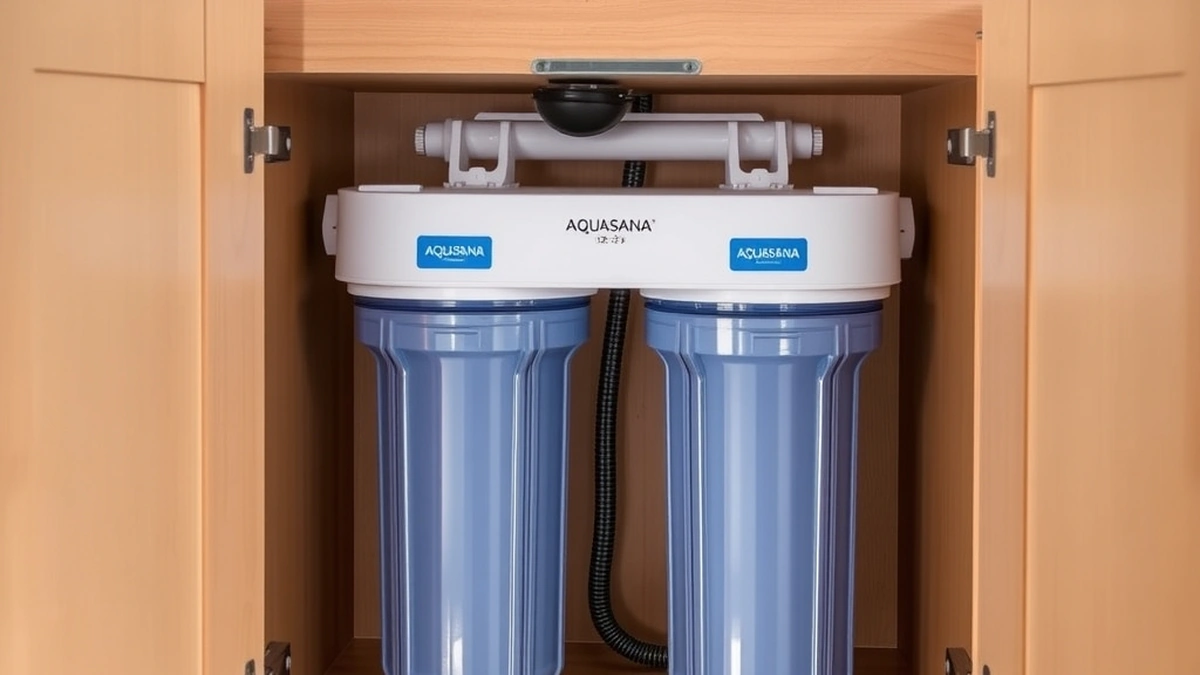
Aquasana water filters are carbon-based under-sink, countertop, and whole-house systems with NSF-certified contaminant claims. Under-sink units run $150 to $400 with $60 to $120 a year in filters, and none of them remove dissolved solids or hardness.
- Under-sink
- $150 - $400
- Whole-house
- $700 - $2,000
- Annual filters
- $60 - $150
- Removes
- Chlorine, lead, some VOCs
- Removes nitrate
- No
Some links on this page are affiliate links.If you buy through them we may earn a commission at no extra cost to you. We do not accept payment for rankings. Read the full disclosure.
Aquasana makes carbon-based water filters in under-sink, countertop, and whole-house formats. They are certified for chlorine, lead, and a range of organic compounds, and they do not remove dissolved solids or hardness. Under-sink units cost $150 to $400 with $60 to $120 a year in filters.
The Product Formats
Under-sink. A two-stage cartridge system feeding a dedicated faucet. The most common residential product and the one most households compare with reverse osmosis.
Countertop. A self-contained unit that connects to the faucet with a diverter, useful for renters.
Whole-house. A tank or twin-housing system on the main line, sized by flow.
| Format | Cost | Annual filters | Flow |
|---|---|---|---|
| Under-sink | $150 - $400 | $60 - $120 | 0.5 - 1 gpm |
| Countertop | $150 - $300 | $60 - $120 | 0.5 gpm |
| Whole-house | $700 - $2,000 | $100 - $250 | 8 - 12 gpm |
What the Media Does
The systems use a combination of carbon block and catalytic carbon, with some models adding a media for lead or chloramine. The housings are typically two-stage, with the first cartridge doing sediment and coarse carbon work and the second doing the finer adsorption.
Carbon removes chlorine, taste, and many organic compounds by adsorption. Catalytic carbon handles chloramine, which standard carbon does not. Added media can target lead or specific volatile compounds.
The key limit is that none of it removes dissolved salts. Nitrate, sodium, and total dissolved solids pass through, which is the difference between carbon filtration and reverse osmosis.
That is not a flaw. Carbon is the right tool for the contaminants it targets, and it does so at full flow with no waste water. Expecting it to behave like a membrane is the category error that leads to disappointment.
What It Removes
| Contaminant | Aquasana carbon |
|---|---|
| Chlorine | Yes |
| Chloramine | On catalytic models |
| Taste and odour | Yes |
| Lead | On certified models |
| VOCs | Yes, per certification |
| Nitrate | No |
| Sodium | No |
| Hardness | No |
| Bacteria | No |
Certification is per product, not per brand. A whole-house tank and an under-sink cartridge from the same company carry different listings, and the listing names the model.
That matters most for lead. A brand that advertises lead reduction may make that claim for one cartridge and not another, and the box for the cheaper model may carry only chlorine certification.
Cost of Ownership
Under-sink filters run $60 to $120 a year, with cartridges changed every six months or per the rated volume.
Five-year arithmetic for a $250 unit with $90 per year in filters: $250 + $450 = $700, or $140 per year. That is cheaper than an RO system at $232 per year, and it treats a narrower set of contaminants.
| System | Five-year cost | Per year |
|---|---|---|
| Aquasana under-sink | $700 | $140 |
| Under-sink RO | $1,160 | $232 |
| Pitcher | $275 | $55 |
The pitcher is cheapest and slowest. The RO is most expensive and removes the most. The carbon system sits in the middle, which is where most municipal water belongs.
At 2 gallons a day, the difference between $140 and $232 a year is about $90, which is less than most households spend on bottled water in a month. The decision should follow the contaminants, not the annual difference.
Whole-House Sizing
The whole-house product is the one that needs real sizing. A tank system must pass the house’s peak flow without a pressure drop the household will notice, and that means matching the tank diameter and valve to the fixture count.
A three-bathroom home peaks around 9 to 10 gallons per minute. A single large tank rated for 8 gpm is marginal at that demand, and a twin-tank system or a larger unit is the better fit. The flow figure on the spec sheet matters more than the grain rating, which does not exist for a carbon filter.
Where It Fits
It fits a household on treated municipal water with a chlorine taste, a lead concern, or an interest in reducing organic compounds at the tap.
It fits a household that wants filtered water at full flow without a storage tank or a drain. That is the practical advantage over RO: no tank, no waste line, no 3 to 4 to 1 reject stream.
It does not fit a well with nitrate, a home with hardness above 7 GPG, or a supply with bacteria. Those need reverse osmosis, a softener, and UV respectively.
Under-sink and countertop units are DIY-friendly. The under-sink version needs a cold supply connection and a faucet hole; the countertop version needs only a diverter.
Whole-house systems involve cutting the main line, adding a bypass, and confirming flow and pressure. That is plumber work, and it usually needs a permit if the drain or electrical is altered.
Five Steps to Choose
- Test the water and list the contaminants.
- Check the certification for the specific model.
- Confirm the flow you need at the tap.
- Price a year of filters, not just the hardware.
- Decide whether dissolved contaminants matter; if so, RO.
Maintenance and Expectations
Change on the rated volume, not on the calendar alone. Aquasana cartridges are typically rated for 500 to 800 gallons, which is six months to a year for a household.
Write the install date on the cartridge. Keep a spare, because a filter that sits exhausted is worse than no filter.
If flow slows early, sediment is loading the carbon block. A pre-filter or a whole-house sediment stage extends cartridge life.
The two are not competitors so much as different tools. Carbon removes chlorine, taste, lead, and organics at full flow with no waste water. RO removes dissolved solids including nitrate and sodium, at lower flow and with a reject stream.
For most municipal water, carbon is enough. For nitrate, sodium, or a broad dissolved-solids concern, RO is the answer. The decision follows the lab report rather than the price of the hardware.
For the direct comparison, see reverse osmosis versus carbon and Aquasana versus Springwell. For the review of a specific model, Aquasana water filter review covers the under-sink line.
Frequently asked questions
What does an Aquasana filter remove?
Chlorine, chloramine on some models, lead, and a range of volatile organic compounds, with certification claims varying by product and listed on the certification.
How much does an Aquasana under-sink filter cost?
Equipment runs $150 to $400 with $60 to $120 per year in replacement filters, and installation is straightforward on a cold supply line.
Does Aquasana remove fluoride?
Standard carbon models do not; only systems with a specific fluoride-reduction media do, and the product listing states whether that certification applies.
Is Aquasana better than reverse osmosis?
It is better for chlorine, taste, and flow, and worse for dissolved contaminants; reverse osmosis removes nitrate, sodium, and most dissolved solids that carbon leaves behind.
How often do Aquasana filters need changing?
Every six months or per the rated volume, typically 500 to 800 gallons for under-sink cartridges, and annually for many whole-house tanks.
Can I install an Aquasana system myself?
Under-sink and countertop units are DIY-friendly with a supply connection and a faucet, while whole-house systems involve cutting the main line and are better left to a plumber.
Sources
Some links are affiliate links.If you buy through them we may earn a commission at no extra cost to you. We do not accept payment for rankings. Read the full disclosure.


