
Water filter system
A water filter system is a staged train of housings, not one cartridge. See the point-of-entry and point-of-use formats, sizing, and installed costs.
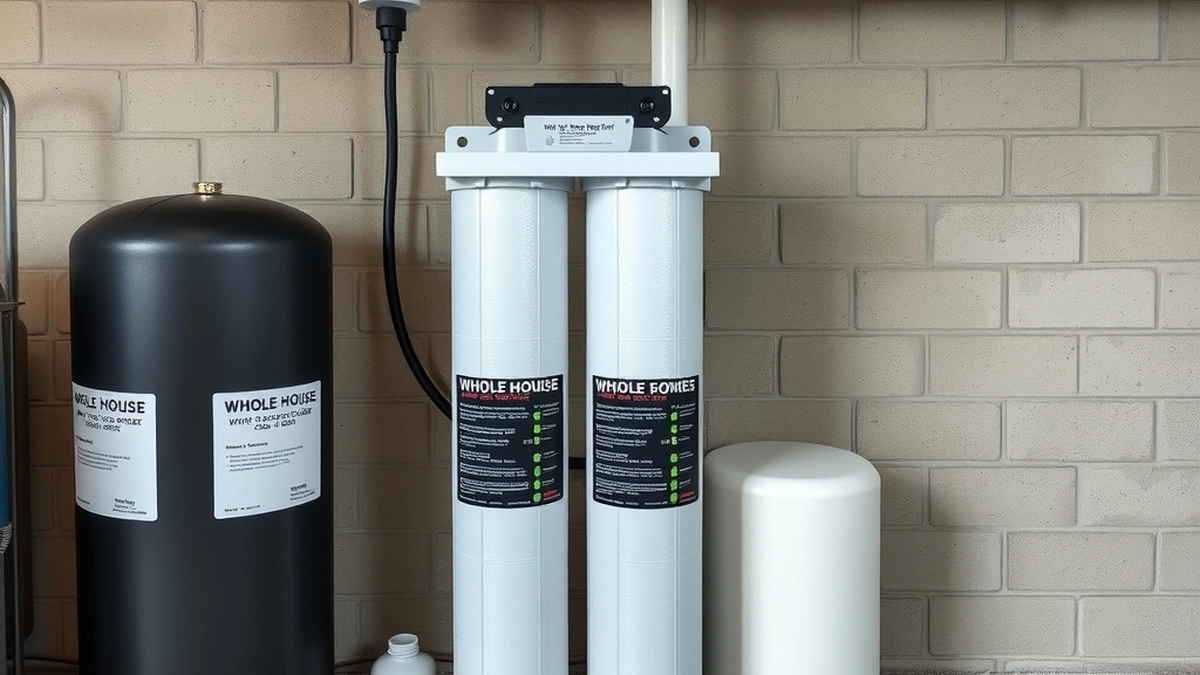
A water filter system is a series of filter stages sized to a flow rate, installed either at the point of entry or at a single tap. Whole-house systems cost $500 to $1,800 installed; under-sink systems $150 to $500. Stage count and housing size follow the water test.
- Whole-house installed
- $500 - $1,800
- Under-sink installed
- $150 - $500
- Annual cartridges
- $80 - $300
- Filter change
- 3 - 12 months by type
- Flow target
- 8 - 15 gpm whole house
Some links on this page are affiliate links.If you buy through them we may earn a commission at no extra cost to you. We do not accept payment for rankings. Read the full disclosure.
A water filter system is a staged train of housings rather than a single cartridge. The stages run in a deliberate order, each protecting the next, and the housing size is set by the flow rate it must pass. Get the order right and the system is cheap to run; get it wrong and you replace cartridges monthly.
Two Formats
Point-of-entry. A whole-house system installed on the main line after the meter or pressure tank. It treats every fixture: showers, laundry, dishwasher, water heater. Housings are large because they must pass 8 to 15 gallons per minute.
Point-of-use. A system at a single tap, usually the kitchen, or an under-sink unit feeding a dedicated faucet. Flow is 1 to 2 gpm, housings are small, and the treatment is more targeted.
Most homes benefit from both: point-of-entry carbon for chlorine and sediment, and a point-of-use RO for drinking water if dissolved contaminants are present.
| Format | Flow | Housings | Installed cost |
|---|---|---|---|
| Whole house, 2 stage | 8 - 15 gpm | 4.5 x 10 or 4.5 x 20 | $500 - $1,800 |
| Whole house, 3 stage | 8 - 15 gpm | Mixed | $900 - $2,500 |
| Under-sink carbon | 1 - 2 gpm | 2.5 x 10 | $150 - $500 |
| Under-sink RO | 50 - 75 gpd | 4 - 5 stages | $300 - $900 |
Stage Order
The sequence follows one rule: remove what would damage or clog the next stage.
- Sediment. 20 or 10 micron first, to take the coarse load. Protects the carbon and the UV sleeve if one is fitted.
- Carbon. Removes chlorine, taste, and odour. Protects resin, membranes, and any downstream media from oxidants.
- Specialty media. Iron, manganese, arsenic, or chloramine reduction, if the lab report calls for it.
- Polishing. A final carbon block for taste, or a UV stage if bacteria are a concern.
Putting carbon before sediment is a common error. The carbon block loads with grit and blinds in weeks, while the sediment cartridge behind it stays clean and useless.
Sizing by Flow
A filter system must pass the house’s peak flow without excessive pressure drop. A 2.5 inch housing is rated for 4 to 6 gpm. A whole-house system needs 8 to 15 gpm. That is why whole-house systems use 4.5 inch housings.
| Housing | Cartridge | Practical flow | Pressure drop |
|---|---|---|---|
| 2.5 x 10 | Standard | 4 - 6 gpm | 2 - 5 psi |
| 4.5 x 10 | Big blue | 8 - 12 gpm | 1 - 3 psi |
| 4.5 x 20 | Jumbo | 12 - 20 gpm | 1 - 3 psi |
Undersizing shows up as weak showers and slow fixture fill, covered in water pressure and filters. The fix is a larger housing, not a coarser cartridge.
What It Costs to Own
Two-stage whole-house system: $700 installed, sediment cartridges at $20 three times a year equals $60, carbon blocks at $40 twice a year equals $80. Annual total $140.
Over ten years: $700 + ($140 × 10) = $2,100, or $210 per year. That is the arithmetic for a mid-range system, and it is an estimate built on published ranges.
Under-sink carbon: $300 installed plus $80 per year in cartridges is $1,100 over ten years, or $110 per year, for one tap.
What a Filter System Cannot Do
It cannot soften. Carbon and sediment filtration leave calcium and magnesium in the water, so scale continues to form in the heater, the dishwasher, and the fixtures. If hardness is above 7 GPG, a filter system is only part of the answer and a softener is the other part.
It cannot remove nitrate. That needs reverse osmosis or a dedicated nitrate-selective resin.
It cannot reliably remove bacteria. Carbon is not a microbiological barrier; UV is the tool for that.
There is also a category error to avoid. A filter system is sometimes sold as a “whole house water treatment system” when it is only filtration. If the water test shows hardness at 14 GPG, iron at 4 ppm, and a sulfur odour, a two-stage carbon system addresses none of the three main problems. The stages have to match the report, and the report has to come first.
| Goal | Filter system alone? | Needs |
|---|---|---|
| Chlorine taste | Yes | Carbon |
| Sediment | Yes | Sediment stage |
| Hardness | No | Softener |
| Nitrate | No | RO |
| Bacteria | No | UV |
| Iron above 3 ppm | No | Iron filter |
Five Steps to Specify One
- Test the water with a $40 to $150 lab panel; the stages follow the results.
- Measure peak flow by counting simultaneous fixtures.
- Choose housing size from the flow, not from the cartridge price.
- Set the stage order as sediment, carbon, specialty, polish.
- Install a bypass so cartridges can be changed without shutting the house down.
Maintenance That Keeps It Working
Sediment every 3 to 6 months, carbon every 6 to 12 months. Mark the date on the housing with a marker; it is the only maintenance record most systems ever have.
If pressure drops before the interval is up, the cartridge is loading faster than expected, which means the upstream sediment stage is undersized or missing. Fix the cause rather than changing cartridges more often.
For the whole-house version in detail, see whole house water filtration and how a whole house filter works. If the test shows hardness as well, water softener systems covers the equipment that addresses it.
A final note on buying. The housings, brackets, and wrenches are commodity parts; the cartridge is the product. Choose a housing that takes a standard size, then choose a certified cartridge from a manufacturer that publishes its certification listing. A system is only as good as the cartridge inside it, and the housing is just a pressure vessel that holds it.
Frequently asked questions
What is a water filter system?
A staged set of filter housings, usually sediment and carbon, installed at the point of entry or at a single tap to remove particles, chlorine, and taste and odour compounds.
How many stages should a water filter system have?
Two for most homes, a sediment stage and a carbon stage, with a third added for chloramine, specific metals, or very high sediment loads.
How much does a whole-house filter system cost?
Installed costs run $500 to $1,800, with cartridges at $80 to $300 per year and replacement intervals of 3 to 6 months for sediment and 6 to 12 months for carbon.
Can a filter system replace a softener?
No. Carbon and sediment filtration do not remove calcium and magnesium, so hardness stays in the water and scale continues to form in the heater and fixtures.
Does a whole-house filter reduce water pressure?
A properly sized system costs 2 to 8 psi across the housings; an undersized housing or a loaded cartridge can cost 15 psi or more and should be corrected.
Where should a filter system be installed?
After the meter or pressure tank, before the water heater, with a bypass and a drain nearby if the system includes a backwashing stage.
Sources
Some links are affiliate links.If you buy through them we may earn a commission at no extra cost to you. We do not accept payment for rankings. Read the full disclosure.


