
Water softener systems
Single tank, twin tank, and cabinet softener systems differ in space, flow, and regeneration. See how each is configured and what it costs installed.
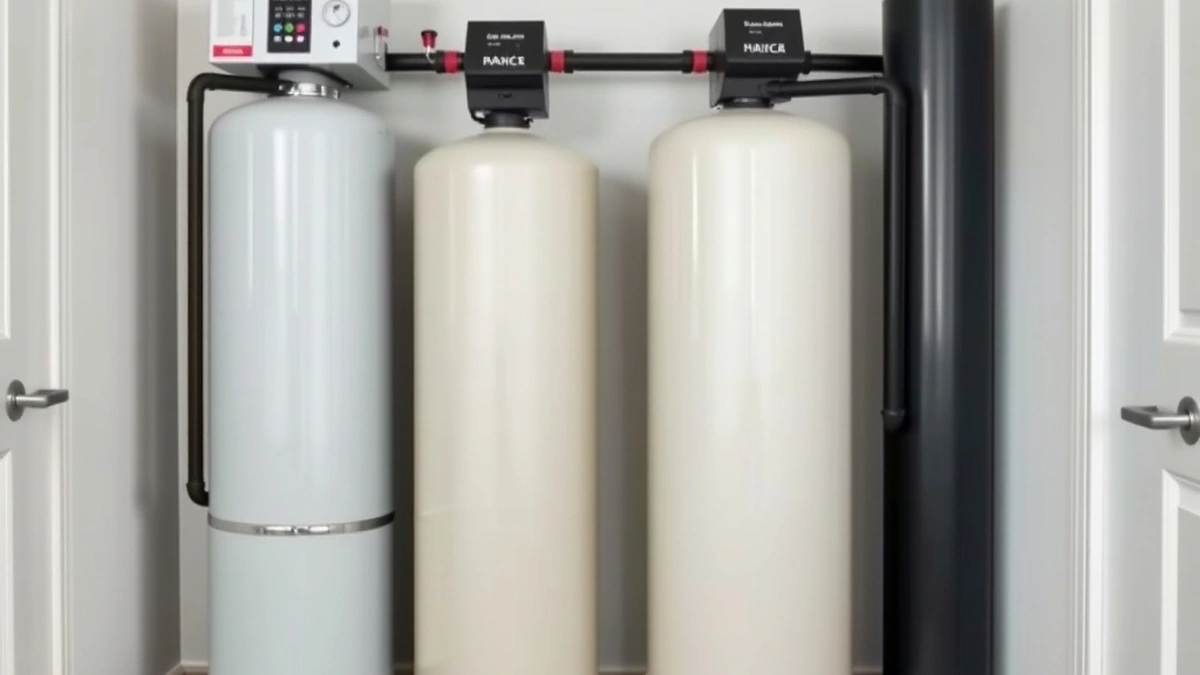
Water softener systems come in three configurations: a single tank with a separate brine tank, a cabinet unit with the brine well inside, and a twin-tank system that softens continuously while the other tank regenerates. Installed costs run $1,200 to $4,500.
- Single tank installed
- $1,200 - $3,500
- Cabinet installed
- $1,000 - $3,000
- Twin tank installed
- $2,500 - $6,000
- Capacity range
- 24,000 - 64,000 grains
- System life
- 10 - 15 years
Some links on this page are affiliate links.If you buy through them we may earn a commission at no extra cost to you. We do not accept payment for rankings. Read the full disclosure.
Water softener systems are ion exchange equipment, and the differences between them are configuration rather than chemistry. A single tank with a separate brine tank, a cabinet unit with the brine well inside, and a twin-tank system that regenerates one bed while the other serves the house all soften water the same way.
Configuration 1: Single Tank Plus Brine Tank
The standard residential arrangement. A fiberglass pressure vessel holds the resin, a control valve sits on top, and a separate brine tank holds salt and water.
Advantages. Large resin volume for the footprint, easy access to the brine tank for salt loading and cleaning, and parts are standard.
Disadvantages. Two pieces to place, and the brine tank is visible, which matters in a finished space.
Best for. Basements, utility rooms, and garages where space is available and appearance does not matter.
Configuration 2: Cabinet Unit
The resin tank and brine well sit inside one cabinet, with salt loaded through a lid on top.
Advantages. Compact, and the salt is hidden. Installation is faster because there is one body to place.
Disadvantages. Smaller brine capacity means more frequent salt loading, and the cabinet limits tank diameter, which limits flow and capacity. Cleaning the brine well is awkward.
Best for. Condos, closets, and tight utility spaces where a two-tank system will not fit.
Configuration 3: Twin Tank
Two resin tanks share one valve or have two coordinated valves. One tank softens while the other regenerates, then they swap.
Advantages. Continuous soft water with no hardness spike during regeneration, and no downtime if one tank needs service.
Disadvantages. Twice the floor space, twice the resin, and a higher price. Also more complex to troubleshoot.
Best for. Large households with high continuous demand, homes with a home business that uses water, and installations where regeneration cannot happen at night.
| Feature | Single tank | Cabinet | Twin tank |
|---|---|---|---|
| Floor space | 4 - 5 sq ft | 2 - 3 sq ft | 7 - 9 sq ft |
| Resin volume | 0.75 - 2.0 cu ft | 0.5 - 1.0 cu ft | 2.0 - 3.0 cu ft |
| Peak flow | 8 - 15 gpm | 6 - 9 gpm | 12 - 20 gpm |
| Continuous soft water | No | No | Yes |
| Installed cost | $1,200 - $3,500 | $1,000 - $3,000 | $2,500 - $6,000 |
Choosing by Demand
Capacity and flow decide the configuration more than preference does.
Four people at 75 gallons per day and 12 GPG is 3,600 grains daily. A 32,000 grain single tank regenerates weekly and handles peak flow of about 9 gpm with a 3/4 inch valve.
A household with five bathrooms, a pool, and irrigation pulling 20 gpm at peak needs a twin tank or a large single tank with a 1 inch valve. The flow limit is what forces the upgrade, not the capacity.
The method is in capacity versus flow rate, and the household math is in what size softener a family of four needs.
What the Components Do
Resin. Strong acid cation beads that exchange calcium and magnesium for sodium. Lasts 8 to 12 years.
Control valve. Runs the regeneration cycle and meters water use. Metered valves regenerate on gallons; timer valves regenerate on a schedule. Metered is more efficient.
Brine tank and float. Stores salt and maintains the water level for brine draw.
Bypass. Isolates the unit for service. Three valves or a single lever.
Drain line. Carries backwash and brine to a drain with an air gap.
Those parts are common to every configuration. The differences are packaging.
Installed Cost Arithmetic
Single tank, mid-range 48,000 grain: $1,300 equipment plus $700 labor equals $2,000 installed. Salt at $250 per year for ten years is $2,500, plus one rebed at $450, for $4,950 total, or $495 per year.
Twin tank at $4,000 installed plus $300 per year salt and a $450 rebed is $4,000 + $3,000 + $450 = $7,450 over ten years, or $745 per year.
The twin tank costs about 50 percent more over a decade. It is worth it only if continuous soft water actually matters to the household.
Five Steps to Choose a System
- Test hardness and iron. Iron above 2 to 3 ppm needs a filter ahead of any softener.
- Calculate daily grains from people, gallons, and GPG.
- Measure peak flow from simultaneous fixtures.
- Measure the space, including clearance above the brine tank.
- Pick the smallest configuration that meets both capacity and flow.
Maintenance Across Configurations
Salt loading frequency depends on brine tank size, not on the softening technology. A cabinet unit with a small well needs salt more often than a large separate tank.
Resin rebedding is the same job on all three, at $300 to $600. Valve service is where twin tanks cost more, because there are two valves or one complex valve with more moving parts.
Annual maintenance is modest: check the salt level monthly, break any bridge, clean the brine tank once a year, and verify hardness at the tap quarterly. The one task people skip is cleaning the brine tank, and it is the one that prevents most of the failures in this category.
If a system is being replaced rather than installed new, the existing drain and bypass usually determine the configuration. Reusing a cabinet unit’s location for a two-tank system often does not work, because the footprint and the brine tank clearance are different.
For the buying comparison across brands, water softeners covers the general market, and whole house water softener covers the point-of-entry installation in detail.
Frequently asked questions
What are the main types of water softener systems?
Single tank with a separate brine tank, cabinet units with the brine well built into the body, and twin tank systems that alternate regeneration for continuous soft water.
Is a twin tank softener worth the extra cost?
Only if water use is high and continuous, because the second tank allows softening during regeneration; most homes regenerate at night and do not need it.
How much space does a softener system need?
A two-tank system needs roughly 4 to 5 square feet of floor and 18 inches of clearance above the brine tank; a cabinet unit fits in about half that.
How long does a softener system last?
Equipment life is 10 to 15 years, with resin lasting 8 to 12 years before a rebed at $300 to $600 and the valve usually the first electronic part to fail.
Which system is best for a family of four?
A single tank unit in the 32,000 to 48,000 grain range with a 3/4 inch or 1 inch valve is usually sufficient for four people on hard water.
Can a softener system be added to an existing loop?
Yes, if there is a bypass and a drain available; retrofits without a drain may need a new connection, which adds $100 to $400 and possibly a permit.
Sources
Some links are affiliate links.If you buy through them we may earn a commission at no extra cost to you. We do not accept payment for rankings. Read the full disclosure.


