
Whole house water softener
A whole-house softener treats every tap, protecting the heater, laundry, and fixtures. See sizing, installation needs, and the ten-year cost.
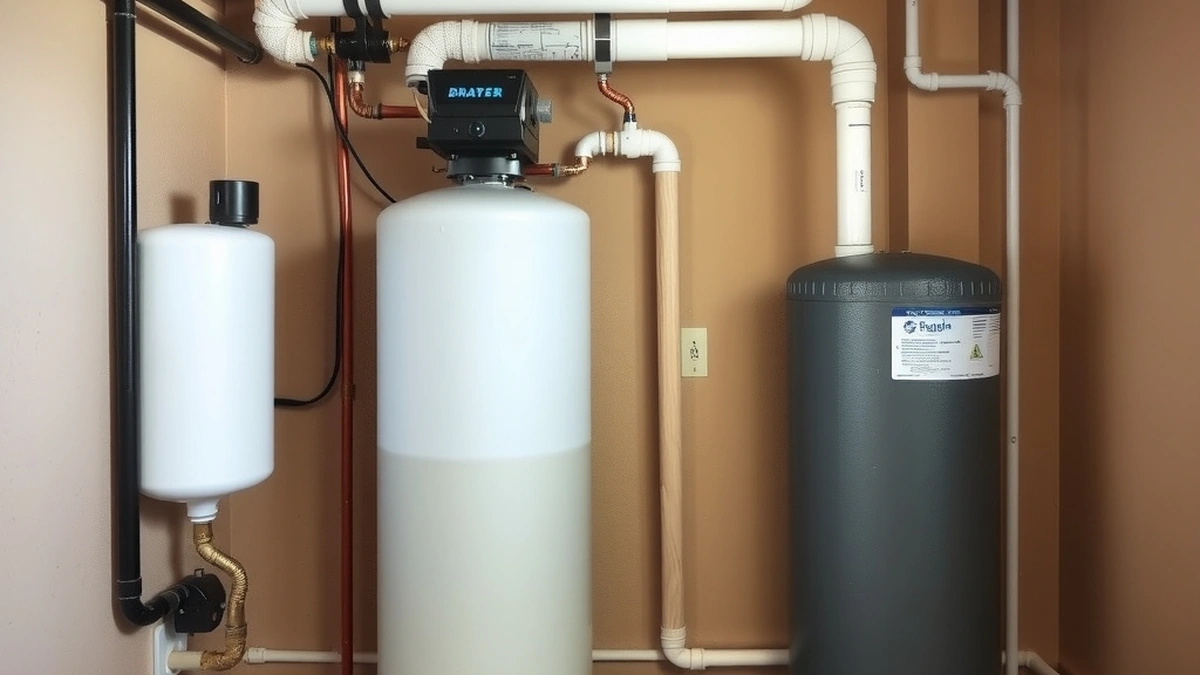
A whole house water softener sits on the main line and softens every fixture, costing $1,200 to $4,500 installed with $120 to $400 per year in salt. Size it from tested hardness and peak household flow, and place it before the water heater.
- Installed cost
- $1,200 - $4,500
- Salt per year
- $120 - $400
- Capacity
- 24,000 - 64,000 grains
- Peak flow
- 8 - 15 gpm
- Equipment life
- 10 - 15 years
Some links on this page are affiliate links.If you buy through them we may earn a commission at no extra cost to you. We do not accept payment for rankings. Read the full disclosure.
A whole house water softener is a point-of-entry ion exchange unit on the main supply line, so every tap, shower, and appliance receives softened water. It costs $1,200 to $4,500 installed and $120 to $400 a year in salt, and the sizing is decided by a hardness test and a household count.
What “Whole House” Changes
A point-of-use softener treats one fixture. A whole-house unit treats the supply, which is why it protects the water heater, the dishwasher, the washing machine, and the shower glass at the same time.
That protection is the actual value. Soft water lathers, rinses, and leaves no scale film. The heater keeps its heat transfer surface clean, the dishwasher uses less detergent, and laundry comes out softer. None of those are dramatic individually; together they are why households buy the equipment.
What it does not do is change taste or remove chlorine. A softener is not a filter, and households expecting better-tasting water from a softener are usually disappointed until they add carbon.
Sizing a Whole-House Unit
Two limits must both be satisfied.
Capacity. People × gallons per person per day × hardness in GPG. Four people at 75 gallons and 12 GPG is 3,600 grains per day. A 48,000 grain unit at 75 percent usable capacity gives 36,000 grains, or ten days between regenerations.
Flow. Peak demand from simultaneous fixtures. Two showers, a washer, and a dishwasher is about 9 to 10 gpm. A 1 inch valve and a tank of adequate diameter pass that without a pressure drop the household will notice.
| Household | 10 GPG | 15 GPG | 20 GPG | Min valve |
|---|---|---|---|---|
| 2 people | 24,000 | 32,000 | 48,000 | 3/4 inch |
| 3 people | 32,000 | 32,000 | 48,000 | 3/4 inch |
| 4 people | 32,000 - 48,000 | 48,000 | 64,000 | 1 inch |
| 5 people | 48,000 | 64,000 | 64,000 | 1 inch |
The distinction between capacity and flow is covered in capacity versus flow rate, and the household math in what size softener a family of four needs.
Site Requirements
Four conditions decide whether the install is straightforward.
| Requirement | Detail | Cost if missing |
|---|---|---|
| Location | After meter, before heater | Relocation, $300+ |
| Drain | Within 30 ft, air gap | $100 - $400 |
| Power | Grounded outlet | $100 - $300 |
| Bypass | Three valves or one lever | $60 - $200 |
A unit installed after the water heater protects nothing and exposes the resin to hot water, which most resins tolerate only up to about 100 to 120 F. That is the most common placement error.
The drain is the second. A softener discharges 40 to 80 gallons per regeneration, and it needs a downhill path to a floor drain, sink, or standpipe with an air gap. Details are in drain requirements for a softener.
What It Costs Over Ten Years
A mid-range 48,000 grain unit: $1,300 equipment plus $700 labor equals $2,000 installed. Salt at $250 per year is $2,500 over ten years. One resin rebed at $450 in year nine. Total $4,950, or about $495 per year.
Add the water and sewer cost of regeneration: 40 cycles a year at 60 gallons is 2,400 gallons, a small line item.
That arithmetic assumes the unit is set correctly. A softener programmed at half the actual hardness will regenerate twice as often and consume roughly twice the salt, which adds $250 a year to the running cost without softening the water.
What It Removes
| Contaminant | Removed |
|---|---|
| Calcium and magnesium | Yes |
| Iron up to 2 - 3 ppm | Partly |
| Manganese, trace | Partly |
| Chlorine | No |
| Nitrate | No |
| Bacteria | No |
| Sediment | No |
Iron is the limit to watch. Above 2 to 3 ppm, resin fouls permanently and regeneration cannot strip it. An iron filter goes first, at $800 to $2,500 installed, and the softener follows.
Regeneration and Control
Once the resin is loaded with hardness, the valve runs a cycle. Backwash lifts and cleans the bed. Brine draws from the salt tank and strips the calcium and magnesium off the resin. A slow rinse pushes the brine through, a fast rinse flushes the residue, and the brine tank refills for next time.
The whole cycle takes 60 to 90 minutes and uses 8 to 12 pounds of salt plus 40 to 80 gallons of water. Most units are set to run at 2 or 3 a.m. so nobody notices.
Metered valves count gallons and regenerate when a set volume has passed. Timer valves regenerate every N days regardless of use. Metered is more efficient in a house with variable occupancy, and it is the standard on better units.
| Control type | Regenerates on | Salt efficiency | Best for |
|---|---|---|---|
| Metered | Gallons used | Higher | Most homes |
| Timer | Fixed schedule | Lower | Steady occupancy |
| Metered with demand | Gallons plus reserve | Highest | Variable occupancy |
Four mistakes account for most poor installs. Installing the softener after the water heater protects nothing and exposes the resin to hot water it was not designed for. Skipping the iron filter fouls a bed rated for only 2 to 3 ppm. Programming from the previous unit’s settings means the hardness and capacity do not match this house. And leaving the bypass half open after service makes a working softener look exactly like a failed one, so check that before diagnosing anything else.
Five Steps to Buy
- Test hardness and iron with a $40 to $150 lab panel.
- Calculate daily grains from people, gallons, and GPG.
- Measure peak flow from simultaneous fixtures.
- Confirm drain, power, and bypass before signing.
- Verify settings after install with a hardness test at the tap.
Maintenance
Salt monthly, brine tank annually, hardness test quarterly, resin at 8 to 12 years. Those four tasks cover almost everything.
Most failures are salt and brine faults, not resin. The diagnostic order in softener stopped softening starts there.
For the installation detail, see water softener installation. For the point-of-entry treatment chain, well water system layout shows where the softener sits relative to iron, carbon, and UV.
Frequently asked questions
What is a whole house water softener?
A point-of-entry ion exchange unit installed on the main supply line, so every fixture in the house receives softened water rather than just one tap.
How much does a whole house softener cost?
Equipment runs $600 to $2,500, installation $500 to $1,500, for an installed total of $1,200 to $4,500, plus $120 to $400 per year in salt.
Where is a whole house softener installed?
After the water meter or pressure tank and before the water heater, with a bypass, a drain within about 30 feet, and a grounded outlet nearby.
How do I size a whole house softener?
Multiply people by daily gallons per person by hardness in GPG to get daily grains, then choose capacity for seven to ten days between regenerations and confirm the flow rating.
Does a whole house softener need a drain?
Yes, for backwash and brine discharge; a floor drain, utility sink, or standpipe within about 30 feet with an air gap is required.
Will a whole house softener remove chlorine?
No. It removes hardness minerals, not chlorine or taste compounds, so a carbon filter is a separate stage if chlorine is a concern.
Sources
Some links are affiliate links.If you buy through them we may earn a commission at no extra cost to you. We do not accept payment for rankings. Read the full disclosure.


