
What size softener a family of four needs
A family of four on 10 GPG water needs roughly 3,000 grains per day, which points to a 32,000 to 48,000 grain softener. The sizing math, step by step.
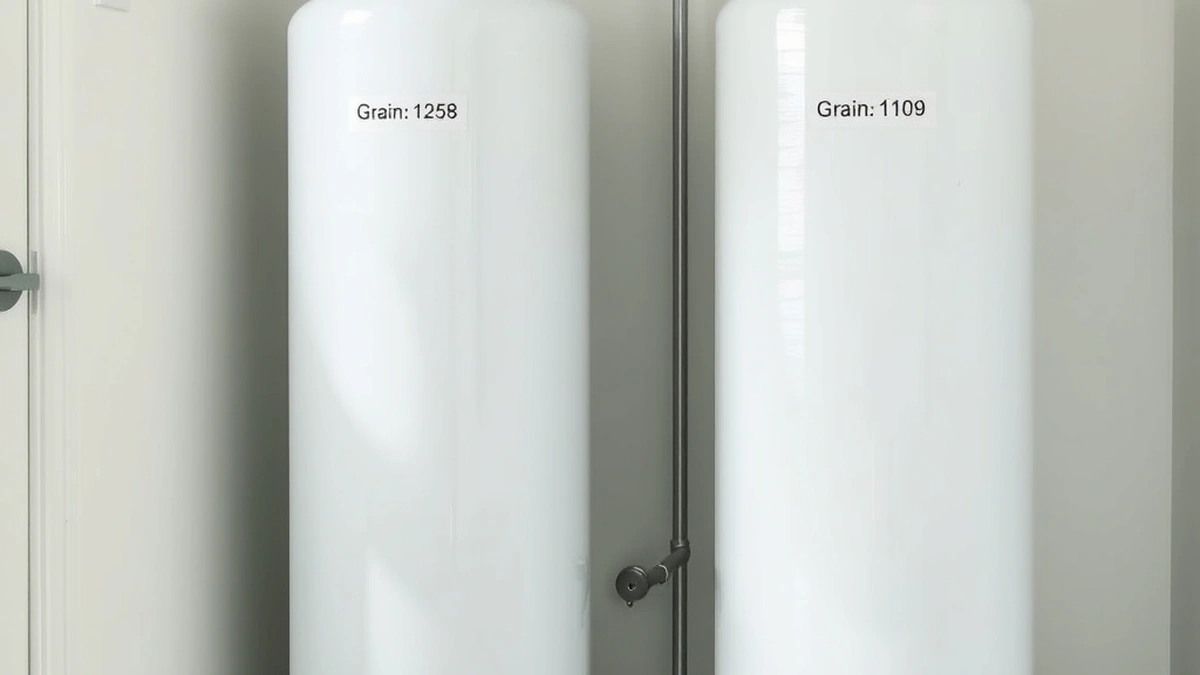
A family of four using 75 gallons per person per day on 10 GPG water creates about 3,000 grains of hardness daily, which suits a 32,000 to 48,000 grain softener regenerating every week to ten days. Softer water or lower use allows a smaller unit.
- Daily load at 10 GPG
- 3,000 grains
- Recommended capacity
- 32,000 - 48,000 grains
- Typical regeneration
- Every 7 - 10 days
- Salt per regeneration
- 8 - 12 pounds
- Installed cost
- $1,200 - $4,500
Some links on this page are affiliate links.If you buy through them we may earn a commission at no extra cost to you. We do not accept payment for rankings. Read the full disclosure.
A family of four on water at 10 GPG hardness needs about 3,000 grains of capacity per day, which makes a 32,000 to 48,000 grain softener the right range. The calculation is three multiplications, and it is the only sizing method that produces a defensible number. Everything else is a guess dressed as a recommendation.
The Sizing Formula
Hardness load per day equals people, times gallons per person per day, times hardness in grains per gallon.
Four people × 75 gallons × 10 GPG = 3,000 grains per day.
Seventy-five gallons per person per day is a common US planning figure that includes laundry, showers, and outdoor use. If your water bill shows a different number, use it. The formula does not care where the gallons go.
Then divide the softener’s capacity by the daily load to get days between regenerations. A 32,000 grain unit set to use its full capacity would run 32,000 ÷ 3,000 = 10.7 days. In practice units are set to regenerate before exhaustion, commonly at 70 to 80 percent of capacity, which brings a 32,000 grain unit to about 7 to 8 days. That is the target zone.
Size Table by Hardness
The table assumes 75 gallons per person per day. Read your hardness band from the row and your household size from the column.
| Hardness | 2 people | 3 people | 4 people | 5 people |
|---|---|---|---|---|
| 5 GPG (moderate) | 24,000 | 24,000 | 32,000 | 32,000 |
| 10 GPG (hard) | 24,000 | 32,000 | 32,000 - 48,000 | 48,000 |
| 15 GPG (very hard) | 32,000 | 48,000 | 48,000 | 64,000 |
| 20 GPG (very hard) | 48,000 | 48,000 | 64,000 | 64,000 |
Residential units are commonly sold from 24,000 to 64,000 grains, so the table stays inside the normal catalog. If your number lands between two rows, size up. A softener that regenerates every five days is working harder than it should and burning salt.
Why Hardness Bands Matter
Hardness categories are 0 to 3 GPG soft, 3 to 7 moderate, 7 to 10 hard, and above 10 very hard. The band changes the load linearly, which is why a family of four on 5 GPG needs half the capacity of the same family on 10 GPG.
The trap is a water report that lists hardness in mg/L as calcium carbonate instead of GPG. One GPG equals 17.1 mg/L. A report showing 171 mg/L is 10 GPG, which is the hard band, not the moderate one. Converting before you multiply is the difference between buying a 24,000 grain unit and a 48,000 grain unit. See water hardness scale for the conversion table.
Capacity Is Not the Same as Flow
A softener has two limits. Capacity is how much hardness it can remove between regenerations, measured in grains. Flow rate is how much water it can pass at once without excessive pressure drop, measured in gallons per minute.
A four-person household with three bathrooms can have a peak demand of 10 to 12 GPM when a shower, a washer, and a dishwasher run together. A 48,000 grain tank with a 3/4 inch valve may not pass that comfortably. The fix is a larger valve or a bigger tank diameter, not more resin. The distinction is covered in capacity versus flow rate.
| Size | Resin volume | Typical peak flow | Suits |
|---|---|---|---|
| 24,000 | about 0.75 cu ft | 6 - 8 gpm | 1 - 2 people |
| 32,000 | about 1.0 cu ft | 8 - 10 gpm | 3 people |
| 48,000 | about 1.5 cu ft | 10 - 12 gpm | 4 people |
| 64,000 | about 2.0 cu ft | 12 - 15 gpm | 5+ people |
Those flow figures are typical ranges, not guarantees; valve size and plumbing diameter set the real limit.
What It Costs
Equipment runs $600 to $2,500, installation $500 to $1,500, and the installed total $1,200 to $4,500. Within that range, the difference between a 32,000 and a 48,000 grain unit is usually a few hundred dollars, and it is money well spent if the smaller unit would regenerate every four days.
Salt is the recurring cost: 8 to 12 pounds per regeneration. At 40 regenerations per year and 10 pounds each, that is 400 pounds, which lands in the $120 to $400 annual band depending on local salt prices and whether you buy pellets or crystals.
A ten-year view: $2,000 installed plus $250 per year in salt equals $2,000 + $2,500 = $4,500, plus one resin rebed at $450 in year nine for $4,950 total, or about $495 per year.
Five Steps to Size and Buy
- Get a lab hardness number. A $40 to $150 panel gives GPG or mg/L, and you convert if needed.
- Read your water bill. Divide the monthly gallons by 30 and by the number of people to get real per-person use.
- Run the formula. People × gallons × GPG equals daily grains.
- Pick the next size up. Choose a capacity that gives 7 to 10 days between regenerations at your load.
- Confirm the valve and flow. Make sure the unit passes your peak demand without dropping pressure at the shower.
What Changes the Answer
Four people is an average, not a rule. A household with a pool, a large garden, or a home laundry business can use twice the planning figure. A household of four that travels half the year uses less. A house with a 20 GPG well needs the very hard row even at two occupants.
If iron is present above 2 to 3 ppm, sizing changes entirely: the softener should not be carrying that load, and an iron filter belongs ahead of it. Read iron in well water before you pick a tank, and water softener sizing for the fuller method including reserve capacity and salt efficiency settings.
Frequently asked questions
What size water softener does a family of four need?
On water at 10 GPG hardness with average use, a 32,000 to 48,000 grain unit is the practical range, sized so it regenerates roughly weekly rather than daily.
How do I calculate grains of hardness per day?
Multiply the number of people by daily gallons per person, then multiply by hardness in GPG. Four people at 75 gallons and 10 GPG gives 3,000 grains per day.
Is a bigger softener always better?
No. An oversized unit costs more upfront and can sit with stale water between regenerations, while an undersized one regenerates constantly and wastes salt.
How often should a softener regenerate?
Weekly to every ten days is a sensible target for a household. Daily regeneration usually means the unit is undersized or the hardness setting is wrong.
Does a family of four need a two-tank system?
Only if water use is high and continuous, such as a household with heavy laundry or a home business, because a twin-tank unit softens while the other tank regenerates.
How much salt will four people use?
At 8 to 12 pounds per regeneration and roughly 40 regenerations a year, expect 320 to 480 pounds annually, which lands in the $120 to $400 per year range.
Sources
Some links are affiliate links.If you buy through them we may earn a commission at no extra cost to you. We do not accept payment for rankings. Read the full disclosure.


