Water pressure and filters: why flow drops
Every filter stage costs pressure. See typical pressure drop per device, the 40 psi floor, and how to find which stage is choking the house.
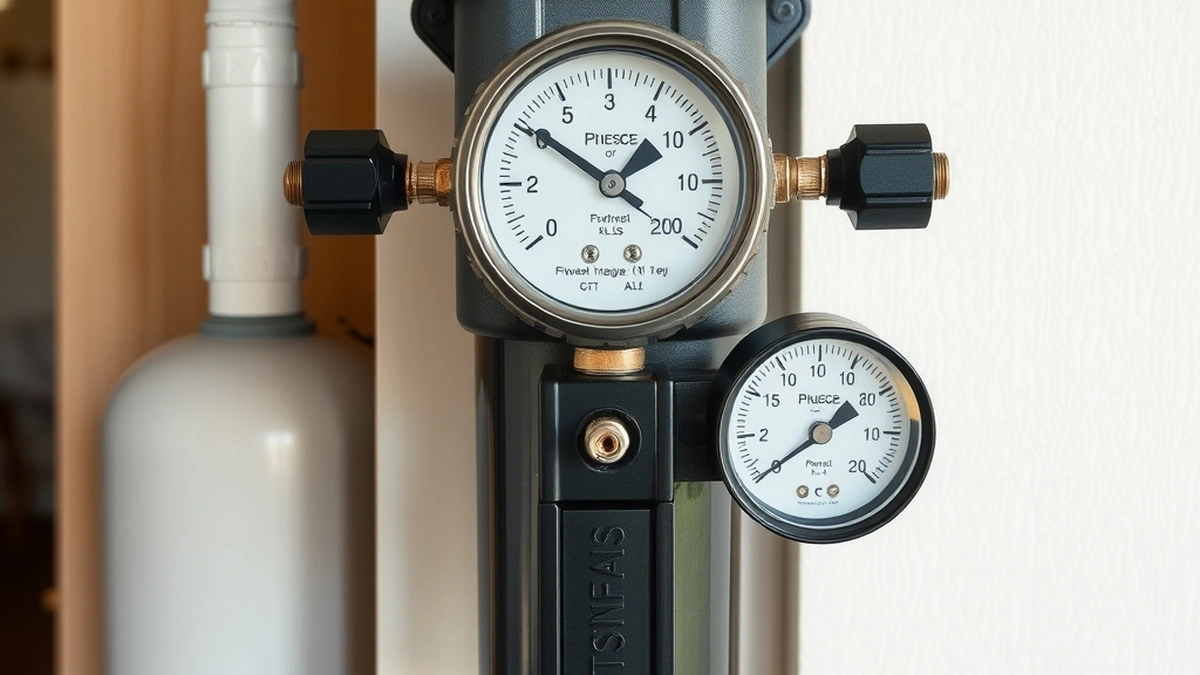
Each filter stage removes pressure: a cartridge housing 2 to 5 psi, a softener 5 to 15 psi at peak flow, and an RO membrane needs 40 psi to produce. Flow drops when a clogged cartridge or an undersized housing spends more than the supply can spare.
- Cartridge housing loss
- 2 - 5 psi
- Softener loss at peak
- 5 - 15 psi
- RO minimum feed
- 40 psi
- Typical house pressure
- 40 - 60 psi
- Sediment change interval
- 3 - 6 months
Some links on this page are affiliate links.If you buy through them we may earn a commission at no extra cost to you. We do not accept payment for rankings. Read the full disclosure.
Every treatment stage costs pressure, and a house only has so much to spare. A clean cartridge housing takes 2 to 5 psi, a softener takes 5 to 15 psi at peak flow, and an RO membrane needs 40 psi just to work. When the total loss approaches the supply pressure, fixtures slow to a trickle and the filter gets blamed for a problem that is really a sizing issue.
The Pressure Budget
Think of supply pressure as a budget. A municipal connection typically delivers 40 to 60 psi at the meter. A private well with a 40/60 pressure switch cycles between those figures. Everything downstream spends from that budget.
| Device | Pressure cost | Notes |
|---|---|---|
| Sediment cartridge, clean | 2 - 5 psi | Rises sharply when loaded |
| Carbon block, clean | 2 - 6 psi | Tighter blocks cost more |
| Big blue housing | 1 - 3 psi | More surface area, lower loss |
| Water softener | 5 - 15 psi | At peak flow, clean resin |
| UV chamber | 1 - 5 psi | Depends on flow and chamber |
| RO membrane | 40 psi minimum feed | Needs pressure, does not just drop it |
| Long 1/2 inch run | 2 - 10 psi | Friction, not filtration |
Add a sediment filter, a carbon block, and a softener and you have spent 10 to 25 psi before the water reaches a shower. On a 45 psi supply, that leaves 20 to 35 psi at the fixture, which is usable but not generous. Add a long run of half-inch pipe to an upstairs bathroom and the shower becomes weak.
Why a Clogged Cartridge Is Different
A clean cartridge has a published pressure drop at a stated flow. A loaded cartridge does not. As sediment fills the pleats, the effective surface area shrinks and pressure drop rises, often non-linearly. A cartridge that cost 3 psi when new can cost 20 psi at month five.
That is why “my pressure slowly dropped” is almost always a cartridge. The symptom is gradual, affects hot and cold equally, and appears at all fixtures downstream of the filter. If the drop is sudden, suspect a closed valve or a broken pipe instead.
Sediment cartridges should be changed every 3 to 6 months. Carbon cartridges every 6 to 12 months. Those intervals are not arbitrary; they are the point at which pressure drop and media exhaustion typically converge.
The Flow Rate Mistake
A filter housing has a maximum flow rating. A standard 2.5 by 10 inch housing passes maybe 4 to 6 gallons per minute comfortably. A whole-house system needs 8 to 15 gpm at peak. Putting a standard housing on a whole-house line and expecting it to keep up is the most common installation error in this category.
| Housing | Cartridge | Practical flow | Suits |
|---|---|---|---|
| 2.5 x 10 | Standard | 4 - 6 gpm | Under sink, fridge, single fixture |
| 4.5 x 10 | Big blue | 8 - 12 gpm | Whole house, small to mid |
| 4.5 x 20 | Jumbo | 12 - 20 gpm | Whole house, large |
The fix for an undersized housing is a larger housing, not a coarser cartridge. A 20 micron cartridge in a 2.5 inch housing still cannot pass 12 gpm without excessive velocity and pressure loss.
Finding the Restriction
The diagnostic is a pair of gauges. Install one on the inlet and one on the outlet of the suspect device, run several fixtures, and read the difference while water is flowing. Static pressure with everything closed tells you nothing about restriction.
- Under 5 psi across a cartridge housing: fine.
- 5 to 15 psi across a softener at peak: normal.
- Over 15 psi across a single device: restricted.
- Pressure good upstream, weak downstream: the device between them.
If you do not want to install permanent gauges, a hose bib gauge on a downstream tap compared with one on an upstream tap gives a rough answer. It is less precise but enough to locate the stage.
Five Steps to Restore Flow
- Measure static pressure at an upstream tap and a downstream tap.
- Replace the sediment cartridge first, since it is the cheapest suspect.
- Check the bypass valves on the softener and any filter; a half-open valve is a common cause.
- Verify housing size against peak flow, not average flow.
- Test again with fixtures running, because static readings hide restriction.
When the Problem Is Upstream
If pressure is low at the first tap after the meter, no filter change will fix it. Municipal supply issues, a failing pressure regulator, or a well pump losing performance are upstream problems. A pressure-reducing valve set too low is a frequent culprit in newer homes; the valve is adjustable and often set at 50 psi when 60 would serve better.
On a well, the pressure tank air charge and the pressure switch settings set the ceiling. A tank that has lost its air charge causes short cycling and low average pressure. That diagnosis belongs in pressure tank and treatment, and the broader symptom list is in low water pressure causes.
Sizing Filters for Pressure, Not Just Filtration
The right way to choose a filter is to specify the flow and the micron rating together. A whole-house sediment filter for a 3 bathroom home should be a 4.5 inch housing rated at 10 gpm or more, with a 10 or 20 micron cartridge that will not load too quickly. That combination costs maybe 3 psi clean and stays under 10 psi for months.
The wrong way is to buy the tightest cartridge that fits the housing. A 1 micron cartridge in a small housing gives excellent filtration and terrible pressure. If fine filtration is the goal, stage it: 20 micron first, 5 micron second, each with its own housing and its own pressure budget.
If the RO at the kitchen sink is the device losing performance, permeate pumps covers the pressure fix for that specific case, and whole house filter cost covers what a correctly sized system runs.
Frequently asked questions
How much pressure does a water filter drop?
A clean cartridge housing typically costs 2 to 5 psi, and a clogged cartridge can cost 15 psi or more, which is why replacement intervals matter more than the housing spec.
Why did my water pressure drop after installing a filter?
Either the housing is undersized for the flow, the cartridge is too tight a micron rating, or the added fittings and pipe length created more restriction than the supply could spare.
What pressure does reverse osmosis need?
About 40 psi at the membrane inlet to produce at its rated rate; below that, output falls and the tank takes much longer to refill.
Does a water softener reduce pressure?
A healthy softener costs roughly 5 to 15 psi at peak flow, but a fouled resin bed or a partially closed bypass valve can cost considerably more.
How do I test pressure drop across a filter?
Install gauges on the inlet and outlet, run several fixtures, and read the difference; anything over about 15 psi across one device indicates a restriction.
Will a bigger filter housing fix low pressure?
It can, because a larger cartridge has more surface area and lower velocity, which reduces pressure drop at the same flow rate.
Sources
Some links are affiliate links.If you buy through them we may earn a commission at no extra cost to you. We do not accept payment for rankings. Read the full disclosure.