Whole-House Water Filter Cost: Equipment, Install And.
Break down whole-house water filter cost by equipment, installation, and ongoing filters. Compare softeners, carbon, UV, and whole-house RO.
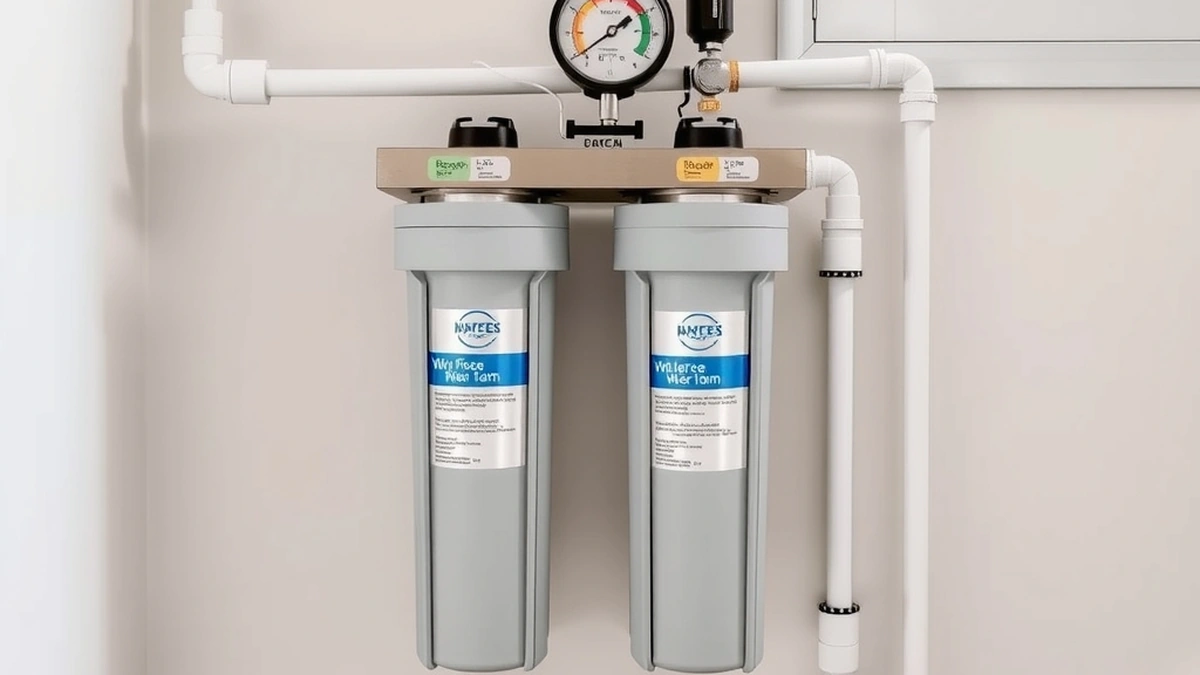
Expect $500–$8,000 installed for most whole-house water filters, plus $80–$500 per year for cartridges, salt, or lamps. A whole-house water filter costs $500 to $8,000 installed, depending on the technology and your home’s flow rate. Equipment alone ranges from $200 for a.
- Equipment only
- $200–$2,500
- Typical installed range
- $500–$8,000
- Annual consumables
- $80–$500
- Flow rate
- 8–15 GPM
Some links on this page are affiliate links.If you buy through them we may earn a commission at no extra cost to you. We do not accept payment for rankings. Read the full disclosure.
A whole-house water filter costs $500 to $8,000 installed, depending on the technology and your home’s flow rate. Equipment alone ranges from $200 for a basic cartridge system to $2,500 for a softener, while whole-house reverse osmosis can reach $8,000. Ongoing filter, salt, lamp, and membrane costs typically add $80 to $500 per year.
1. Start With a Water Test
Before comparing equipment, test the water. A lab water test costs $40–$150 and identifies hardness, iron, sulfur, nitrate, and sediment levels. Without results, you risk buying a carbon filter when you need an iron filter, or a softener when nitrate is the concern. Hardness is measured in grains per gallon (GPG): 0–3 is soft, 3–7 is moderate, 7–10 is hard, and 10+ is very hard. If iron exceeds 2–3 ppm, a standard softener may not handle it alone, and nitrate above 10 mg/L requires specific treatment. See current lab pricing at /water-testing-cost/.
2. Equipment Cost by System Type
Whole-house equipment prices vary widely by technology. The table below shows installed cost ranges for common whole-house options.
| System | Installed Cost | Typical Flow Rate |
|---|---|---|
| Carbon whole-house filter | $500–$1,800 | 8–15 GPM |
| Salt-free conditioner | $500–$1,800 | 8–15 GPM |
| Water softener | $1,200–$4,500 | 8–15 GPM |
| Iron filter | $800–$2,500 | 8–15 GPM |
| Sulfur filter | $1,000–$3,000 | 8–15 GPM |
| Whole-house RO | $3,000–$8,000 | Varies by tank and pump |
A water softener removes hardness minerals through ion exchange. Equipment alone is $600–$2,500, with installation adding $500–$1,500, for a total installed cost of $1,200–$4,500. Softener capacity ranges from 24,000 to 64,000 grains. For arithmetic, a household using 300 gallons per day with 10 GPG hardness removes 3,000 grains daily. A 32,000-grain softener would theoretically regenerate about every 10 to 11 days before efficiency losses. Salt use is typically 8–12 pounds per regeneration, and annual salt costs run $120–$400. Resin rebeds cost $300–$600 and are usually needed after 8–12 years, while the full softener lasts 10–15 years. More detail is at /how-much-does-a-water-softener-cost/ and /water-softener-installation-cost/.
Carbon whole-house filters reduce chlorine, taste, and odor. Equipment plus installation runs $500–$1,800. Carbon cartridges cost $80–$300 per year and are replaced every 6–12 months. Sediment pre-filters, if used, need replacement every 3–6 months. Salt-free conditioners fall in the same $500–$1,800 installed range but do not soften water in the ion-exchange sense; they alter hardness minerals to reduce scale.
Iron and sulfur filters address specific well-water issues. Iron filters cost $800–$2,500 installed, and sulfur filters cost $1,000–$3,000 installed. Whole-house reverse osmosis is the most expensive option at $3,000–$8,000 installed and requires a storage tank and pump to maintain pressure throughout the house. Under-sink RO is a smaller alternative at $300–$900 installed, with equipment at $200–$600 and running costs of $60–$150 per year. RO membranes last 2–3 years, rejection rates are 80–95 percent, and waste ratios run 3–4:1. See /reverse-osmosis-system-cost/ for under-sink details.
3. Installation Costs
Installation labor and materials typically add $500–$1,500 for a softener and are included in the $500–$1,800 range for most carbon and conditioner systems. Whole-house RO and iron or sulfur filters may cost more if the installer must run a drain line, add a pre-filter, or install a booster pump. Homes with tight mechanical rooms, older galvanized plumbing, or no existing bypass loop will pay more on the high end. Always confirm whether the quote includes a bypass valve, pressure gauge, and fittings.
4. Annual Filter and Maintenance Costs
Ongoing costs separate cheap systems from expensive ones. Carbon cartridges at $80–$300 per year are the most common recurring expense. Sediment cartridges, replaced every 3–6 months, add another recurring cost if your water carries sand or silt. UV systems require a lamp replacement every 12 months at $30–$90. Softeners need salt at $120–$400 per year and occasional resin rebeds at $300–$600 every 8–12 years.
For example, a carbon whole-house filter installed at $1,200 with $200 in annual cartridge costs totals $2,200 over five years before any plumbing repairs. A softener installed at $2,500 with $250 in annual salt totals $3,750 over five years, not counting a possible resin rebed. Label all of these figures as estimates; actual usage depends on water quality and household volume.
5. Whole-House RO vs. Point-of-Use RO
Whole-house reverse osmosis treats every tap but costs $3,000–$8,000 installed and produces wastewater at a 3–4:1 ratio. That means for every gallon of product water, 3 to 4 gallons go to drain. Running costs are $60–$150 per year for filters and membranes, with membrane replacement every 2–3 years. Because whole-house RO removes minerals aggressively, many homeowners pair it with a post-treatment step or use under-sink RO at $300–$900 installed for drinking water only. The point-of-use option limits waste and cost while treating water at the kitchen tap.
6. UV Disinfection Add-On
If a lab test shows bacteria, a UV system can be added to a whole-house setup. UV lamps last 12 months and cost $30–$90 to replace. UV equipment is often sold as an add-on rather than a standalone whole-house filter, so total cost depends on the base system. UV does not remove sediment, hardness, or chemicals, so it is usually installed after filtration. More information is at /uv-water-purifier-cost/.
7. Five-Year Cost Examples
These examples show how equipment, installation, and consumables combine. All figures are estimates.
Carbon whole-house filter:
- Installed: $1,200
- Cartridges: $200 per year × 5 = $1,000
- Five-year total: $2,200
Water softener:
- Installed: $2,500
- Salt: $250 per year × 5 = $1,250
- Five-year total: $3,750
Whole-house RO:
- Installed: $5,000
- Filters and membrane: $100 per year × 5 = $500
- Five-year total: $5,500
These totals exclude unexpected plumbing repairs, higher salt use for very hard water, or early membrane replacement from high TDS feed water.
8. How to Choose Based on Your Test
Match the system to the lab results, not the sales pitch. Hardness above 7 GPG suggests a softener. Iron above 2–3 ppm suggests an iron filter. Chlorine taste and odor suggest carbon. Bacteria suggests UV after filtration. Nitrate at or above 10 mg/L requires a dedicated treatment method, not a standard carbon filter. Whole-house flow rates of 8–15 GPM are typical for residential plumbing, so confirm the system will not create a pressure drop at peak usage. For well water specifically, see /well-water-treatment-cost/, and for iron-specific pricing, see /iron-filter-cost/.
Next, compare how much does a water softener cost, water softener installation cost, reverse osmosis system cost before you commit.
Frequently asked questions
What does a whole-house water filter cost installed?
Most whole-house systems fall between $500 and $8,000 installed, depending on technology, flow rate, and whether plumbing or electrical work is needed.
How much do replacement filters cost per year?
Carbon cartridges run $80–$300 per year, sediment cartridges need replacement every 3–6 months, and UV lamps cost $30–$90 annually.
Is a water softener a whole-house filter?
A softener treats hardness throughout the house and costs $1,200–$4,500 installed, but it does not remove chlorine, sediment, or bacteria like a filter does.
Do I need a water test before buying?
Yes. A lab water test costs $40–$150 and tells you what the system actually needs to treat, which prevents buying the wrong equipment.
How long does whole-house equipment last?
Softeners last 10–15 years, resin beds 8–12 years, and carbon tanks vary by media and usage; UV lamps must be replaced every 12 months.
Can I install a whole-house filter myself?
Some cartridge housings are DIY-friendly, but whole-house softeners, iron filters, and RO units usually require plumbing cuts and a drain connection.
Sources
Some links are affiliate links.If you buy through them we may earn a commission at no extra cost to you. We do not accept payment for rankings. Read the full disclosure.