What a Countertop Reverse Osmosis System Costs
Countertop RO units run $200 - $600 with no installation. See filter costs, electricity, five-year totals, and the break-even against bottled water.
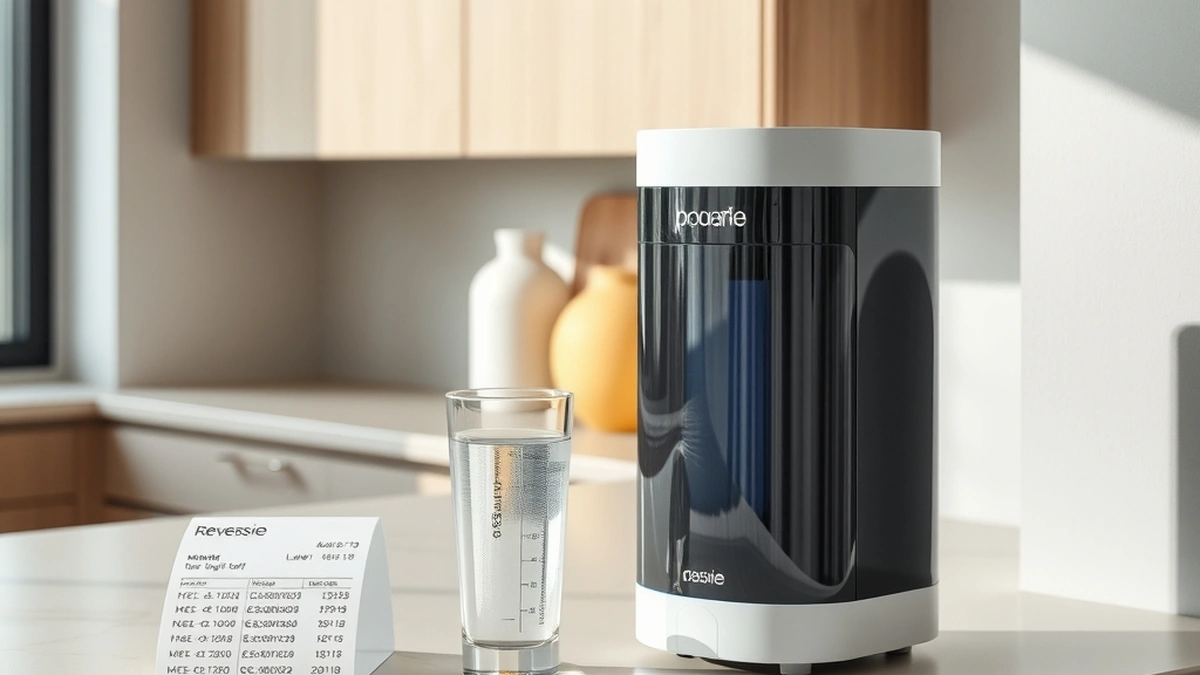
A countertop reverse osmosis system costs $200 - $600 with no installation charge. Filters run $60 - $150 a year, a membrane every 1 - 2 years costs $40 - $100, and five-year ownership lands at $700 - $1,400.
- Unit price
- $200 - $600
- Installation
- $0
- Filters per year
- $60 - $150
- Membrane
- $40 - $100 every 1 - 2 years
- Five-year total
- $700 - $1,400
Some links on this page are affiliate links.If you buy through them we may earn a commission at no extra cost to you. We do not accept payment for rankings. Read the full disclosure.
A countertop reverse osmosis system costs $200 - $600 and needs no installation. Filters run $60 - $150 a year, a membrane every 1 - 2 years costs $40 - $100, and five-year ownership lands at $700 - $1,400.
The Unit Price
Entry-level countertop units sell for $200 - $300. They typically have three stages and a 1-gallon tank.
Mid-range units sell for $300 - $450, with better pumps and 2 - 3 gallon tanks. They refill faster and handle a larger household.
Premium units sell for $450 - $600, often with four stages and a remineralization cartridge. The extra stage changes taste rather than the removal mechanism.
No installation charge applies. That is the main cost advantage over an under-sink system, which runs $300 - $900 installed.
Filters and Membranes
A prefilter and postfilter set costs $30 - $70 and lasts 6 - 12 months. Annual filter cost lands at $60 - $150.
A membrane costs $40 - $100 and lasts 1 - 2 years in a countertop unit, which is shorter than the 2 - 3 years of an under-sink membrane because the element is smaller.
Add the two: year one is the unit plus a filter set, and years two through five are filters plus one or two membranes.
Five-Year Arithmetic
The range of $700 - $1,400 reflects how much the unit costs and how often the filters are changed. Feed water quality drives the frequency as much as the calendar.
Cost Per Gallon
A household drinking 3 gallons a day uses 1,095 gallons a year, or 5,475 gallons over five years.
At a five-year cost of $970, that is about $0.18 per gallon. At $660, it is $0.12 per gallon. At $1,340, it is $0.24 per gallon.
Bottled water at $1 - $2 per liter is $3.79 - $7.57 per gallon. The countertop unit is roughly 20 - 60 times cheaper per gallon.
Electricity and Waste Water
The pump draws a few watts while running. A unit producing 3 gallons a day might use 2 - 5 kWh a month, or $3 - $8 a year at 15 cents per kWh.
RO sends 3 - 4 gallons of reject water per gallon produced. A household producing 3 gallons a day sends 9 - 12 gallons to the drain daily, or 3,300 - 4,400 gallons a year.
At $4 per 1,000 gallons, that is $13 - $18 a year. Small, but it belongs in the arithmetic.
Countertop vs Under-Sink vs Bottled
| Option | Upfront | Annual | Five-year |
|---|---|---|---|
| Countertop RO | $200 - $600 | $60 - $150 | $700 - $1,400 |
| Under-sink RO | $300 - $900 | $60 - $150 | $600 - $1,500 |
| Pitcher filter | $25 - $60 | $50 - $100 | $275 - $560 |
| Bottled water | $0 | $1,095 - $2,190 | $5,475 - $10,950 |
The pitcher is cheapest and removes the least. The countertop and under-sink systems are close over five years, and the choice comes down to counter space versus installation.
Proprietary cartridges cost two to three times standard ones and can push the annual filter bill to $150 - $200.
Hard feed water shortens membrane life, so a household at 15 GPG may replace the membrane every year instead of every two.
Shipping and tax add 5 - 12 percent to the unit price, and a warranty extension adds $30 - $80.
What Adds Cost and What Saves It
- Buy a unit with standard cartridges; the five-year difference is $200 - $400.
- Change prefilters on schedule to protect the membrane.
- Use filtered feed water to stretch membrane life.
- Skip the warranty extension unless the unit is expensive.
- Buy during a promotion rather than at full price.
- Avoid models with discontinued cartridges, which become expensive to maintain.
Changing prefilters on schedule is the single biggest saving, because the membrane is the most expensive consumable in the system.
A last consideration is resale value, which is effectively zero for a countertop appliance. Unlike a whole-house system, it does not transfer with the property and does not count as an improvement. That is fine for a renter and worth knowing for an owner comparing it with an under-sink install.
The five-year comparison also depends on how long the household stays. A renter who moves every two years never reaches the membrane replacement, and the countertop unit’s portability becomes a real advantage rather than a footnote.
For an owner, the calculation is closer. An under-sink system at $600 installed plus $110 a year in filters and one membrane lands near $1,300 over five years, which is inside the countertop range and delivers more capacity and no counter footprint.
Deciding on the Numbers
If the household drinks less than a gallon a day, a pitcher may be enough and the RO is a luxury.
If the household drinks 2 - 4 gallons a day and rents, a countertop unit at $300 - $450 pays back against bottled water in a few months.
If the household owns the home and has cabinet space, an under-sink system at a similar five-year cost is more convenient.
One more cost to weigh is the counter. A unit occupies about a square foot, and in a small kitchen that space has an alternative use. The under-sink system costs more to install and gives the counter back, which is a real trade for a household that cooks. The unit also needs a stable spot away from heat, and a kitchen with limited outlets may need an extension cord rated for the pump draw.
For the category comparison, see countertop reverse osmosis. For the under-sink option, see reverse osmosis system cost. For maintenance timing, see reverse osmosis maintenance.
Frequently asked questions
How much does a countertop RO system cost?
Units sell for $200-$600, and there is no installation cost because they need no plumbing. Filters add $60-$150 a year.
Is a countertop RO cheaper than an under-sink system?
Up front, yes. A countertop unit at $200-$600 beats an under-sink install at $300-$900. The gap narrows over five years as filters are replaced.
How much does countertop RO water cost per gallon?
At $400 for the unit and $100 a year in filters over five years, the cost is about $0.12-$0.20 per gallon for a household using 3 gallons a day.
How often do countertop RO filters need changing?
Prefilters and postfilters every 6-12 months, and the membrane every 1-2 years depending on feed water quality.
Does countertop RO use much electricity?
Very little. A small pump drawing a few watts for an hour a day costs roughly $3-$8 a year at typical rates.
Is it cheaper than bottled water?
Yes, by a wide margin. Bottled water at $1-$2 per liter costs $1,095-$2,190 a year for 3 liters a day, against roughly $100-$150 in filters.
Sources
Some links are affiliate links.If you buy through them we may earn a commission at no extra cost to you. We do not accept payment for rankings. Read the full disclosure.