What an Alkaline Water Filter Costs: Systems and Filters
Alkaline filters range from $30 pitchers to $4,000 ionizers. See equipment tiers, filter and plate costs, and what the ten-year total looks like.
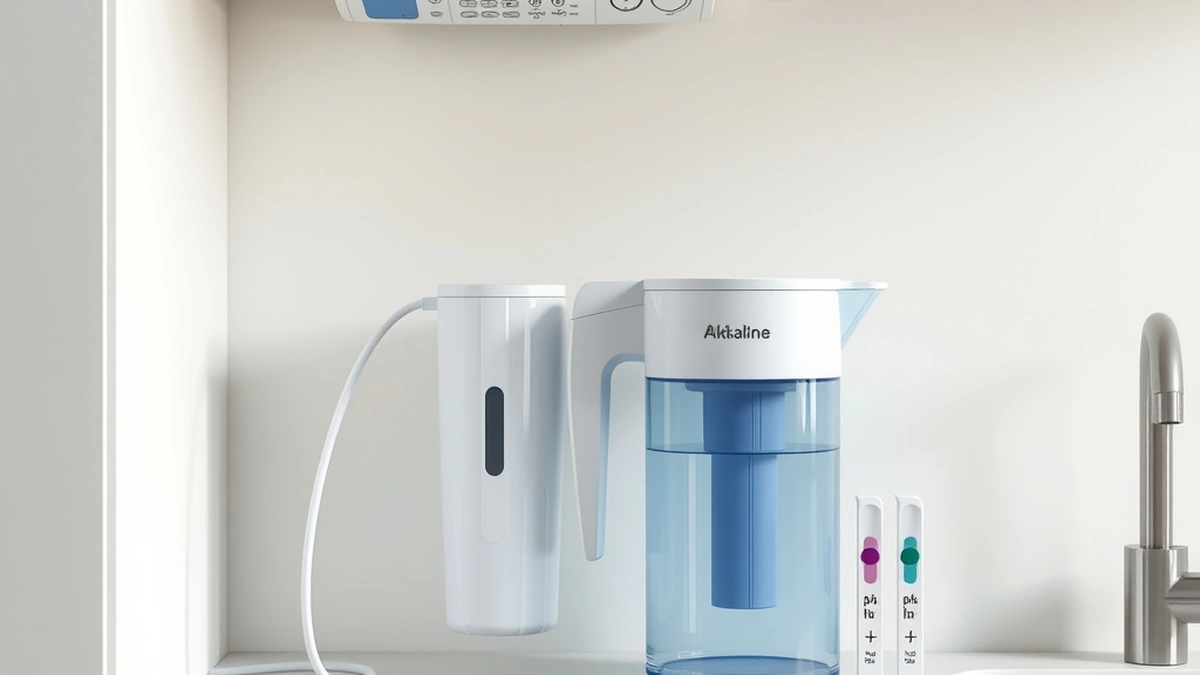
Alkaline water filters cost $30 - $100 for a pitcher, $200 - $800 for an under-sink unit, and $1,000 - $4,000 for an ionizer. Filters run $40 - $200 a year, and ionizer plates need cleaning or replacement every few years.
- Pitcher
- $30 - $100
- Under-sink unit
- $200 - $800 installed
- Ionizer
- $1,000 - $4,000
- Filters per year
- $40 - $200
- Ten-year total
- $400 - $6,000
Some links on this page are affiliate links.If you buy through them we may earn a commission at no extra cost to you. We do not accept payment for rankings. Read the full disclosure.
Alkaline water filters cost $30 - $100 for a pitcher, $200 - $800 for an under-sink unit, and $1,000 - $4,000 for an ionizer. Filters run $40 - $200 a year, and ionizer plates need cleaning or replacement every few years. The ten-year total ranges from $400 to $6,000.
Pitchers and Dispensers
An alkaline pitcher sells for $30 - $100 and uses a cartridge with mineral media that raises pH as water passes through.
Cartridges cost $15 - $40 and last 40 - 80 gallons, which is one to three months for a household drinking a gallon a day. Annual cost is $60 - $200.
The pitcher is the cheapest entry point and the least precise. pH output varies with the source water and the cartridge’s remaining capacity.
Under-Sink Units
An under-sink alkaline filter sells for $200 - $500, installed at $300 - $800. It uses a multi-stage cartridge with a mineral stage at the end.
Cartridges cost $40 - $120 and last 6 - 12 months. The unit delivers alkaline water at a dedicated faucet without occupying counter space.
Some units combine carbon filtration with the mineral stage, which makes them useful for chlorine and taste as well as pH.
Ionizers
A water ionizer sells for $1,000 - $4,000. It uses electrolysis to separate the water stream into alkaline and acidic outputs.
The price depends on plate count, flow rate, and controls. A 3-plate unit sits at the low end; a 7-plate unit with a large screen sits at the high end.
Plates need cleaning every few months with a citric acid solution, and replacement every 3 - 7 years at $200 - $600.
The Cost Table
| System | Purchase | Annual | Ten-year |
|---|---|---|---|
| Pitcher | $30 - $100 | $60 - $200 | $400 - $1,300 |
| Faucet mount | $50 - $150 | $60 - $150 | $450 - $1,200 |
| Under-sink | $200 - $800 | $40 - $120 | $600 - $1,600 |
| Ionizer | $1,000 - $4,000 | $100 - $300 | $2,000 - $6,000 |
The ten-year column assumes one replacement of consumables where applicable and does not include repairs.
An ionizer’s ten-year total includes plate replacement, cleaning supplies, and the electricity to run it, which is small but not zero.
What Drives the Price
The technology is the main factor. A mineral cartridge is a few dollars of media in a housing; an ionizer is a power supply, plates, and controls.
The plate count drives ionizer cost. More plates mean higher flow and a higher price, and most households do not need the top of the range.
The housing quality matters at the low end. A $30 pitcher and a $100 pitcher often use similar media, and the difference is the seal and the pour spout.
Hard water scales ionizer plates and consumes mineral media faster. A softener or a sediment prefilter ahead of the unit adds $150 - $4,500 but extends its life.
Proprietary cartridges cost two to three times standard ones and can push the annual filter bill to $200.
Cleaning supplies for an ionizer run $30 - $80 a year if you use the manufacturer’s solution rather than citric acid.
The Cheapest Option
A pinch of baking soda or a few drops of mineral concentrate raises pH at a cost of cents per gallon. It is the least expensive way to change pH and the least consistent.
The tradeoff is measurement. Without a pH meter at $30 - $80, you are guessing at the dose and the result.
For a household that wants a consistent number, a filter or ionizer provides it. For a household that wants the cheapest path, the drops work.
Steps Before Buying
- Test the source water for pH, hardness, and alkalinity.
- Decide whether you want a pH change or filtration plus a pH change.
- Price the replacement cartridges before buying the system.
- Check the warranty on the housing and the plates.
- Confirm the flow rate meets your kitchen demand.
- Install a prefilter if hardness is above 7 GPG.
- Measure the output pH with a meter rather than trusting the display.
What the Cost Does Not Buy
An alkaline filter does not remove nitrate, arsenic, lead, or bacteria unless it includes the stages for them.
It does not soften water. A mineral cartridge adds minerals; it does not remove calcium or magnesium.
It does not guarantee a health outcome. The purchase is an equipment decision about pH and taste, and the price should be evaluated that way.
Pitcher housings crack and lids break. Replacement bodies cost $15 - $40, and some brands sell them separately.
Under-sink housings and faucets are replaceable parts at $30 - $100. The cartridge is the consumable, and the housing lasts years.
Ionizer repairs are the expensive case. A failed power board can cost $200 - $500, and a service call adds $100 - $200.
Hard water scales ionizer plates and consumes mineral media faster, so a softener or a sediment prefilter ahead of the unit adds $150 - $4,500 and extends its life. Proprietary cartridges cost two to three times standard ones and can push the annual filter bill to $200, and cleaning supplies for an ionizer run $30 - $80 a year if you use the manufacturer’s solution rather than citric acid.
Repairs are the expensive case for ionizers. Pitcher housings and under-sink faucets are replaceable at $15 - $100, so the low-end systems are cheap to keep running.
For the category overview, see alkaline water ionizer. For the filter side, see under-sink water filter cost. For pH and hardness, see how to treat hard water.
Frequently asked questions
How much does an alkaline water filter cost?
A pitcher costs $30-$100, an under-sink alkaline filter $200-$800 installed, and a water ionizer $1,000-$4,000 depending on the plate count and features.
Do alkaline filters need special cartridges?
Yes. Most use proprietary cartridges or media, at $40-$200 a year. Price the replacements before buying the system.
How long do ionizer plates last?
Plates typically last 3-7 years depending on water hardness and cleaning. Replacement plates cost $200-$600.
Is an expensive ionizer better than a filter?
They do different things. A filter adjusts pH with mineral media; an ionizer splits the water stream using electricity. The price difference reflects the technology, not necessarily a better result.
Does hard water affect an alkaline filter?
Yes. Hard water scales ionizer plates and consumes media faster, so a softener or a prefilter is often recommended ahead of the unit.
Can I make alkaline water without buying a system?
Adding a small amount of baking soda or mineral drops raises pH, at a few cents per gallon. It is the cheapest option and the least consistent.
Sources
Some links are affiliate links.If you buy through them we may earn a commission at no extra cost to you. We do not accept payment for rankings. Read the full disclosure.