
Countertop Reverse Osmosis Water Filter: No Plumbing
Countertop RO units plug in, fill from the tap, and need no drain line. See production rates, tank sizes, filter costs, and where they fall short.
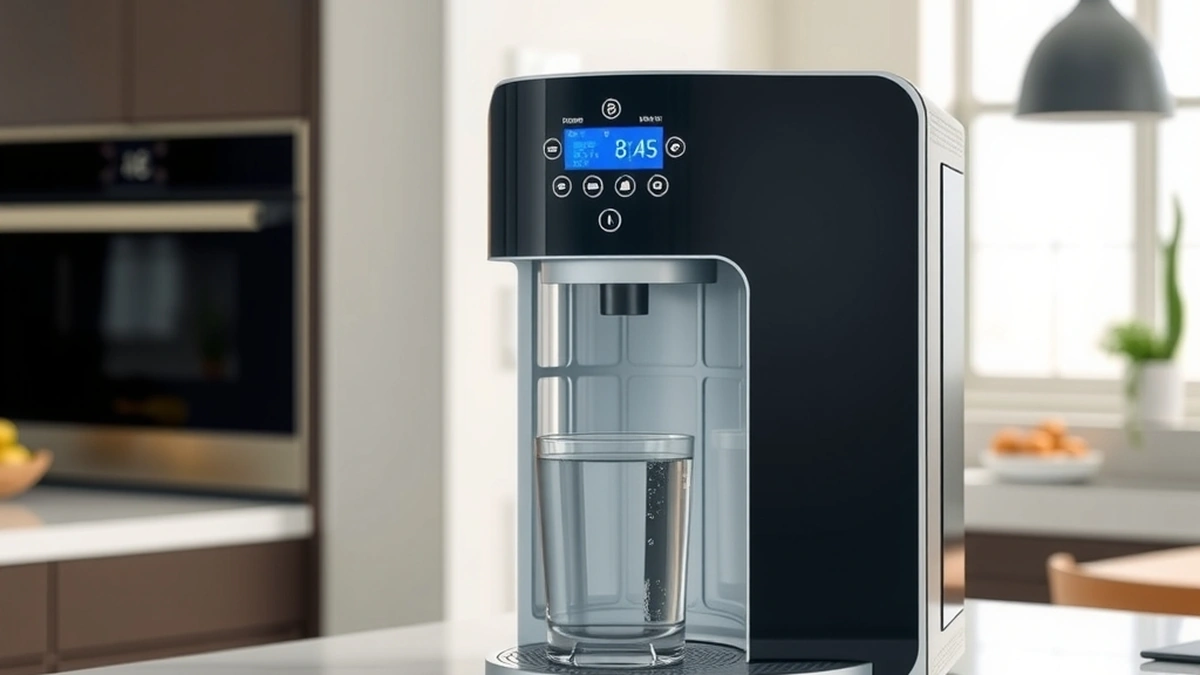
A countertop reverse osmosis filter sits on the counter, fills from the tap, and plugs into a wall outlet with no plumbing connection. Units cost $200 - $600 and produce 50 - 100 gallons a day, enough for drinking and cooking but not for a whole house.
- Unit price
- $200 - $600
- Installation
- None, fills from tap
- Production
- 50 - 100 gallons per day
- Annual filter cost
- $60 - $150
- Waste ratio
- 3 - 4 gallons per gallon
Some links on this page are affiliate links.If you buy through them we may earn a commission at no extra cost to you. We do not accept payment for rankings. Read the full disclosure.
A countertop reverse osmosis filter is a self-contained RO unit that sits on the kitchen counter, fills from a pitcher or a small diverting valve, and plugs into a wall outlet. It needs no drain line and no cabinet space. Units cost $200 - $600 and produce 50 - 100 gallons a day, far more than a household drinks.
How a Countertop RO Unit Works
A countertop RO filter packs the same stages as an under-sink system into a smaller housing: sediment prefilter, carbon block, RO membrane, and postfilter, sometimes with a remineralization stage. Water goes into a reservoir, gets pressurized by a small pump, passes through the membrane, and collects in a product tank.
The difference is scale and plumbing. An under-sink unit connects permanently to the cold water line and sends reject water to the drain. A countertop unit takes water from a fill tank you top up, or from a diverter that clamps onto the faucet, and stores reject water in a separate compartment you empty.
That design is why renters and apartment dwellers buy them. Nothing is cut, drilled, or permanently connected. When you move, the unit goes in a box.
Production, Tank Size, and Real Demand
Production is rated in gallons per day, and the numbers look large next to actual use. A four-person household drinks and cooks with roughly 2 - 5 gallons a day. A unit rated at 50 GPD covers that several times over.
The constraint is not daily capacity but draw rate. A countertop unit fills a 1 - 2 gallon tank slowly, often over an hour or two, and the tank refills only as fast as the membrane produces. Pour three pitchers in a row for a dinner party and you will wait.
Tank size is the spec to check. A 1-gallon tank is fine for one or two people. A household of four that cooks with filtered water should look at 2 gallons or more, or a unit with a direct-flow mode that bypasses the tank.
Countertop vs Under-Sink vs Pitcher
| Feature | Countertop RO | Under-sink RO | Pitcher filter |
|---|---|---|---|
| Installed cost | $200 - $600 | $300 - $900 | $25 - $50 |
| Plumbing | None | Supply and drain | None |
| Production | 50 - 100 GPD | 50 - 75 GPD | Slow, manual |
| Removal | 80 - 95 percent TDS | 80 - 95 percent TDS | Chlorine and some metals |
| Filter cost per year | $60 - $150 | $60 - $150 | $50 - $100 |
| Best for | Renters, small kitchens | Owned homes | Low-demand, low-budget |
A pitcher filter is cheaper but does not remove dissolved solids. If the concern is nitrate, arsenic, or high TDS, the pitcher is not a substitute. If the concern is chlorine taste, the pitcher does most of the job for a fraction of the price.
Under-sink RO is the better long-term choice for an owned home with cabinet space. It is out of sight, has a larger tank, and delivers at a dedicated faucet without occupying counter space. The countertop unit wins on portability and installation.
What It Costs to Own
A countertop unit runs $200 - $600. There is no installation charge, which is the main saving against an under-sink system at $300 - $900 installed.
Filters run $60 - $150 a year. Countertop cartridges are smaller than under-sink cartridges, so they change more often, and proprietary designs sit at the top of the range. A membrane every 1 - 2 years adds $40 - $100.
Over five years: $400 for the unit plus $500 in filters plus one membrane at $70 equals $970. An under-sink system at $600 installed plus $500 in filters plus a $90 membrane equals $1,190. The gap is modest, and the under-sink unit is more convenient.
Electricity is small but not zero. The pump draws a few watts while running, and a unit producing 3 gallons a day might use 2 - 5 kWh a month, or roughly $3 - $8 a year at 15 cents per kWh.
Setting One Up
- Unpack and rinse the reservoirs, then install the cartridges per the manual.
- Fill the inlet tank with tap water and let the unit run its first flush cycle, discarding the first batch.
- Place the unit on a stable counter away from direct sun and heat.
- Top the inlet tank when it drops below the minimum line, and empty the reject tank before it overflows.
- Change prefilters every 6 - 12 months and the membrane every 1 - 2 years, or when production slows.
Where Countertop RO Falls Short
The first limit is volume. A countertop unit cannot supply a whole house, a shower, or a washing machine. It treats drinking and cooking water only.
The second is labor. You fill the inlet tank and empty the reject tank, which is a daily chore in a busy kitchen. Units with a faucet diverter reduce the filling but still need reject water handled.
The third is counter space. A typical unit occupies about a square foot and stands 15 - 20 inches tall, which matters in a small kitchen. Some designs are slim enough to tuck under a cabinet; others are not.
The fourth is wastewater. RO sends 3 - 4 gallons to reject for every gallon produced. A countertop unit with a reject tank makes that visible, which is honest but also a reminder that the process is not free.
Who Should Buy One
Buy a countertop RO if you rent, if the kitchen has no cabinet space or no drain access, if you want filtered water at a home office or a second location, or if you are testing whether RO suits your household before committing to an under-sink install.
Skip it if you need water at multiple taps, if counter space is tight, if the household drinks more than 5 gallons a day, or if the water has high sediment that will clog small prefilters quickly. In those cases, under-sink water filter cost is the better comparison, and best countertop reverse osmosis covers specific models.
For the process itself, see how reverse osmosis works. If you are choosing between a tank and a tankless design, tankless RO vs tank RO lays out the tradeoffs.
Frequently asked questions
Do countertop RO units need a plumber?
No. They sit on the counter, draw water from a fill tank or a diverting valve, and plug into a standard outlet, so no drain or supply line is required.
How much water does a countertop RO make per day?
Most models produce 50-100 gallons per day, which is well beyond typical drinking and cooking use of 2-5 gallons per day for a household.
Where does the wastewater go?
It goes back into the unit's own tank in most designs, or to a small collection container you empty. Units with a drain line send it to the sink.
Is countertop RO water safe for baby formula?
RO water is low in dissolved solids, and many households use it for formula. Follow the manufacturer's instructions and your pediatric guidance on mixing.
How long do countertop RO filters last?
Prefilters usually last 6-12 months and the membrane 1-2 years in countertop units, which are smaller than under-sink systems.
Can a countertop RO run on a tankless water supply?
The unit needs a filled reservoir or a supply connection, so it does not care how the house is plumbed. It only needs the inlet tank topped up.
Sources
Some links are affiliate links.If you buy through them we may earn a commission at no extra cost to you. We do not accept payment for rankings. Read the full disclosure.


