
Aquasure water softener
What to check before buying an Aquasure softener, how the online brand compares with dealer systems, and what installation involves.
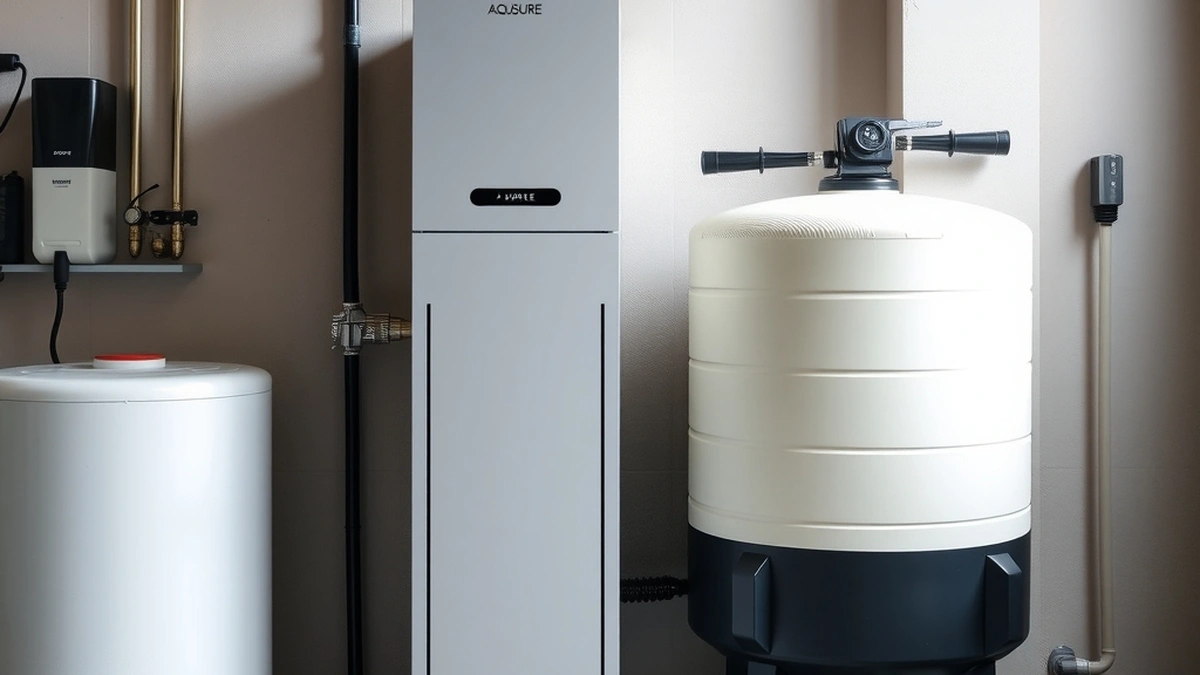
An Aquasure water softener is an online-sold ion exchange system that typically costs less than a dealer package. Check the grain capacity against your hardness test, confirm the valve and warranty, and budget $1,200 to $4,500 for a typical installed job.
- Equipment band
- $600 - $2,500
- Installed band
- $1,200 - $4,500
- Capacity needed
- 24,000 - 64,000 grains
- Salt per year
- $120 - $400
- Water test
- $40 - $150
Some links on this page are affiliate links.If you buy through them we may earn a commission at no extra cost to you. We do not accept payment for rankings. Read the full disclosure.
An Aquasure water softener is an ion exchange system sold online rather than through a dealer network. Equipment usually falls in the $600 to $2,500 band, and a completed installation lands between $1,200 and $4,500. What matters is whether the grain capacity matches the hardness test and whether the valve and warranty are supportable locally.
What the product is
Aquasure sells cabinet and two-tank softeners aimed at homeowners who are comfortable buying online and arranging installation.
The system is conventional: a resin tank, a brine tank, and a control valve that runs a regeneration cycle. There is no proprietary treatment technology, which is good news for parts and service and means the specification sheet can be compared directly with any other brand.
The difference from a dealer system is the channel. You buy the unit, then either install it or hire a plumber. Warranty support is handled by the manufacturer and the seller rather than by a local branch, which is the main trade-off for the lower equipment price.
Match the capacity to the test
A water test at $40 to $150 reports hardness in grains per gallon. That number, multiplied by daily gallons, gives the daily grain load.
Four people at 75 gallons each is 300 gallons per day. At 12 gpg, that is 300 x 12 = 3,600 grains per day.
A unit that regenerates weekly needs about 25,200 grains plus a reserve, which points to a 32,000-grain model. At 20 gpg, the same household needs 6,000 grains per day, or 42,000 weekly, which points to 48,000 or 64,000 grains.
| Household | Hardness | Grains/day | Capacity |
|---|---|---|---|
| 2 people | 8 gpg | 1,200 | 24,000 |
| 4 people | 12 gpg | 3,600 | 32,000 |
| 4 people | 20 gpg | 6,000 | 48,000 - 64,000 |
Buying on price alone is how households end up with a 24,000-grain cabinet on 18 gpg water. The unit runs continuously, salt use climbs, and the water still feels hard a day after each regeneration.
What installation involves
The unit goes on the main line after the meter or pressure tank and before the water heater. The work is a bypass, an inlet and outlet connection, a drain line, and power for the valve.
A confident homeowner can do it with copper or PEX tools. The risk points are cutting into the main without a proper shut-off, and a drain line that can back up.
A plumber typically charges $500 to $1,500 for the labour, which is the same band as a dealer installation. The saving on an online unit is in the equipment, not the labour, and it shrinks further if the install needs a new drain or outlet. Get the plumber’s quote before you order, not after.
Online versus dealer
| Factor | Aquasure-style online unit | Dealer system |
|---|---|---|
| Equipment price | $600 - $2,500 | Often higher |
| Installation | Arrange separately | Included |
| Service | Manufacturer and local plumber | In-house |
| Warranty | Parts, terms vary | Parts and labour, service tied |
| Best for | Hands-on buyers | Full-service buyers |
A dealer package at $2,400 and an online unit at $1,200 plus $900 labour come to $2,100, which is inside the same installed band. The dealer adds service convenience; the online route adds choice.
Checking the valve and warranty
The valve is the part that fails first. Ask which valve the model uses, whether replacement parts are available, and whether a local technician will service it.
Read the warranty for three things: the parts period, the labour period, and whether professional installation is required to keep coverage. Some warranties are void if the unit is self-installed, which changes the economics of the DIY route.
Check the resin type and volume. A unit with less resin than its rating suggests will regenerate more often and use more salt, and the specification sheet is the only place that difference shows up.
Running costs
Salt runs $120 to $400 per year depending on hardness and volume. A household regenerating twice a week at 10 pounds per cycle uses about 1,040 pounds per year, or 26 bags of 40 pounds.
Resin lasts 8 to 12 years, and a rebed costs $300 to $600. On an online unit, confirm that a replacement resin tank or a rebed service is available locally.
Before you buy
- Test the water and write down hardness and iron.
- Calculate daily grains and choose the capacity.
- Confirm the valve model and parts availability.
- Read the warranty, especially the installation condition.
- Price the installation labour separately.
- Confirm the unit includes a bypass and a brine tank.
If iron is above 2 to 3 ppm, budget for an iron filter at $800 to $2,500 before the softener. A softener alone will foul, and the resin rebed at $300 to $600 arrives sooner than the warranty paperwork suggests.
For the installation pricing, see water softener installation cost and how much does a water softener cost. For the sizing arithmetic, water softener sizing walks through the numbers.
Bottom line
An Aquasure softener is a conventional ion exchange unit sold online. Judge it on capacity against the test, valve support, and warranty terms, and compare the installed total rather than the box price.
Frequently asked questions
Is an Aquasure water softener any good?
It is a conventional ion exchange softener, so performance depends on correct sizing, the valve, and installation rather than on the brand name.
How much does an Aquasure softener cost?
Equipment typically falls in the $600 to $2,500 band, and a completed installation lands between $1,200 and $4,500 depending on labour.
Can I install an Aquasure softener myself?
A confident homeowner can, since the work is a bypass, two connections, a drain, and power, but a plumber is safer on copper or tight spaces.
What size do I need?
Multiply daily gallons by hardness in grains per gallon; a family of four at 12 gpg needs about 3,600 grains per day and a 32,000-grain unit.
Does it remove iron?
Most softeners handle only 2 to 3 ppm of iron, so higher iron needs an iron filter at $800 to $2,500 installed upstream.
What warranty support is available?
Warranty terms vary by model and seller; confirm the parts and labour coverage in writing and who performs service in your area.
Sources
Some links are affiliate links.If you buy through them we may earn a commission at no extra cost to you. We do not accept payment for rankings. Read the full disclosure.


