Hard water softening system
How a softening system removes hardness, how to size it to a house, and what it costs to install and run in the first year.
A hard water softening system removes calcium and magnesium by ion exchange, replacing them with sodium. Installed cost runs $1,200 to $4,500 with $120 to $400 a year in salt, and sizing follows tested hardness, household size, and peak flow.
- Installed cost
- $1,200 - $4,500
- Salt per year
- $120 - $400
- Hardness target
- Under 3 GPG
- Capacity
- 24,000 - 64,000 grains
- Equipment life
- 10 - 15 years
Some links on this page are affiliate links.If you buy through them we may earn a commission at no extra cost to you. We do not accept payment for rankings. Read the full disclosure.
A hard water softening system removes calcium and magnesium through ion exchange, replacing them with sodium. Installed cost runs $1,200 to $4,500 and salt adds $120 to $400 a year. The sizing is decided by a hardness number, a household count, and a peak flow figure.
The Mechanism
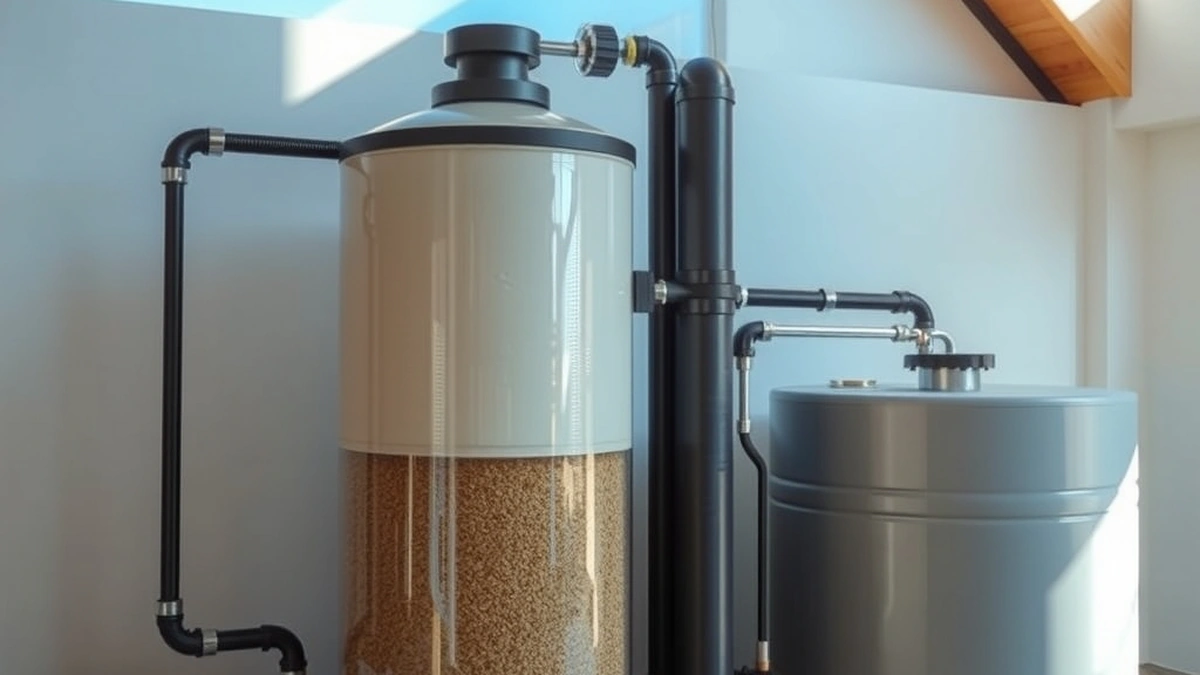
Hard water carries dissolved calcium and magnesium bicarbonates. The softener tank holds strong acid cation resin, a polystyrene bead with sulfonic acid exchange sites charged with sodium.
As water passes, calcium and magnesium bind to the sites and sodium is released. The water leaves soft and slightly higher in sodium. When the sites are full, the valve runs a regeneration cycle with brine, which strips the hardness minerals off the resin and sends them to drain.
Nothing is filtered out in the physical sense. The minerals are exchanged, which is why a softener removes hardness completely rather than reducing it. A test at the tap reads near zero, not merely lower.
That completeness is the difference between a softener and a conditioner. A conditioner can reduce scale adhesion while the hardness reading stays exactly where it was. If the goal is soft water rather than less visible scale, only the exchange does it.
Do You Need One
Hardness is measured in grains per gallon. The bands are 0 to 3 soft, 3 to 7 moderate, 7 to 10 hard, and above 10 very hard.
The symptoms appear around 5 GPG and become obvious at 7: soap that will not lather, white film on glass, spots on dishes, stiff laundry, and scale in the kettle and the water heater.
A lab test at $40 to $150 gives the number. Without it, the two common errors are buying a softener for water that is not hard and buying one too small for water that is.
There is also a conversion trap. Reports often list hardness in milligrams per litre as calcium carbonate, and one grain per gallon equals 17.1 mg/L. A report showing 171 mg/L is 10 GPG, which is the hard band, not the moderate one. Converting before sizing is the difference between a 24,000 grain unit and a 48,000 grain unit.
Sizing the System
Capacity is three multiplications: people × gallons per person per day × hardness in GPG.
Four people at 75 gallons and 10 GPG is 3,000 grains per day. A 32,000 grain unit at 75 percent usable capacity gives 24,000 grains, or eight days between regenerations.
Flow is the second limit. A four-bathroom house draws 10 to 12 gallons per minute at peak, which needs a 1 inch valve and adequate tank diameter. A large tank with a small valve still chokes the showers.
Capacity and flow do not scale together. Capacity follows resin volume, while flow follows tank diameter and valve size. That is why two units with the same grain rating can behave completely differently in the same house.
| Household | 10 GPG | 15 GPG | 20 GPG |
|---|---|---|---|
| 2 people | 24,000 | 32,000 | 48,000 |
| 4 people | 32,000 - 48,000 | 48,000 | 64,000 |
| 6 people | 48,000 | 64,000 | 64,000 |
What It Costs
Equipment runs $600 to $2,500. Installation runs $500 to $1,500, higher if a new drain or outlet is needed.
A mid-range unit at $1,300 equipment plus $700 labor is $2,000 installed. Salt at $250 per year for ten years is $2,500. One rebed at $450. Total $4,950, or about $495 per year.
That is an estimate from published ranges. Local labor, pipe material, and drain conditions move it, and a new drain connection can add $100 to $400.
Installation Requirements
The unit goes after the meter or pressure tank and before the water heater. Softener resin tolerates only about 100 to 120 F continuously, so hot water must not pass through it.
It needs a bypass for service, a drain within about 30 feet with an air gap, and a grounded outlet. Those three details decide whether the install is straightforward or a project.
| Requirement | Detail |
|---|---|
| Location | After meter, before heater |
| Drain | Within 30 ft, air gap |
| Power | GFCI outlet in reach |
| Space | 18 in above brine tank |
| Bypass | Three valves or one lever |
Five Steps to Buy
- Test hardness and iron with a lab panel.
- Calculate daily grains from people, gallons, and GPG.
- Measure peak flow from simultaneous fixtures.
- Confirm drain, power, and bypass before signing.
- Verify settings after install with a tap test.
Maintenance
Salt monthly, brine tank annually, hardness quarterly, resin at 8 to 12 years.
Most failures are salt and brine faults rather than resin. A bridge or mush stops brine production while the tank still looks full, and the water goes hard within days. The diagnostic order in softener stopped softening starts there for that reason.
When Softening Is the Wrong Answer
A softener removes hardness and nothing else. If the complaint is chlorine taste, a carbon filter is the purchase. If it is nitrate, reverse osmosis at the tap. If it is iron above 2 to 3 ppm, an iron filter goes first.
A salt-free conditioner is a different product. It alters scale adhesion without removing minerals, so a hardness test still reads the same number.
The conditioners have a place: no drain, no brine, no salt, and less scale on the showerhead. They simply are not softeners, and buying one expecting soft water is the most common disappointment in this category.
For the alternatives, see salt-based versus salt-free softener. For sizing detail, water softener sizing covers reserve capacity, and water softeners covers the market.
Frequently asked questions
How does a hard water softening system work?
Water passes through cation resin charged with sodium; calcium and magnesium bind to the resin and sodium is released, and brine regeneration resets the bed.
How much does a softening system cost?
Equipment runs $600 to $2,500, installation $500 to $1,500, and the installed total $1,200 to $4,500, with salt at $120 to $400 per year.
What hardness level needs a softener?
Seven grains per gallon and above is the usual threshold, though households notice symptoms from about five and some choose to treat earlier.
Does a softener remove iron?
It handles small amounts up to about 2 to 3 ppm; above that, iron fouls the resin and an iron filter belongs ahead of the softener.
Is softened water safe to drink?
For most people yes; the sodium added is small compared with dietary intake, and a sodium-restricted diet is a reason to bypass the kitchen tap rather than skip softening.
How long does a softening system last?
Ten to fifteen years for the equipment, with the resin bed lasting eight to twelve years and a rebed costing $300 to $600.
Sources
Some links are affiliate links.If you buy through them we may earn a commission at no extra cost to you. We do not accept payment for rankings. Read the full disclosure.