How to choose a catalytic carbon filter
Choose catalytic carbon when your utility uses chloramine. See media volume, tank sizing, and the $700-$1,800 installed range against standard GAC.
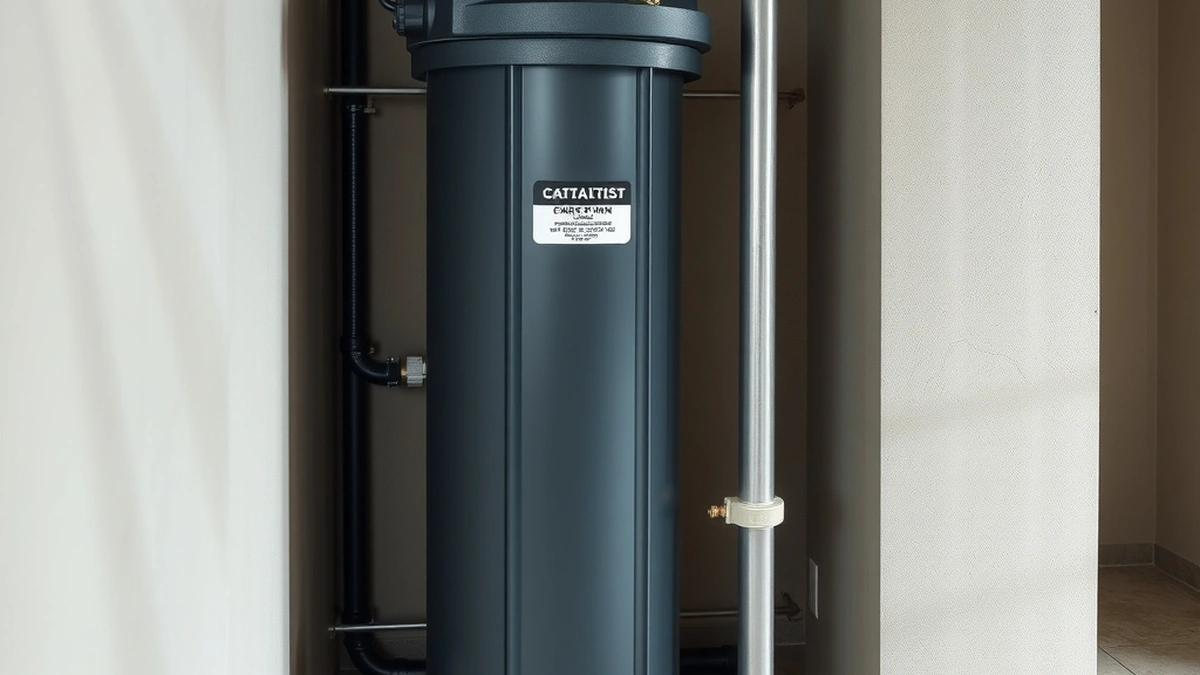
Choose catalytic carbon when your utility disinfects with chloramine or the water carries hydrogen sulfide. Size the tank for 8-15 GPM and 2-4 minutes of contact time, at $700-$1,800 installed.
- Installed cost
- $700 - $1,800
- Contact time
- 2 - 4 minutes
- Typical flow
- 8 - 15 GPM
- Media life
- 3 - 5 years
- Media cost
- $180 - $450
Some links on this page are affiliate links.If you buy through them we may earn a commission at no extra cost to you. We do not accept payment for rankings. Read the full disclosure.
Choose catalytic carbon when the utility disinfects with chloramine or the water carries a sulfur odor. Standard granular carbon handles free chlorine fine and costs less. The decision is made by asking the water department one question, not by comparing media spec sheets.
Ask what the utility uses
Chloramine is a compound of chlorine and ammonia, and a growing number of US utilities use it because it lasts longer in the distribution system. Standard granular activated carbon has limited capacity for it at household flow rates.
Catalytic carbon is processed to accelerate the breakdown of chloramine on its surface. That is the entire reason it exists, and it is the reason it costs $40-$120 more per cubic foot.
Call the water department or read the annual quality report. If the answer is “chloramine,” buy catalytic. If it is “free chlorine,” standard GAC is sufficient and cheaper.
Catalytic versus standard GAC
| Factor | Standard GAC | Catalytic carbon |
|---|---|---|
| Media cost | $25 - $60 per cu ft | $65 - $180 per cu ft |
| Chloramine | Limited | Good |
| Free chlorine | Good | Good |
| Hydrogen sulfide | Limited | Better |
| Backwash | Required | Required |
| Installed cost | $500 - $1,500 | $700 - $1,800 |
The installed price gap is smaller than the media gap because the tank, valve, and labor are the same. That is worth knowing when a salesperson quotes a large premium for catalytic.
Sizing for contact time
Contact time is the number that decides whether the media works. Catalytic carbon needs roughly 2-4 minutes of empty bed contact time for chloramine.
A 1.5-cubic-foot tank holds about 11 gallons of media volume. At 4 GPM, that is roughly 2.7 minutes of contact. At 8 GPM, it drops to 1.4 minutes, which is below target.
A 2.5-cubic-foot tank holds about 19 gallons. At 8 GPM, contact time is about 2.4 minutes, which is adequate.
Match the tank to peak flow. A three-bathroom home peaks near 6-8 GPM, so a 2-cubic-foot tank is the safe choice.
Backwash and drain
A tank unit backwashes every 3-7 days at 5-10 GPM for 10-15 minutes, discharging 50-150 gallons to drain.
That requires a drain within 10-15 feet, a continuous slope, and an air gap. A floor drain is ideal; a standpipe works; a bucket does not.
A cartridge-based catalytic unit needs no drain and no power, but it holds far less media and suits a single tap rather than a house.
What it does not do
Catalytic carbon does not remove iron, hardness, nitrate, or bacteria. It removes chlorine, chloramine, taste, odor, and some organic compounds.
Iron above 2-3 ppm coats the media and shortens its life. Hardness scales the valve. Both need treatment upstream, not more carbon.
If the complaint is a rotten-egg smell at 5 ppm, catalytic carbon is undersized for the job. A dedicated sulfur filter at $1,000-$3,000 is the right equipment.
Cost over ten years
A $1,100 installed system with $300 media in year five: $1,100 + $300 = $1,400 over ten years, plus $60 per year in prefilters and test supplies ($600). Total: $2,000, or $200 per year.
A standard GAC system at $900 installed with the same media cycle: $1,200 over ten years plus the same $600, or $180 per year.
The $20-per-year difference buys chloramine capacity. If the utility uses chloramine, that is not optional.
Filter housing and valve quality
The tank and valve last longer than the media, so buy for the second and third media changes rather than the first.
A fiberglass pressure vessel is standard and reliable. A metered, demand-initiated valve costs $150-$350 more than a timer valve and backwashes only when capacity is used, which saves water and extends media life.
Check that the valve has a manual backwash option. Every valve does, but the procedure differs, and a homeowner who cannot trigger a cycle cannot diagnose a problem.
Ask about the bypass. A three-valve bypass is included in some quotes and extra in others, and it is not optional equipment: without it, every service call shuts water off to the house.
Confirm the drain line size and the air gap. A 1/2-inch drain line is adequate for 5-10 GPM backwash; a 3/8-inch line is not, and the failure looks like a weak backwash rather than a plumbing problem.
A buying sequence
- Confirm the utility’s disinfectant from the quality report.
- Test for iron, manganese, and sulfur as well as chlorine.
- Measure peak flow by counting simultaneous fixtures.
- Size the tank for 2-4 minutes of contact time at that flow.
- Confirm drain access and an outlet for the valve.
- Compare quotes on media volume rather than tank dimensions.
What to ignore
Ignore a quote that does not state media volume. A 10-inch by 54-inch tank can hold 1.5 cubic feet or less, and the difference decides performance.
Ignore “catalytic” as a marketing label on a cartridge with no specification. Ask for the media type and the chloramine reduction data.
Ignore a system sized only by house size. Flow and contact time are what determine whether chloramine gets through. Catalytic carbon filter cost covers the price bands, catalytic carbon filter installation covers the commissioning, and chlorine in tap water explains what the utility switch means. “”
Frequently asked questions
Do I need catalytic carbon or standard carbon?
Catalytic if the utility uses chloramine or the water smells of sulfur. Standard GAC is adequate for free chlorine and taste on water that is otherwise clean.
How do I find out whether my water has chloramine?
Check the utility's annual water quality report or call the water department. Total chlorine tests will read positive for both, so ask directly rather than testing at home.
What size catalytic carbon tank do I need?
Size for peak flow and contact time. A 1.5-cubic-foot tank handles 4-6 GPM at 2-4 minutes of contact; a 2.5-cubic-foot tank handles 6-10 GPM.
Does catalytic carbon need backwashing?
A tank unit does, typically every 3-7 days depending on sediment load. A cartridge unit is replaced rather than backwashed.
How long does the media last?
Three to five years under normal chloramine service, then $180-$450 for replacement. Heavy sediment or sulfur shortens that.
Can catalytic carbon remove hydrogen sulfide?
It accelerates the oxidation of dissolved hydrogen sulfide, which helps at low concentrations. Above roughly 1 ppm, a dedicated sulfur filter is the better choice.
Sources
Some links are affiliate links.If you buy through them we may earn a commission at no extra cost to you. We do not accept payment for rankings. Read the full disclosure.