How to choose a dual tank water softener
Choose a twin tank softener only if water use is 24-hour or demand is high. See capacity math, valve types, and the $1,800-$4,500 installed range.
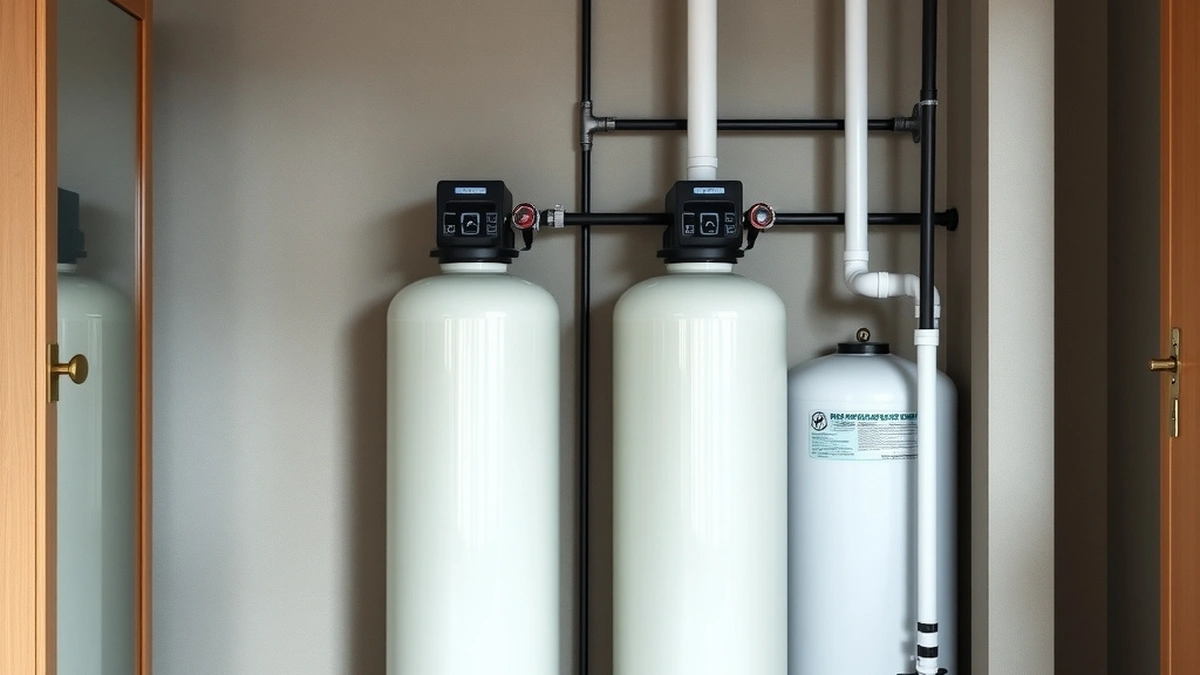
Choose a dual tank softener when the house cannot tolerate a regeneration gap, such as shift work, rental units, or high simultaneous demand. Size each tank to carry a full day alone, at $1,800-$4,500 installed.
- Installed cost
- $1,800 - $4,500
- Capacity per tank
- 24,000 - 64,000 grains
- Salt per year
- $120 - $400
- Footprint
- 30 x 48 inches
- Regeneration gap
- None
Some links on this page are affiliate links.If you buy through them we may earn a commission at no extra cost to you. We do not accept payment for rankings. Read the full disclosure.
Choose a dual tank softener when the house cannot tolerate a regeneration gap. Shift workers, rental units with shared laundry, and homes with high simultaneous demand are the cases that justify it. Everyone else is paying $400-$1,200 for continuity they will never notice.
What the second tank buys
A single tank softener goes offline for 60-120 minutes during regeneration. Most households never notice because the timer runs at 2 a.m.
A dual tank system alternates: one tank serves while the other regenerates, so soft water never stops. That is the entire benefit.
The cost is a second pressure vessel, a second resin charge, a more complex valve, and double the plumbing at the manifold.
When continuity actually matters
Homes with overnight laundry, shift workers who shower at 4 a.m., and buildings with a shared hot-water loop on demand all see the gap.
Homes with a boiler feeding an instantaneous hot water system also notice, because there is no stored volume to cover the regeneration window.
A family of four in a 2,000 square foot house with daytime water use does not notice. That is the honest majority case.
Sizing each tank
| Household | Daily grains | Per-tank capacity | Pair size |
|---|---|---|---|
| 2 people, 10 gpg | 1,500 | 20,000 | 2 x 24,000 |
| 4 people, 10 gpg | 3,000 | 32,000 | 2 x 32,000 |
| 4 people, 20 gpg | 6,000 | 48,000 | 2 x 48,000 |
| 6 people, 20 gpg | 9,000 | 64,000 | 2 x 64,000 |
The arithmetic: 4 people at 75 gallons each is 300 gallons per day. At 10 gpg, that is 3,000 grains removed daily. Each tank must carry a full day plus reserve, so 32,000 grains each.
Sizing each tank to half the household load is the classic error. It leaves the house hard at the end of every cycle.
Valve choices
An alternating valve with a single controller is the standard. It tracks capacity across both tanks and switches automatically.
Two separate valves with a shared meter cost less and require more setup. They work, but the programming is fussier and the failure modes are less obvious.
A metered, demand-initiated controller adds $250-$500 and pays back in salt within a few years.
Space and installation
Two 10-inch tanks plus a brine tank need about 30 inches of width and 48 inches of depth. Add 12 inches above for valve service.
The manifold needs isolation valves on each leg so either tank can be serviced. A manifold without them means every repair shuts down the whole system.
The drain requirement is the same as a single tank: within 10-15 feet, with an air gap. One drain serves both tanks through the shared valve.
Cost over ten years
A $2,100 installed twin with $260 per year in salt and a $700 rebed in year ten: $2,100 + $2,600 + $700 = $5,400.
A $1,600 single with $240 per year in salt and a $450 rebed: $1,600 + $2,400 + $450 = $4,450.
The difference is $950 over a decade, or about $95 per year, for uninterrupted soft water. That is a reasonable price for the households that need it and a waste for those that do not.
A buying sequence
- Confirm hardness and daily gallons from a lab test and a usage estimate.
- Decide whether a regeneration gap is actually a problem in your house.
- Size each tank to carry a full day alone, plus 20 percent.
- Choose an alternating valve over parallel unless flow demands otherwise.
- Confirm 30 inches of width and 48 inches of depth.
- Get a quote that names both tank sizes and the resin volume.
What to ignore
Ignore a twin sold as “commercial grade” without a capacity number. The number is what matters.
Ignore a quote that sizes the pair to the same total capacity as a single tank you were considering. That is a downgrade with an extra vessel.
Ignore parallel configurations unless you have a flow problem, not a continuity problem. They regenerate together, which defeats the point. Dual tank water softener cost covers the price bands, and dual tank versus single tank softener sets out the trade. “”
The questions to ask a seller
A twin-tank quote can hide a lot in two lines of text. Ask these before comparing prices.
How many cubic feet of resin are in each tank? Capacity in grains is a function of resin volume and salt dose, and a “64,000 grain” pair with 1 cubic foot per tank is not the same as one with 2 cubic feet per tank.
What valve is on it, and does it meter? A metered alternating valve tracks capacity across both tanks. A timer valve switches on schedule regardless of use.
What happens during regeneration if one tank fails? Good controllers have a manual override that keeps the working tank online. A controller without one leaves the house hard until service arrives.
What does the resin rebed cost, and who does it? Two vessels mean two charges, and $500-$1,000 is the realistic figure. A seller who quotes a single-tank rebed price for a twin has not thought about it.
Finally, ask what the controller does when one tank’s sensor fails. A twin that cannot run on one tank is a single-tank system with extra plumbing, and that is worth knowing before the failure rather than after. Water softener sizing covers the capacity math in more detail.
Frequently asked questions
Is a dual tank softener worth the extra cost?
Only if the house uses water around the clock or cannot tolerate hard water during regeneration. For a typical family of four, a single tank regenerating at 2 a.m. is invisible.
How do I size each tank in a twin system?
Size each tank to carry the household alone for a full day, plus reserve. That means the pair's total capacity is roughly double a single-tank unit, not half.
How much space does a dual tank softener need?
About 30 inches of width for two 10-inch tanks plus a brine tank, and 48 inches of depth, with 12 inches above for valve service.
Does a twin tank use more salt?
No, if it is programmed correctly. Total capacity and dose per regeneration stay in the 8-12 pound range, so annual salt spend remains $120-$400.
What is the difference between alternating and parallel twin tanks?
Alternating systems switch tanks so one always serves while the other regenerates. Parallel systems run both together for higher flow, which is a capacity decision rather than a continuity one.
How long does a dual tank softener last?
Ten to fifteen years for the tanks and valve, with a resin rebed at 8-12 years costing $500-$1,000 because there are two vessels.
Sources
Some links are affiliate links.If you buy through them we may earn a commission at no extra cost to you. We do not accept payment for rankings. Read the full disclosure.