
Dual-Tank vs Single-Tank Softener: Which Fits Your Home
Compare dual-tank and single-tank water softeners on capacity, salt use, installed cost, and continuous flow.
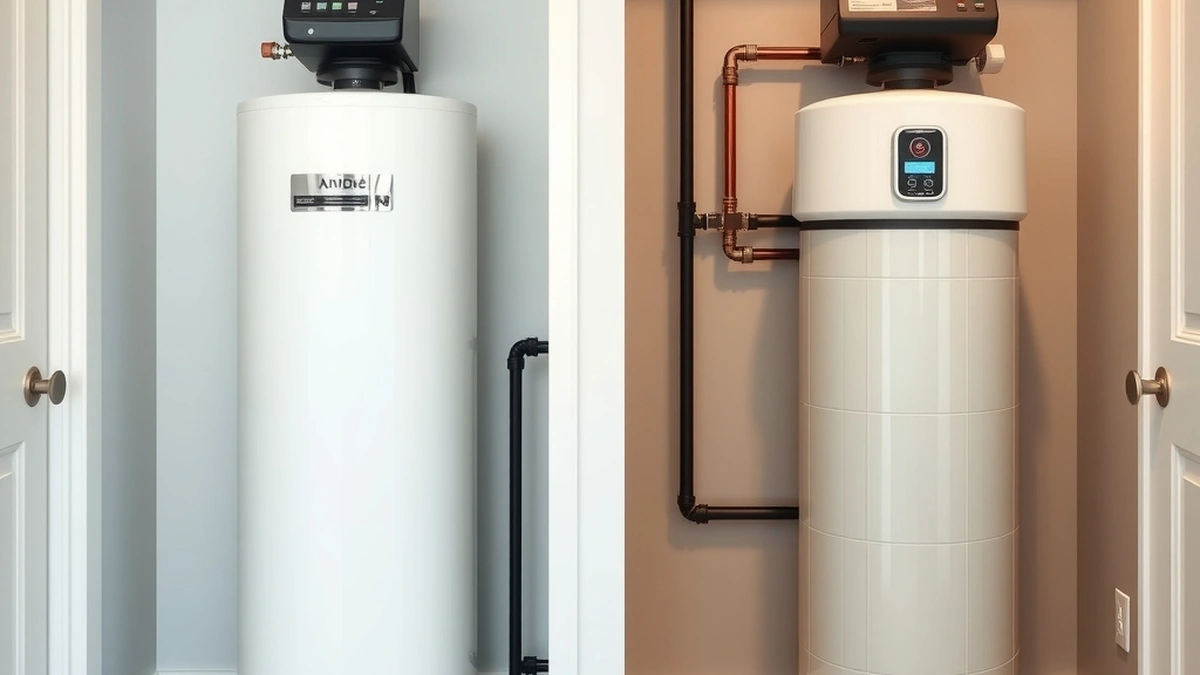
Dual-tank softeners provide soft water during regeneration; single-tank units do not. Choose dual-tank for continuous flow, single-tank for lower installed cost.
- Best for continuous soft water
- Dual-tank
- Lower installed cost
- Single-tank
- Typical equipment range
- $600-$2,500
- Typical installed range
- $1,200-$4,500
- Resin life
- 8-12 years
Some links on this page are affiliate links.If you buy through them we may earn a commission at no extra cost to you. We do not accept payment for rankings. Read the full disclosure.
A dual-tank softener keeps soft water flowing while one tank regenerates; a single-tank softener does not. That is the core difference between the two designs, and it drives most of the cost and installation decisions. This article compares dual-tank and single-tank softeners on capacity, salt use, installed price, and long-term maintenance.
How Each Design Works
A single-tank softener has one resin vessel and one brine tank. When the resin bed reaches its capacity limit, the unit enters regeneration, draws salt brine through the resin, rinses it, and returns to service. During that window, usually at night, the home receives untreated hard water or bypasses the softener entirely.
A dual-tank softener, sometimes called a twin-tank system, has two resin vessels sharing a single brine tank. While Tank A is in service, Tank B can stand by or regenerate. When Tank A exhausts its capacity, the system switches to Tank B. Tank A then regenerates and stands by. The result is a continuous supply of soft water with no hard-water bypass during regeneration.
Installed Cost and Equipment Price
Equipment for a standard ion-exchange softener typically runs $600-$2,500, with professional installation adding $500-$1,500. Total installed cost usually lands between $1,200 and $4,500. Dual-tank models generally cost more than single-tank models because they include a second resin vessel, additional valves, and more complex controls.
For example, if a single-tank system installs for $1,800 and a comparable dual-tank system installs for $2,600, the upfront difference is $800. Over a 10- to 15-year equipment life, that works out to roughly $53-$80 per year before salt and maintenance. Households that need soft water at all times may find that justified; households that can schedule regeneration overnight may not.
Salt typically costs $120-$400 per year depending on water hardness, household size, and regeneration frequency. Resin rebeds cost $300-$600 and are usually needed every 8-12 years. These recurring costs apply to both designs.
Grain Capacity and Regeneration Loads
Softener capacity is measured in grains of hardness removal, commonly 24,000-64,000 grains per tank. A dual-tank system does not automatically double your capacity in daily use; it provides two tanks that alternate. Each tank still has its own rated capacity.
Salt use per regeneration is typically 8-12 pounds. To estimate annual salt, determine how often the unit regenerates. A household using 300 gallons per day with 10 grains per gallon hardness produces 3,000 grains of demand per day. A 30,000-grain tank set to regenerate at 80 percent capacity handles about 24,000 grains between regenerations, or roughly eight days. At 10 pounds of salt per regeneration, that is about 45 regenerations per year and 450 pounds of salt. At $0.40-$0.80 per pound for bulk salt, annual salt cost lands near $180-$360, inside the $120-$400 range.
Dual-tank systems can regenerate on demand based on actual usage rather than a fixed timer, which can reduce salt waste if configured correctly. Single-tank metered units can do the same, but they still go offline during the regeneration cycle.
Continuous Flow and Household Size
The main reason to choose a dual-tank softener is continuous soft water. In a single-tank system, regeneration often lasts 60-90 minutes. If someone runs a shower or dishwasher during that window, the plumbing bypasses the softener or delivers hard water. For large families, homes with multiple bathrooms, or houses with water-using appliances on timers, that interruption can matter.
A dual-tank system eliminates that gap because the standby tank takes over immediately. Flow rates for whole-house treatment commonly fall in the 8-15 gallons per minute range, though the exact figure depends on the valve and tank size, not the number of tanks alone.
If your household is small, uses little water at night, and can set regeneration for 2:00 a.m., a single-tank softener usually meets the need at a lower price. If you need soft water around the clock, a dual-tank system is the practical choice.
Maintenance and Service Life
A full softener typically lasts 10-15 years. Resin lasts 8-12 years before a rebed is needed, costing $300-$600. Brine tanks, valves, and seals require occasional inspection but do not follow a strict replacement schedule.
Dual-tank systems have more moving parts: an additional tank, more piping, and a more complex control valve. That can mean slightly higher service costs over time, though both designs share the same brine tank and basic regeneration logic. Salt bridges, clogged injectors, and worn seals can occur on either type.
What to Test Before Buying
Water treatment starts with a water test, not equipment. A lab test typically costs $40-$150. You need to know grains per gallon of hardness, iron level, and whether other contaminants are present. Softening is generally effective for hardness and limited clear-water iron, usually up to 2-3 ppm. Higher iron or sulfur often needs a dedicated filter before or instead of a softener, with iron filters installed around $800-$2,500 and sulfur filters around $1,000-$3,000.
If your water also needs drinking-water treatment at the tap, an under-sink reverse osmosis system costs $300-$900 installed and runs $60-$150 per year in consumables. Whole-house RO is far more expensive, typically $3,000-$8,000 installed, and is rarely needed just for hardness.
Comparison Table
| Factor | Single-Tank | Dual-Tank |
|---|---|---|
| Soft water during regeneration | No | Yes |
| Typical installed cost | Lower end of $1,200-$4,500 | Higher end of $1,200-$4,500 |
| Equipment complexity | Simpler | More valves and controls |
| Salt per regeneration | 8-12 pounds | 8-12 pounds |
| Resin life | 8-12 years | 8-12 years |
| Best fit | Small households, nighttime regeneration | Large households, continuous demand |
Bottom Line
Choose a single-tank softener if you want the lowest installed cost and can schedule regeneration when no one is using water. Choose a dual-tank softener if your household cannot tolerate hard water during regeneration and the higher upfront price fits your budget. Both designs use salt, require resin rebeds every 8-12 years, and should be sized after a water test confirms hardness and iron levels.
For more on pricing, see our guides to water softener cost and water softener installation cost. If you are also considering filtration, the whole-house water filter cost page covers cartridge and tank-based options.
Next, compare how much does a water softener cost, water softener installation cost, whole house water filter cost before you commit.
Frequently asked questions
What is the main difference between dual-tank and single-tank softeners?
A dual-tank softener has two resin tanks so one can regenerate while the other supplies soft water; a single-tank unit takes itself offline to regenerate.
Does a dual-tank softener use more salt than a single-tank?
Not necessarily. Salt use depends on grain capacity and regeneration settings, typically 8-12 pounds per regeneration for either design.
How long does water softener resin last?
Resin typically lasts 8-12 years, while the full softener system lasts 10-15 years under normal use.
Is a dual-tank softener worth the extra cost?
It is worth it if your household cannot tolerate hard water during nightly or weekly regeneration; otherwise a single-tank unit costs less to install.
What size softener do I need?
Size depends on grains per gallon of hardness and daily water use; a water test comes before equipment selection.
Can a softener remove iron?
Some softeners handle limited iron, generally up to 2-3 ppm; higher levels usually need a dedicated iron filter.
Sources
Some links are affiliate links.If you buy through them we may earn a commission at no extra cost to you. We do not accept payment for rankings. Read the full disclosure.


