How to choose a tankless reverse osmosis
Choose a tankless RO by daily gallons, pump quality, and outlet access. See output rates, cabinet fit, and the $300-$900 installed range.
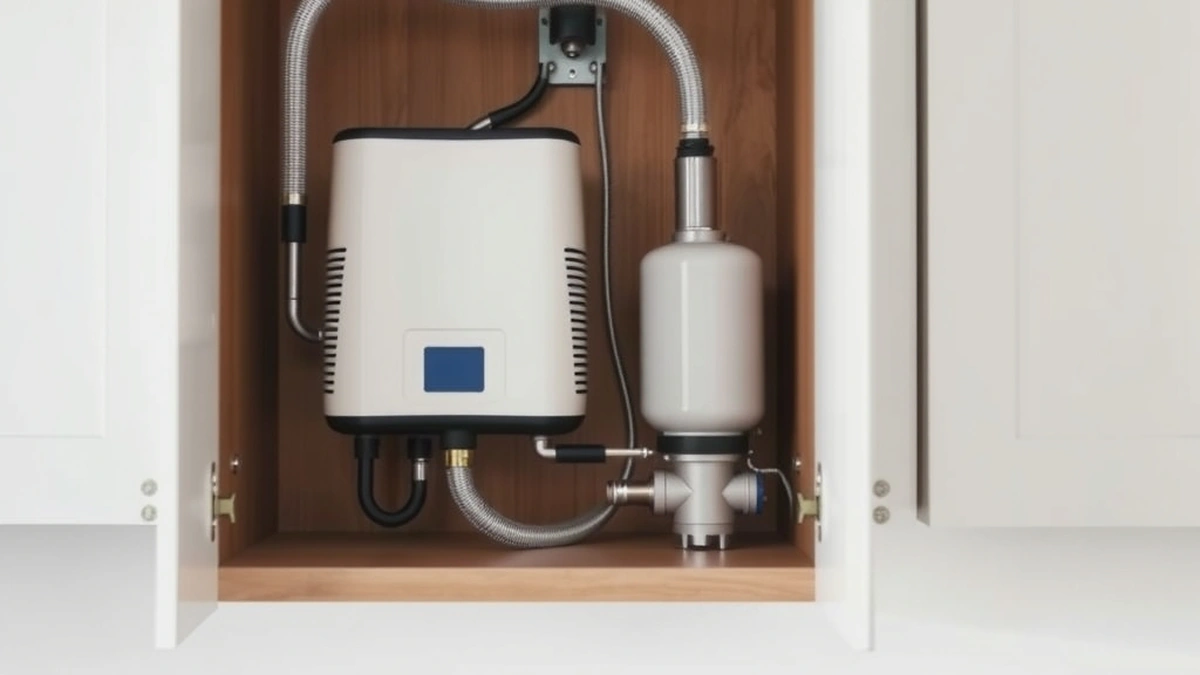
Choose a tankless reverse osmosis unit by daily gallons and outlet access, then by pump quality. Units cost $200-$600, deliver 0.4-0.8 GPM on demand, and need a grounded 120V receptacle in the cabinet.
- Equipment
- $200 - $600
- Output
- 0.4 - 0.8 GPM
- Power
- 120V outlet
- Annual filters
- $60 - $150
- Waste ratio
- 3-4:1
Some links on this page are affiliate links.If you buy through them we may earn a commission at no extra cost to you. We do not accept payment for rankings. Read the full disclosure.
Choose a tankless reverse osmosis unit by daily gallons and outlet access, then by pump quality. Units cost $200-$600 and deliver 0.4-0.8 GPM on demand. The pump is the part that distinguishes a good unit from a cheap one, and the outlet is the part people forget to check.
Start with the cabinet
A tankless unit hangs on the cabinet wall and needs 14-20 inches of height plus 8 inches below for filter changes. Measure before comparing models.
The outlet is the gating item. Most kitchens have no receptacle inside the sink base, and adding one costs $150-$350. A unit that needs an electrician is a $500 purchase, not a $300 one.
If there is no outlet and no budget for one, a tanked system is the correct choice. It runs on line pressure and produces water without electricity.
Output and recovery
| Rated output | Time per glass | Time per pitcher | Household fit |
|---|---|---|---|
| 0.4 GPM | 25 - 30 sec | 2 - 3 min | One or two people |
| 0.6 GPM | 15 - 20 sec | 1.5 - 2 min | Family of three |
| 0.8 GPM | 12 - 15 sec | 1 - 1.5 min | Family of four |
A tanked unit delivers the first glass instantly because water is already stored. A tankless unit delivers at a steady rate with no tank to run dry.
For a household that fills pots and pitchers, the steady rate is better. For someone who wants one cold glass immediately, the tank still feels faster.
Pump quality
The pump is the wear item. A diaphragm pump from a known manufacturer lasts years; a generic pump may fail in months and is often not sold separately.
Ask whether the pump is replaceable and what it costs. A $60-$120 replacement part turns a five-year appliance into a ten-year one.
Listen for noise in reviews. A pump that is loud at installation gets louder as it wears, and a kitchen cabinet amplifies it.
Filtration stages
Most tankless units carry a sediment stage, one or two carbon stages, the membrane, and sometimes a post-carbon polisher. The stage count matters less than the media volume in each stage.
A unit with a real 10-inch sediment cartridge is easier and cheaper to maintain than one with a proprietary capsule. Standard cartridges cost $10-$30; proprietary ones cost $40-$80.
Check that replacement filters are stocked locally and priced sanely. A $250 unit with $90 cartridges is a more expensive five-year purchase than a $400 unit with $25 cartridges.
Installation requirements
Besides the outlet, a tankless unit needs a feed valve on the cold supply and a drain connection for concentrate. The drain is usually a saddle on the trap, and it must slope continuously.
A faucet is required unless the unit feeds an existing dedicated tap. If the sink has a fourth hole, use it; otherwise drilling stone adds $95-$250.
The unit also needs to be primed before first use. Running a pump dry damages the diaphragm, and that is the most common installation mistake on these systems.
The details that separate models
Two units at the same price can differ in ways that matter more than the spec sheet. Check these before you commit.
Filter housing standard. A unit that takes 10-inch cartridges costs $10-$30 per change; a proprietary capsule costs $40-$80. Over three years the difference is $200-$400, which is more than the price gap between models.
Drain saddle quality. A cheap saddle with a thin gasket weeps within a year. A metal saddle with a rubber sleeve costs $8 more and does not.
Controller behavior. A good controller shuts the pump off within a second of the faucet closing. A poor one runs on for several seconds, sending water to drain and cycling the pump unnecessarily.
Tubing type. Push-fit tubing is fine, but it must be fully seated. Some units ship with pre-assembled lines, which removes the most common installation error.
Warranty terms. A one-year warranty that covers the pump is worth more than a five-year warranty that covers only the housing. Read what is excluded, and check whether the warranty requires a registered installer. A self-installed unit with a void warranty is a $300 bet on a $300 appliance.
A buying sequence
- Measure cabinet height, width, and depth.
- Confirm a grounded outlet exists within six feet.
- Estimate daily drinking gallons and pick an output rate.
- Check whether the pump is replaceable and what it costs.
- Compare cartridge prices and local availability.
- Confirm drain access and faucet provisions.
What to ignore
Ignore “unlimited” output claims. Every unit has a rated flow and a duty cycle, and a 0.4 GPM unit is 0.4 GPM no matter how the box describes it.
Ignore stage counts without media volume. Three tiny stages are not better than two real ones.
Ignore a unit with no listed replacement pump. When the pump fails, the whole appliance becomes landfill, and a $60 part becomes a $400 replacement.
Ignore output figures quoted only in gallons per day. A 600 GPD rating on a unit that produces 0.4 GPM is a statement about continuous running, not about how fast your glass fills. Tankless reverse osmosis installation covers the outlet and drain work, tankless versus tank RO compares the two formats directly, and tankless reverse osmosis cost covers the annual consumable bill. “”
Frequently asked questions
How much does a tankless RO cost?
Two hundred to six hundred dollars for the unit, or three hundred to nine hundred installed including a faucet and drain connection. An electrician for a cabinet outlet adds $150-$350.
How fast does a tankless RO produce water?
Most residential units deliver 0.4-0.8 gallons per minute on demand. That fills a glass in 15-30 seconds and a pitcher in about a minute.
Do I need an outlet for a tankless RO?
Yes. The booster pump and controller need a grounded 120V receptacle within cord reach, usually six feet. Without one, a tanked unit is the simpler choice.
Is tankless RO louder than tanked?
Yes, slightly. The pump runs whenever water is drawn, which produces a soft hum. Tanked units are silent because they store water under pressure.
How long do the filters last?
Sediment every 3-6 months, carbon every 6-12 months, and the membrane every 2-3 years. Annual consumable cost is $60-$150.
Can I add a storage tank to a tankless RO?
Some models support an optional tank, which improves first-glass delivery. Check the accessory list before buying, because not all units are designed for it.
Sources
Some links are affiliate links.If you buy through them we may earn a commission at no extra cost to you. We do not accept payment for rankings. Read the full disclosure.