
tankless reverse osmosis installation: what it involves
Tankless RO installs in 1-2 hours and costs $300-$900. See the outlet requirement, drain saddle, pump priming, and why it needs no storage tank.
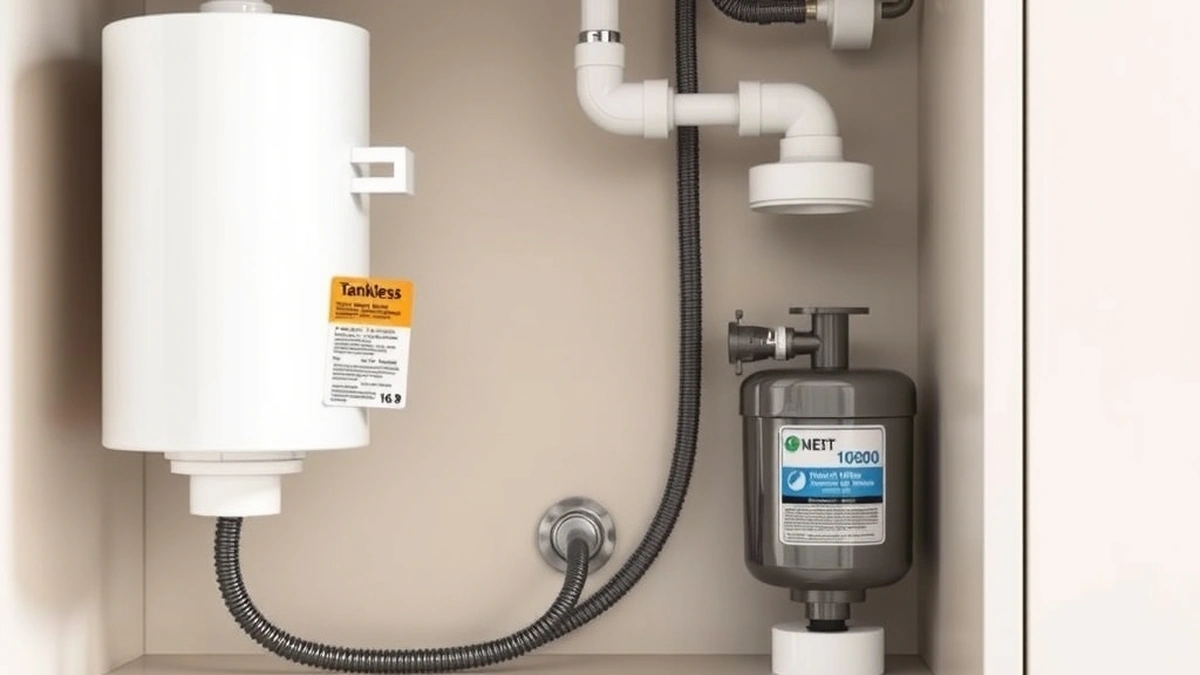
Tankless reverse osmosis installation takes 1-2 hours and costs $300-$900 installed. It needs the same supply and drain connections as a tanked unit plus a 120V outlet for the pump, and it saves the storage tank connection.
- Installed cost
- $300 - $900
- Install time
- 1 - 2 hours
- Power
- 120V outlet
- Drain
- Required
- Output
- 0.4 - 0.8 GPM
Some links on this page are affiliate links.If you buy through them we may earn a commission at no extra cost to you. We do not accept payment for rankings. Read the full disclosure.
Tankless reverse osmosis installation takes 1-2 hours and costs $300-$900 installed. It uses the same supply and drain connections as a tanked unit, adds a 120V outlet for the pump, and skips the storage tank entirely. The plumbing is familiar; the electrical requirement is the new part.
What changes without a tank
A tankless reverse osmosis system is a point-of-use unit that produces permeate on demand and sends it straight to the faucet. A pump and controller ramp production when flow is sensed, and the system idles when the tap closes.
Removing the tank removes one connection and about 12-18 inches of cabinet height. It also removes the pressure drop you feel when a tank empties, because there is no stored volume to run out of.
What it adds is a pump that needs power and a controller that needs a pressure switch. Those two parts are why the install has an electrical step.
The connections, and what is different
| Connection | Tanked RO | Tankless RO |
|---|---|---|
| Cold supply | Yes | Yes |
| Drain saddle | Yes | Yes |
| Faucet | Yes | Yes |
| Storage tank | Yes | No |
| Power outlet | No | Yes, 120V |
| Pump priming | No | Yes |
Three connections stay, one goes away, and two appear. The net is a job that takes about the same time but has a different failure point: a pump that air-locks if it is not primed.
Priming the pump
A dry-run pump is the most common installation mistake on these units. Before the first production cycle, the system has to be filled and the air bled.
Most units handle this automatically through a purge cycle, but some require a manual step: open the tank or faucet valve, let water flow until it stops sputtering, then power the unit. Read the manual’s commissioning section, because the procedure varies.
If the pump runs dry for more than a minute, the diaphragm can be damaged. That turns a $300 install into a $450 one with a replacement pump.
The outlet problem
Cabinet outlets are not standard. Many kitchens have one above the counter and none below, and a tankless unit needs a grounded receptacle within cord reach, usually 6 feet.
Adding an outlet costs $150-$350 with an electrician, plus patching if the wall is finished. That line item is routinely left out of the budget because the product listing says “plug in and go.”
Do not use an extension cord on a permanent install. A pump drawing 1-2 amps on a 16-gauge cord is a fire risk behind a cabinet, and it voids most warranties.
If there is no outlet and no budget for one, a tanked unit is the correct choice. It needs no power and produces water at line pressure.
Installation sequence
- Confirm the cold shutoff works and that a drain trap is within reach.
- Mount the bracket at a height that leaves room for filter changes below.
- Fit the feed valve and connect the supply line to the manifold inlet.
- Drill the 7/8-inch drain hole, clamp the saddle, and run the line with a continuous slope.
- Mount the faucet and connect its tube to the outlet.
- Plug in the unit, open the feed valve, and run the purge cycle until flow is steady.
- Flush 2-5 minutes and discard the first batch of water.
Cost and output
Equipment runs $200-$600, the same band as tanked units. Labor at $95-$175 per hour for 1-2 hours is $95-$350. Fittings and a faucet add $45-$120.
Low end: $200 + $95 + $45 = $340. High end: $600 + $350 + $120 = $1,070. The published $300-$900 band covers the middle, and an electrician visit pushes a job toward the top.
Output is 0.4-0.8 GPM on most residential units, which fills a glass in 15-30 seconds and a pitcher in about a minute. That is slower than a tank’s first pour and faster than waiting for a tank to refill.
Tankless versus tanked, on install effort
A tanked unit needs no power and one more connection. A tankless unit needs power and one fewer connection. For a cabinet with an outlet, tankless is the easier install; without one, tanked wins.
Space is the other factor. A tanked system needs 12-18 inches of vertical clearance for the tank plus room for the manifold. A tankless unit hangs flat against the cabinet wall, which matters in a shallow sink base.
If you are still choosing, tankless versus tank RO compares recovery, noise, and footprint. For the full cost picture including filters, tankless reverse osmosis cost breaks out the annual spend, and reverse osmosis system installation covers the tanked version step by step.
Cabinet conditions that change the job
Four conditions decide whether this is a one-hour install or a three-hour one. The first is the shutoff valve. A quarter-turn valve that closes cleanly is a 5-minute connection; a seized gate valve will not close at all, and replacing it adds $150-$350.
The second is the drain. A plastic trap with a straight run above the P-trap is ideal. A cast iron trap or a trap packed against the cabinet back makes the saddle awkward, and a saddle that cannot seal will drip into the cabinet every time the unit produces.
The third is cabinet height. A tankless unit needs 14-20 inches of wall, plus 8 inches below for filter removal. A deep sink base with a drawer above is the common conflict.
The fourth is the faucet hole. If the sink has a fourth hole with a soap dispenser, swap the dispenser for the RO faucet and save the drilling. If not, a stone counter needs a diamond bit and patience, or a $95-$250 charge from a fabricator.
Frequently asked questions
Does a tankless RO need electricity?
Yes. The booster pump and controller need a grounded 120V outlet, which is the main installation difference from a tanked unit. Without an outlet, add $150-$350 for an electrician.
How long does tankless RO installation take?
One to two hours on a standard cabinet with a working shutoff and a drain trap. Adding an outlet or drilling a faucet hole pushes it longer.
Does tankless RO need a drain line?
Yes. The concentrate stream discharges at a 3-4:1 ratio, so a saddle on the trap or a routed line to a standpipe is required. There is no tank to buffer, so the drain runs whenever the unit is producing.
Can I add a tank to a tankless RO later?
Some models support an optional tank, which improves first-glass delivery but adds a connection. Check the manufacturer's accessory list before assuming it is possible.
Why does my tankless RO run every time I open the tap?
That is normal. The unit produces on demand and shuts off when flow stops. If it cycles with the tap closed, the pressure switch or a check valve is faulty.
Is tankless RO harder to install than tanked?
Slightly. You skip the tank connection but add an electrical requirement and a pump priming step. The plumbing work is otherwise identical.
Sources
Some links are affiliate links.If you buy through them we may earn a commission at no extra cost to you. We do not accept payment for rankings. Read the full disclosure.


