How to choose a whole house reverse osmosis
Choose whole-house RO by daily gallons, pretreatment needs, and storage. See when a $3,000-$8,000 system beats a $300-$900 sink unit.
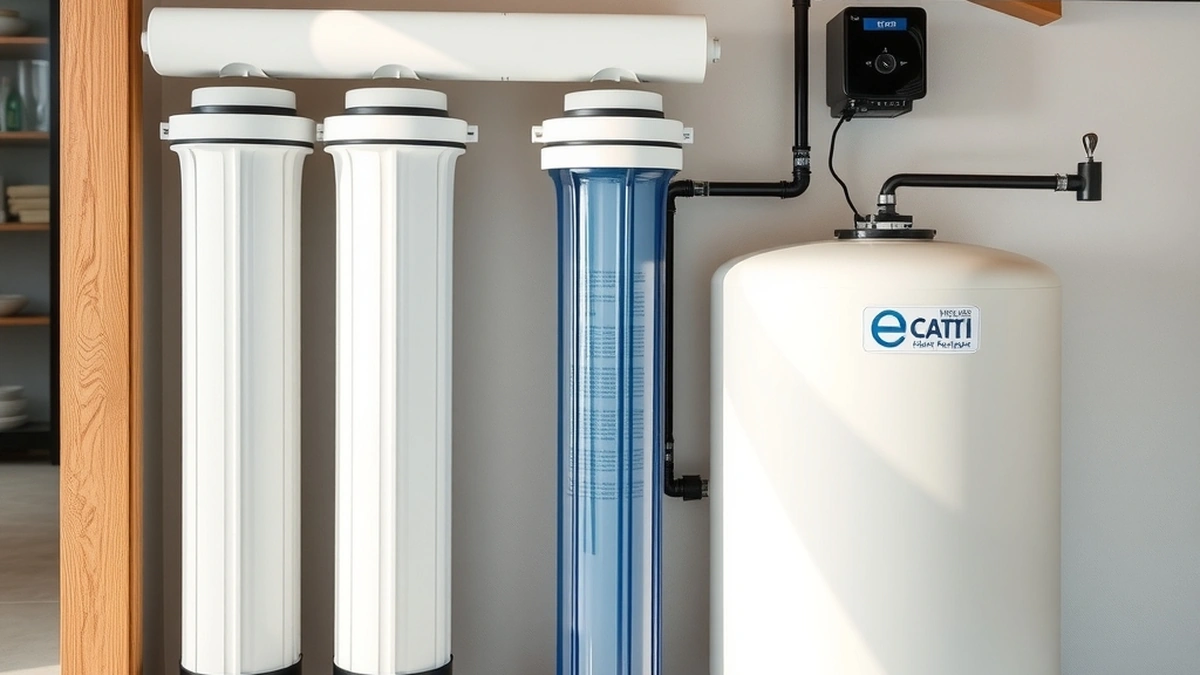
Choose whole house reverse osmosis only when a contaminant affects every tap and point-of-use treatment cannot reach it. Systems cost $3,000-$8,000 installed and need pretreatment, storage, a repressurization pump, and a drain.
- Installed cost
- $3,000 - $8,000
- Daily output
- 100 - 600 GPD
- Storage tank
- 20 - 80 gallons
- Pretreatment
- Sediment and carbon
- Waste ratio
- 3-4:1
Some links on this page are affiliate links.If you buy through them we may earn a commission at no extra cost to you. We do not accept payment for rankings. Read the full disclosure.
Choose whole house reverse osmosis only when a contaminant affects every tap and point-of-use treatment cannot reach it. Nitrate, arsenic, and high total dissolved solids qualify. Taste and hardness do not. Systems run $3,000-$8,000 installed and need pretreatment, storage, a pump, and a drain.
Start with the contaminant, not the technology
A whole house reverse osmosis system forces every gallon through a membrane, rejecting 80-95 percent of dissolved solids. That is a powerful capability and an expensive way to solve a small problem.
If the concern is chlorine taste, a $500-$1,800 carbon filter at the entry point solves it for a fraction of the cost. If the concern is hardness, a $1,200-$4,500 softener is the correct device.
If the concern is nitrate at 14 mg/L, arsenic, or TDS above 1,000 ppm from a brackish well, whole-house RO is one of the few tools that works at every tap.
A fourth case exists and is often overlooked: a building with lead service lines or old galvanized plumbing that sheds metal into every fixture. Whole-house RO removes most dissolved lead, but so does a point-of-use unit at the kitchen tap, and at a fraction of the cost. The distinguishing question is always whether the water is a problem in the shower as well as in the glass.
Ask what happens to the concentrate before you fall in love with the permeate. A system that solves the drinking water problem but doubles the household’s water bill is a trade, and it should be a chosen one.
A cost comparison that settles most cases
| Approach | Installed cost | Annual cost | Covers |
|---|---|---|---|
| Carbon filter | $500 - $1,800 | $80 - $300 | Taste, chlorine |
| Softener | $1,200 - $4,500 | $120 - $400 | Hardness |
| Under-sink RO | $300 - $900 | $60 - $150 | One tap |
| Whole house RO | $3,000 - $8,000 | $300 - $700 | Every tap |
A household with one contaminant at the kitchen tap is usually better served by the under-sink unit at $300-$900. The whole-house system becomes rational when showers, laundry, and the water heater all need treated water.
Run the ten-year arithmetic before choosing. A whole-house system at $5,000 installed with $450 per year in consumables and $700 per year in concentrate costs $5,000 + $4,500 + $7,000 = $16,500 over a decade. An under-sink unit at $600 with $100 per year in filters costs $600 + $1,000 = $1,600. The gap is $14,900, and it buys treated shower water.
Pretreatment is not optional
Chlorine destroys thin-film composite membranes. Hardness scales them. Iron fouls them permanently. Sediment blinds the feed spacer.
That means a carbon stage is mandatory on municipal water, and a softener is mandatory above 7 grains per gallon. Iron above 2-3 ppm needs oxidation and filtration ahead of the membrane.
Those upstream devices add $500-$4,500 to the project. A quote of $4,000 for a whole-house RO that assumes perfect feed water is not the whole project cost.
Ask for the feed water specification the warranty requires. Most membrane warranties are voided by chlorine exposure above a stated limit, and a carbon stage that is changed late is the usual cause. A $60 carbon cartridge protects a $200-$600 membrane, and the arithmetic is not close.
If the water carries iron, treat it before the membrane. Iron fouling is irreversible, and no cleaning chemical restores a fouled element. That is a $400 mistake that repeats every year if the upstream filter is undersized.
Sizing by daily gallons
Membrane capacity is rated in gallons per day. A household using 150 gallons per day needs a system rated above that, with headroom for cold water and lower pressure.
Cold water cuts output. At 50°F, a membrane produces roughly half its 77°F rating, which is why winter production is the number that matters in northern states.
Storage buffers the gap between slow production and fast demand. A 150 gallon per day household needs 80 gallons of storage plus a reserve, or the repressurization pump runs dry during a shower and a laundry cycle.
Size the repressurization pump to fixture demand, not to membrane output. A pump that delivers 5 GPM cannot feed two showers and a dishwasher, and the symptom is a pressure drop that looks like a plumbing problem.
A pressure switch with a 20 psi differential keeps the pump from short-cycling. Without it, the pump starts and stops every time a glass is filled, and the motor wears out years early.
Drain and operating cost
At a 3-4:1 waste ratio, 150 gallons of permeate sends 450-600 gallons to the drain. Over a month that is 13,500-18,000 gallons of concentrate.
On metered water at $0.005 per gallon combined water and sewer, that is $68-$90 per month, or $800-$1,080 per year just for the concentrate. That figure belongs in the decision.
On a septic system, the extra volume matters too. A 1,000-gallon tank receiving another 500 gallons per day is being asked to handle a third more flow, and the designer should be consulted.
Space, power, and service access
A whole-house RO skid needs a level pad, a drain, and 40 inches of clear space in front of the membrane housings for element removal.
The booster pump and repressurization pump each need a circuit. Together they draw 1-2 kW during operation, and both run frequently.
Noise and heat are real in a finished basement. An insulated mechanical closet costs $300-$800 during a build and considerably more afterward.
A buying sequence
- Test for the specific contaminant and confirm it affects every tap.
- Compare the cost against point-of-use treatment for that contaminant.
- Confirm pretreatment needs: carbon, softener, iron filter.
- Size the membrane for winter output and the storage for daily demand.
- Verify drain capacity and the cost of concentrate disposal.
- Confirm service clearance for membrane changes.
What to ignore
Ignore a system sold without pretreatment. A membrane without carbon ahead of it on chlorinated water is a warranty claim waiting to happen.
Ignore gallon-per-day ratings quoted without pressure and temperature conditions. The number moves by half with cold water.
Ignore “zero waste” claims. Every RO system produces concentrate; the ratio is what varies. Whole house reverse osmosis cost covers the price bands, whole house reverse osmosis installation covers the physical requirements, and whole house reverse osmosis maintenance covers the annual pretreater schedule. “”
Frequently asked questions
Is whole house reverse osmosis worth it?
Only when a specific contaminant such as nitrate, arsenic, or high TDS affects every tap. For taste or hardness, a carbon filter or softener costs far less and does the job.
How much does a whole house RO system cost?
Three thousand to eight thousand dollars installed, plus pretreatment if hardness or iron is present. Storage tank and repressurization pump account for much of the price.
How much water does whole house RO waste?
At a 3-4:1 ratio, producing 150 gallons per day sends 450-600 gallons to the drain, or about 13,500-18,000 gallons per month.
Do I need a softener before whole house RO?
Yes if hardness is above 7 grains per gallon. Hardness scales the membrane, and a softener ahead of it extends membrane life from months to years.
How big should the storage tank be?
At least one day of household demand plus a reserve. A home using 150 gallons per day needs 80 gallons of storage to avoid running dry during peak use.
Can whole house RO run on a well?
Yes, but the well must supply both the feed water and the concentrate discharge. Low-yield wells often need additional storage and a booster pump.
Sources
Some links are affiliate links.If you buy through them we may earn a commission at no extra cost to you. We do not accept payment for rankings. Read the full disclosure.