How to test for PFAS in water
Why PFAS needs a laboratory panel, how to collect a sample, and how to read results reported in parts per trillion.
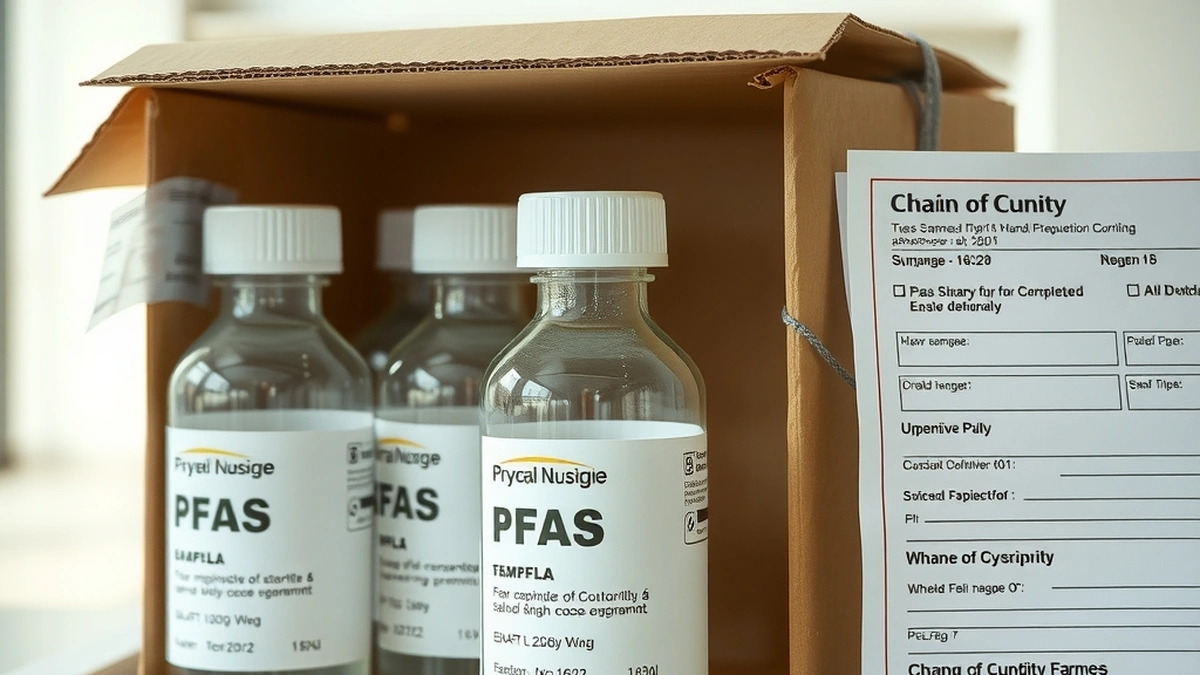
PFAS testing requires a laboratory panel, not a strip, because results are reported in parts per trillion. Use a certified lab, follow its sampling instructions exactly, and test treated water separately to confirm the filter works.
- Test type
- Laboratory panel
- Reporting unit
- Parts per trillion
- Field strips
- Not suitable
- Retest interval
- Annually or after treatment
- General lab panel
- $40 - $150
Some links on this page are affiliate links.If you buy through them we may earn a commission at no extra cost to you. We do not accept payment for rankings. Read the full disclosure.
PFAS testing requires a laboratory panel because the compounds are detected at parts per trillion. Field strips cannot see at that level, and a general water panel does not include the analysis. Use a certified lab, follow its sampling instructions exactly, and test the treated water separately.
Why strips cannot do this
One part per trillion is roughly one drop in an Olympic-size swimming pool. Detecting at that concentration requires chromatography and mass spectrometry in a laboratory.
Strips and handheld meters read colour changes at concentrations thousands of times higher. They cannot report PFAS, and a product claiming to do so is not measuring the compounds.
A general water test at $40 to $150 covers hardness, iron, nitrate, and bacteria. PFAS is a specialty panel ordered separately, and the two are usually ordered together so the treatment design has both sets of numbers.
Ordering the right panel
Ask the laboratory three questions before ordering.
Which compounds are included? A panel that reports a handful of PFAS is not the same as one covering a longer list.
What is the reporting limit? The lab should state the lowest concentration it can reliably report for each compound.
Is the lab certified for the method in your state? Certification matters if the result will be used for a health department inquiry or a property transaction.
Costs vary with the compound list, so ask for a quote rather than assuming the general test price applies. A broader panel costs more, but it is the only way to know which compounds are present.
Sampling without contaminating the sample
PFAS is used in everyday products, including some waterproof clothing, food packaging, and personal care items. Cross-contamination is a real risk.
- Use only the containers supplied by the laboratory.
- Do not rinse the containers.
- Wash your hands and avoid lotions, sunscreen, or waterproof jackets while sampling.
- Run the tap for two minutes, then fill without touching the inside of the cap.
- Cap immediately and label the sample with the date and location.
- Keep the sample cool and ship it within the lab’s holding time.
A sample taken with the wrong container or held too long can produce a false result in either direction.
Reading the results
Results are reported per compound in nanograms per litre, which is equivalent to parts per trillion.
A report may list a dozen compounds with individual values and a total. The total is useful for context, but the individual values matter for treatment selection.
Some compounds are more adsorbable than others. A result dominated by short-chain compounds points toward anion exchange or reverse osmosis rather than standard carbon.
Testing treated water
A raw-water test establishes the problem. A treated-water test establishes whether the treatment works.
Sample the treated water at the tap after the system, using the same laboratory method. A reduction from the raw value is the evidence that the media or membrane is doing its job.
For a whole-house system, sample after the tank. For an under-sink RO unit, sample from the dedicated faucet.
When to retest
Retest annually, and after any of these events.
A change in the water source or a utility notice. A filter or membrane replacement. A new well or a pump change. A move into a new home. A report of contamination in the area.
Routine retesting is the only way to know when media has exhausted, because PFAS breakthrough is invisible.
What to do with a positive result
Do not panic and do not buy equipment on the same day. Get the compound list and the concentrations first.
Then choose treatment based on the compounds. The table below is a starting point, not a specification.
| Result pattern | Likely treatment | Notes |
|---|---|---|
| Longer-chain compounds dominate | Granular activated carbon | Media exhausts and needs replacement |
| Short-chain compounds dominate | Anion exchange | Carbon alone may not reduce enough |
| Mixed compounds at low levels | Under-sink reverse osmosis | Treats drinking water at one tap |
| High total across the panel | Whole-house system plus point-of-use | Design by a specialist |
Retest the treated water before assuming the job is done. A system that reduces the total by half may still leave the compounds of concern above the target.
If the home is on municipal water, the utility’s annual report and its PFAS testing results are public. Check them before paying for a private test.
If the utility reports detections, it may already be planning treatment. A household filter can still be worthwhile for drinking water in the interim.
A PFAS panel costs more than the $40 to $150 general test because the analysis is specialised. Ask the lab for the price of the specific compound list rather than a range.
Treatment costs are separate: a carbon filter at $500 to $1,800 installed, or an under-sink RO at $300 to $900.
For the treatment comparison, see pfas in water treatment and pfas in water. For the general panel, water testing cost covers the standard tests, and water test kit cost covers the retail options.
Bottom line
PFAS testing is a laboratory job reported in parts per trillion. Order the right compound list, sample without contaminating the bottle, and test the treated water to prove the system works. No strip can do this.
Frequently asked questions
Can I test for PFAS with a home kit?
No. PFAS is detected at parts per trillion, which requires laboratory equipment and a method designed for the compound list.
How do I collect a PFAS sample?
Use the lab's supplied containers, avoid contact with clothing and sunscreen, and return the sample within the holding time stated.
What do parts per trillion mean?
One part per trillion is roughly one drop in an Olympic-size swimming pool, so results are reported at extremely low concentrations.
How much does a PFAS test cost?
PFAS panels are specialty tests and cost more than a general water panel at $40 to $150; ask the lab for a quote for the compound list.
Should I test before or after treatment?
Test both. The raw sample establishes the problem, and the treated sample confirms the system is reducing the compounds it was installed for.
How often should PFAS be retested?
Retest annually, and whenever the water source changes, a filter is replaced, or a utility reports a change in its supply.
Sources
Some links are affiliate links.If you buy through them we may earn a commission at no extra cost to you. We do not accept payment for rankings. Read the full disclosure.