What a Water Test Kit Costs: Strips, Drops, and Labs
Test kits run $10 - $150 depending on method, and a lab panel costs $40 - $150. See what each price buys and which tests you can skip.
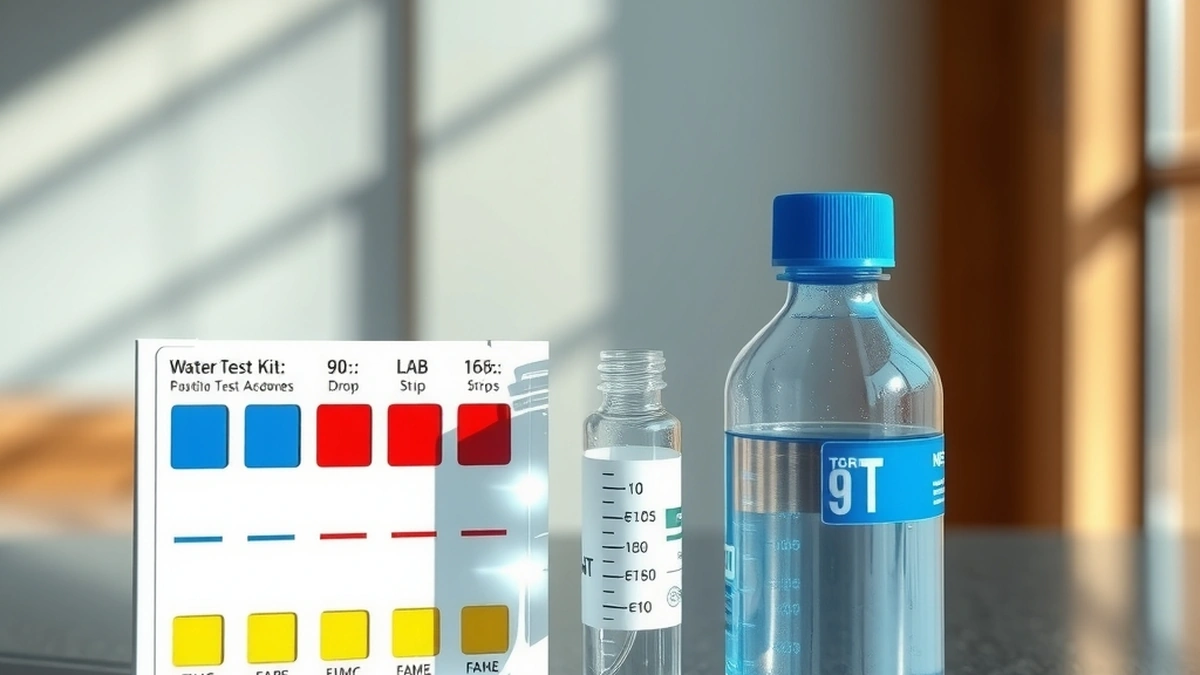
A water test kit costs $10 - $25 for strips, $20 - $60 for a drop kit, $50 - $150 for a photometer, and $40 - $150 for a lab panel. The lab panel covers the most parameters and is the one to buy before choosing treatment.
- Strips
- $10 - $25
- Drop kit
- $20 - $60
- Photometer
- $50 - $150
- Lab panel
- $40 - $150
- Full suite
- $150 - $400
Some links on this page are affiliate links.If you buy through them we may earn a commission at no extra cost to you. We do not accept payment for rankings. Read the full disclosure.
A water test kit costs $10 - $25 for strips, $20 - $60 for a drop kit, $50 - $150 for a photometer, and $40 - $150 for a lab panel. The lab panel covers the most parameters and is the one to buy before choosing any treatment equipment.
Strips
Strips cost $10 - $25 for 25 - 100 tests. They read in under a minute and require no reagents or glassware.
Accuracy is roughly plus or minus 1 - 2 GPG for hardness. That is enough to answer “soft or hard” and not enough to size a softener precisely.
Strips degrade with humidity and expire. A tube left open in a bathroom for a year gives readings that drift, which is worse than no reading.
Drop Kits
A drop titration kit costs $20 - $60 and covers 50 - 100 tests. The reagent is added drop by drop until the color changes, and the number of drops gives the result.
Accuracy is about 1 GPG, and the method is repeatable. For a household tracking a softener monthly, it is the best value in the category.
Kits have expiration dates and some reagents need refrigeration. Check before buying a large kit.
Photometers
A digital photometer costs $50 - $150 and reads the color change with a light sensor. It removes the subjectivity of matching a shade to a chart.
Accuracy is about 0.5 - 1 GPG, and the meter can test several parameters with different reagents.
Reagents are sold separately, in packs of 25 - 100, at $10 - $40. The ongoing cost is higher than strips and lower than a lab.
Lab Panels
A lab panel costs $40 - $150 and covers hardness, iron, manganese, nitrate, arsenic, lead, bacteria, and pH, depending on the package.
The lab supplies the bottle and the holding time. The result is defensible and precise, and it is what a treatment dealer will ask for.
A full suite with PFAS, radon, or uranium can cost $150 - $400. Most households do not need every test every year.
Cost by Test
| Test | Home kit | Lab |
|---|---|---|
| Hardness | $10 - $60 | $15 - $40 |
| Iron | $15 - $60 | $20 - $50 |
| Nitrate | $15 - $40 | $20 - $50 |
| Bacteria | Not reliable | $20 - $50 |
| Arsenic | Not reliable | $40 - $100 |
| Lead | Not reliable | $30 - $100 |
| PFAS | Not available | $200 - $500 |
| Full panel | Not applicable | $40 - $150 |
The pattern is clear: cheap tests are available for parameters that are easy to measure, and the important safety parameters need a lab.
Ten-Year Testing Budget
A household on a private well testing bacteria and nitrate annually at $60 a year spends $600 over ten years.
Adding a full panel every three years at $120 each adds $400, for $1,000 total.
A household on municipal water testing hardness once a year at $25 spends $250 over ten years, plus a full panel at $120 every five years.
What the Money Buys
The point of testing is to avoid buying the wrong equipment. A $40 - $150 panel compared with a $1,200 - $4,500 softener is the cheapest part of the project.
It also catches problems that have no visible symptom, such as nitrate above 10 mg/L or arsenic above 0.010 mg/L.
Skipping the panel to save $100 is the most expensive economy in water treatment.
Steps to Build a Testing Plan
- Test the raw water before any treatment.
- Order bacteria and nitrate annually on a private well.
- Add metals every three to five years.
- Keep a log of results with dates.
- Retest after any treatment installation.
- Retest after well work or a change in taste.
Buy strips for monthly monitoring and a lab panel for the annual baseline. That combination costs less than a photometer and covers both needs.
Bundle tests at one lab. A panel with bacteria, nitrate, and metals usually costs less than the same tests ordered separately.
Skip PFAS unless the well is near a known source. It is the most expensive single test and the least likely to be needed.
Do not skip bacteria testing on a private well. It is $20 - $50 and it is the only way to know whether the well is compromised.
Do not use strips for nitrate, arsenic, or lead. The resolution is inadequate and the result can be misleading.
Do not test only once. A single result is a snapshot, and water changes with seasons and land use.
That combination costs less than a photometer and covers both needs, and bundling several tests at one lab usually costs less than ordering them separately. Skip PFAS unless the well is near a known source, since it is the most expensive single test and the least likely to be needed.
Do not skip bacteria testing on a private well. At $20 - $50 it is the only way to know whether the well is compromised, and it is the cheapest test with the highest consequence. Do not use strips for nitrate, arsenic, or lead, because the resolution is inadequate and a misleading result is worse than no result.
One last economy: keep the reports rather than the kits. A ten-year file of lab results costs nothing to store and is worth more at resale than any meter, because it shows a history rather than a single afternoon’s reading.
For the kit comparison, see hard water test kit and best water test kit. For the lab schedule, see water testing cost and water tests for wells.
Frequently asked questions
How much does a water test cost?
A lab panel runs $40-$150 for a basic suite. Home kits cost $10-$150 depending on the method, and a full contaminant suite can reach $400.
Are cheap test strips accurate enough?
Strips are accurate to roughly plus or minus 1-2 GPG for hardness and are fine for screening. They are not adequate for sizing equipment or for bacteria and metals.
What is the best value test kit?
A drop titration kit at $20-$60 is the best value for repeat home testing. A lab panel at $40-$150 is the best value before buying treatment.
Do I need a lab test before buying a softener?
Yes, if you want the unit sized correctly. Sizing uses hardness plus daily gallons, and iron changes the equipment plan.
How much does a bacteria test cost?
Typically $20-$50 at a certified lab, and often less when bundled with a nitrate or full well panel.
Can I skip the lab and use strips only?
Only if you are screening. Strips cannot detect bacteria, nitrate, arsenic, or lead, and those are the parameters that affect safety.
Sources
Some links are affiliate links.If you buy through them we may earn a commission at no extra cost to you. We do not accept payment for rankings. Read the full disclosure.