
Water Tests for Wells: What to Test and When
Private wells need annual bacteria and nitrate tests plus periodic metals screening. See the full panel, lab costs, and how to take a sample that holds up.
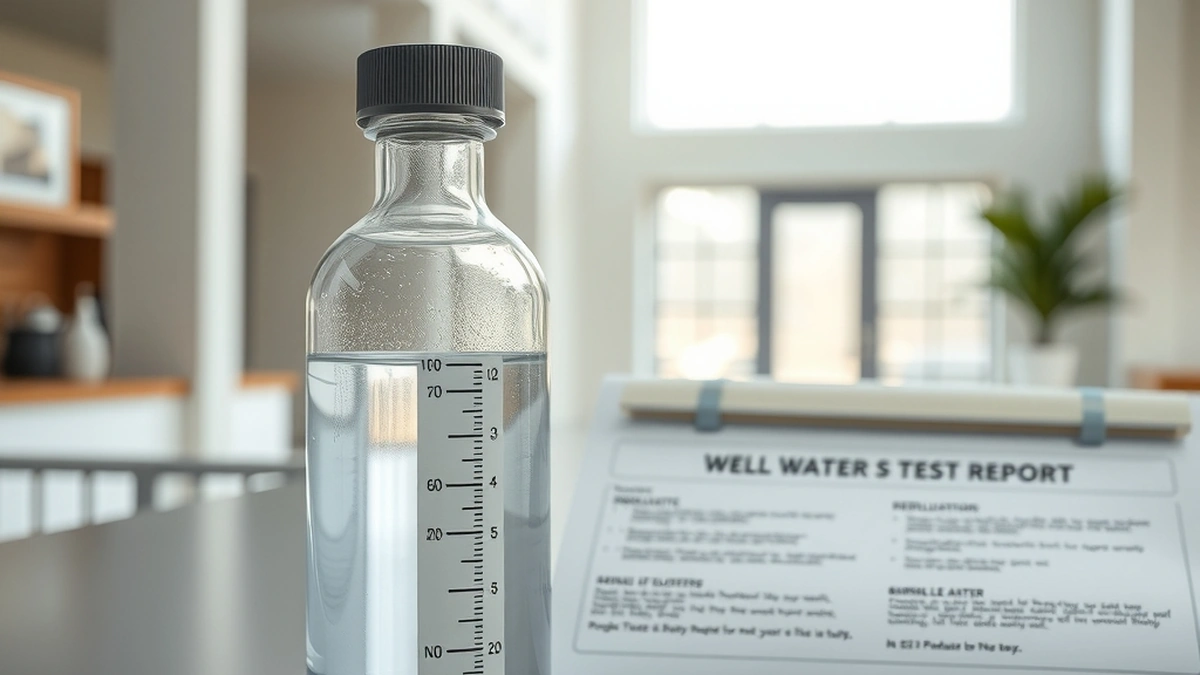
Test well water for bacteria and nitrate every year, and add arsenic, lead, iron, manganese, hardness, and pH at least once. A lab panel costs $40 - $150, and the sample must come from an unfiltered tap after several minutes of running.
- Basic lab panel
- $40 - $150
- How often
- Bacteria and nitrate yearly
- Nitrate limit
- 10 mg/L
- Iron softener limit
- 2 - 3 PPM
- Sample tap
- Unfiltered, after 5 minutes
Some links on this page are affiliate links.If you buy through them we may earn a commission at no extra cost to you. We do not accept payment for rankings. Read the full disclosure.
Water tests for wells fall into two groups: the annual safety screen for bacteria and nitrate, and the periodic chemistry panel that guides treatment. A basic lab panel costs $40 - $150 and covers both if you order the right tests. Sampling technique decides whether the result means anything.
The Annual Safety Screen
Bacteria and nitrate are the two tests that should run every year. Both can change without any noticeable taste or odor, and both are common in agricultural and suburban areas.
The bacteria test looks for total coliform and E. coli. Coliforms are a broad group that includes soil and fecal organisms. A positive total coliform result means surface water or soil may be reaching the well, which points to a casing, cap, or grout problem. E. coli is the more specific indicator and calls for immediate action.
Nitrate is measured in milligrams per liter, and the federal drinking water limit is 10 mg/L. Nitrate comes from fertilizer, septic systems, and animal waste. It moves easily through soil and does not filter out with a standard cartridge. Boiling does not remove it; it concentrates it.
A lab panel that covers both usually runs $40 - $80. The sample must be collected in the lab’s sterile bottle and returned within the holding time, often 24 - 48 hours.
The Chemistry Panel for Treatment
Hardness, iron, manganese, pH, and alkalinity are not safety tests. They are the numbers that decide what equipment to buy.
Hardness tells you whether a softener is justified. The bands are 0 - 3 GPG soft, 3 - 7 moderately hard, 7 - 10 hard, and 10+ very hard. A softener installed runs $1,200 - $4,500.
Iron matters because softener resin tolerates only about 2 - 3 PPM before fouling accelerates. Above that, an iron filter at $800 - $2,500 installed belongs ahead of the softener. Manganese behaves similarly and stains fixtures black.
pH below 6.5 is corrosive to plumbing and calls for a neutralizer. Alkalinity buffers pH and affects how treatment behaves. None of these are health judgments; they are plumbing and equipment facts.
Metals and Emerging Contaminants
Arsenic, lead, uranium, and PFAS do not belong in an annual screen, but they belong in the first full panel and in periodic retests.
Arsenic occurs naturally in some aquifers and has no taste or smell. Lead usually comes from plumbing or a pump component rather than the aquifer, which is why sampling matters. Uranium appears in certain geologic regions. PFAS is a newer concern and needs a specialized lab method, which costs more.
| Test | Frequency | Typical lab cost |
|---|---|---|
| Bacteria | Yearly | $20 - $50 |
| Nitrate | Yearly | $20 - $45 |
| Hardness, iron, pH | Every 3 - 5 years | $40 - $90 |
| Arsenic, lead, uranium | Every 3 - 5 years | $60 - $150 |
| PFAS | Once, then per guidance | $150 - $400 |
A full suite at the top of these ranges runs $300 - $400. Most households do not need every test every year. Start with the basic panel, add metals if the area is known for them, and retest on a schedule.
Taking a Sample That Holds Up
- Get the bottle from the lab first. A rinsed jar from the kitchen will contaminate the sample.
- Bypass any softener, carbon filter, or RO unit, because treated water tells you nothing about the well.
- Run the tap for five minutes to clear water sitting in the plumbing.
- Fill the bottle to the line without touching the inside of the cap or the bottle mouth.
- Chill the sample if the lab requires it and deliver it within the holding time.
- Record the date, tap location, and whether treatment was bypassed.
For a bacteria sample, some labs ask for the aerator removed and a flame-sterilized tap. Follow the lab’s instructions exactly. A careless sample produces a false positive that costs a service call, or a false negative that hides a real problem.
Reading the Report Without Panicking
Lab reports list results against a limit or a range. Read three things: the result, the unit, and the comparison value.
Nitrate at 4 mg/L against a 10 mg/L limit is a pass with room. Nitrate at 12 mg/L is over the limit and points to a treatment decision, usually reverse osmosis at the point of use or a dedicated nitrate-selective system.
Iron at 0.4 PPM is cosmetic. Iron at 6 PPM is a treatment problem that a softener alone will not solve. Hardness at 18 GPG is very hard and justifies softening. pH at 6.2 is corrosive and needs a neutralizer before the water runs through new copper.
Do not treat a single high result as a permanent verdict. Resample to confirm, especially for bacteria, where a bad sample is common. Then treat the confirmed number.
What to Do With the Results
If the well passes the safety tests and the chemistry is mild, do nothing beyond retesting next year. If hardness is high, price a softener. If iron or manganese reads high, price an iron filter first. If nitrate or arsenic is over the limit, price point-of-use RO and consider a whole-house answer for the specific contaminant.
Keep every report in one folder, paper or digital. A treatment dealer will ask for the last one, and a buyer will ask for it at sale. A ten-year history of results is more useful than a single snapshot, because it shows whether anything is moving.
For the treatment side, see how to read a water test report, water testing cost, and best water test kit. If the well is new, drilling a water well covers the completion sequence and the first sample.
Frequently asked questions
How often should well water be tested?
Bacteria and nitrate every year, and a broader panel for arsenic, lead, and other metals every three to five years, or sooner if taste or odor changes.
How much does a well water test cost?
A basic lab panel runs $40-$150. Expanded testing for arsenic, uranium, radon, or PFAS costs more, sometimes $150-$400 for a full suite.
Can I use test strips for well water?
Strips are useful for hardness and pH screening, but they are not adequate for bacteria, nitrate, arsenic, or lead. Those need a certified laboratory.
Where should I take the water sample?
From a kitchen or bathroom tap that has run for several minutes, with any filter or softener bypassed, using the sterile bottle the lab supplies.
What does a coliform result mean?
Coliform bacteria indicate that surface water or soil may be entering the well. A positive result calls for resampling, inspection, and typically shock chlorination.
Is well water testing required by law?
Most states do not require routine testing of private wells, though some require it at sale or for a new well. The responsibility sits with the owner.
Sources
Some links are affiliate links.If you buy through them we may earn a commission at no extra cost to you. We do not accept payment for rankings. Read the full disclosure.


