Hard Water Test Kit: Strips, Drops, and Lab Panels
Compare hardness test kits by accuracy, cost, and what they measure. See which kit answers your question and when to send a sample to a lab.
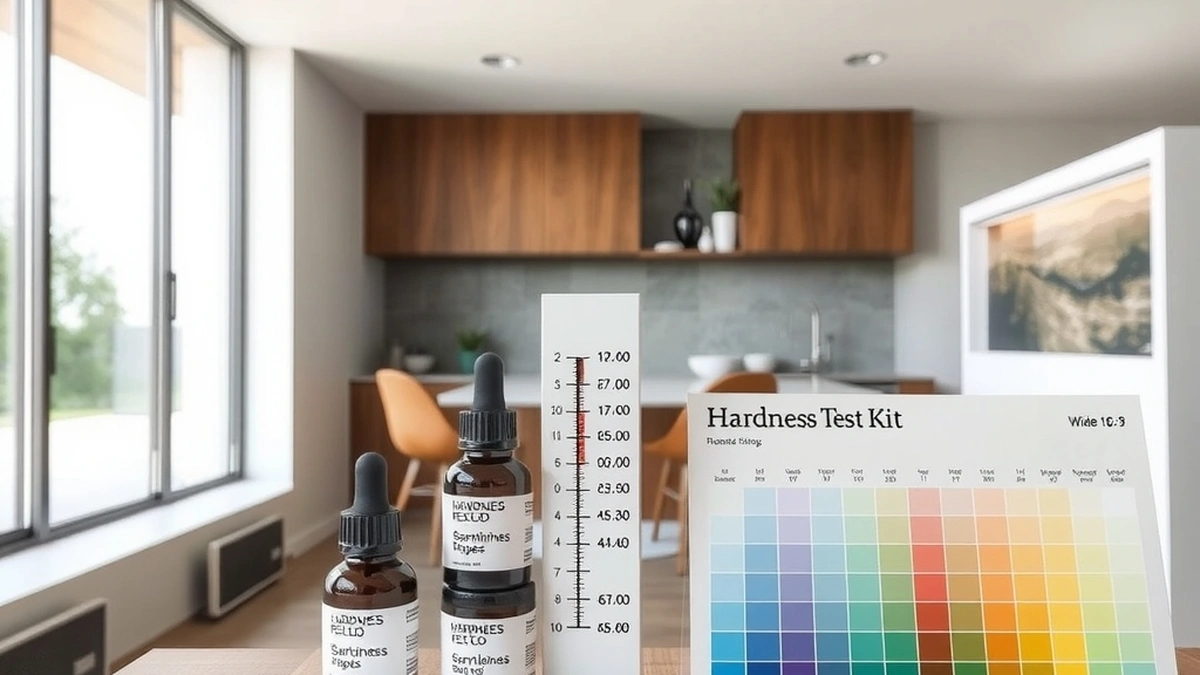
A hard water test kit ranges from $10 strips to a $150 lab panel. Strips and drop kits read grains per gallon at home, while a lab panel also covers iron, nitrate, arsenic, and bacteria, which is what treatment sizing actually needs.
- Strip kit
- $10 - $25
- Drop titration kit
- $20 - $60
- Digital photometer
- $50 - $150
- Lab panel
- $40 - $150
- Accuracy, strips
- Plus or minus 1 - 2 GPG
Some links on this page are affiliate links.If you buy through them we may earn a commission at no extra cost to you. We do not accept payment for rankings. Read the full disclosure.
A hard water test kit measures calcium and magnesium concentration in grains per gallon. Kits range from $10 strips to a $150 lab panel, and the right choice depends on whether you need a rough screen or a number precise enough to size a softener.
The Four Kit Types
Test strips are paper or plastic pads impregnated with a colorimetric reagent. Dip, wait, compare to a chart. They cost $10 - $25 for 25 - 100 strips and read in under a minute.
Drop titration kits use a reagent added drop by drop until the sample changes color. The number of drops gives the hardness. They cost $20 - $60 and are accurate to about 1 GPG.
Digital photometers read the color change with a light sensor instead of your eye. They cost $50 - $150 and remove the subjectivity that makes strips inconsistent.
Lab panels are mail-in or drop-off sample tests run by a certified laboratory. They cost $40 - $150 and cover hardness plus iron, manganese, nitrate, arsenic, lead, bacteria, and pH.
Accuracy and What It Means for Sizing
| Kit type | Cost | Accuracy | Best use |
|---|---|---|---|
| Strips | $10 - $25 | Plus or minus 1 - 2 GPG | Quick screen |
| Drop titration | $20 - $60 | About 1 GPG | Repeatable home testing |
| Photometer | $50 - $150 | About 0.5 - 1 GPG | Frequent monitoring |
| Lab panel | $40 - $150 | Laboratory grade | Sizing and safety |
A 2 GPG error changes the sizing math. A household using 250 gallons a day at 10 GPG carries 2,500 grains daily. At 12 GPG it carries 3,000. Over a week that is 17,500 versus 21,000 grains, which can move the recommendation from a 24,000-grain unit to a 32,000-grain unit.
Strips answer “is this soft, hard, or very hard.” They do not answer “which capacity do I buy.” For a purchase decision in the $1,200 - $4,500 range, the lab panel is the cheaper input.
What the Kit Should Measure Besides Hardness
Hardness alone can mislead. Iron above 2 - 3 PPM exceeds what softener resin handles before fouling, so an iron filter at $800 - $2,500 installed belongs ahead of the softener. Manganese stains fixtures black and behaves similarly.
pH below 6.5 means corrosive water, which needs a neutralizer before it eats copper plumbing. Nitrate above 10 mg/L needs reverse osmosis at the tap. Bacteria need disinfection, not softening.
A kit that reports only hardness leaves those questions unanswered. That is why a $40 - $150 lab panel is the better first purchase for anyone on a private well, and why municipal customers can often start with the utility’s published water quality report.
Using a Kit Correctly
- Collect water in a clean glass from a cold tap, and let it reach room temperature.
- Bypass any softener or filter; raw water is what you want to measure.
- Follow the kit’s timing exactly. Early reads give low results.
- Read the color in natural daylight against a white background.
- Record the result with the date, tap, and whether treatment was bypassed.
- Repeat once to confirm, especially if the reading is near a decision boundary.
For a softener check, sample before and after the unit. The outlet should read near zero. A reading of 3 - 5 GPG at the outlet means the resin is exhausted, the brine draw is failing, or the unit is in bypass.
Testing Frequency
Municipal water changes slowly. Testing hardness once a year is enough unless the utility switches sources or blends supplies. A test after any plumbing change confirms nothing has shifted.
Private wells change with the season, the water table, and nearby construction. Test bacteria and nitrate every year, and hardness with the same annual sample. Retest after heavy rain if the well has a history of turbidity.
A softener owner should test the treated water quarterly. It takes five minutes and catches a failing unit before the scale returns to every fixture.
When the Kit Is Not the Answer
If the complaint is staining, odor, or cloudy water, a hardness kit tells you only part of the story. Those symptoms need the broader panel. Iron staining is not hardness, sulfur odor is not hardness, and cloudy water is not hardness.
If the kit reads 4 GPG and the symptoms are severe, the test may be wrong or the symptoms may have another cause. A lab panel resolves the conflict. Do not buy equipment on a single strip reading.
One more habit improves any kit: keep a log. Write the date, the tap, the raw reading, and the treated reading in a notebook or a phone note. Over a year, the log shows whether hardness is drifting, whether a softener is keeping up, and whether the money spent on testing produced any decisions. That record is also the first thing a treatment dealer asks for when you request a quote.
Kits also expire. Reagents degrade, strips absorb moisture, and a photometer’s calibration drifts if it has been dropped. Check dates before relying on a result, and store kits indoors rather than in a garage or a laundry room. A reading from a two-year-old kit is worse than no reading, because it looks like data.
For the treatment decision, see how to treat hard water and water softener sizing. For the testing schedule, see water tests for wells and water testing cost. For the strip-specific accuracy discussion, see water hardness test strips.
Frequently asked questions
What is the most accurate home hardness test?
A drop-count titration kit or a digital photometer is more accurate than strips, typically within about 1 GPG, and both are repeatable enough to track a softener.
Can a test kit check for bacteria?
No home hardness kit tests for bacteria. That requires a laboratory with a sterile sample bottle and a culture method.
How much should a hardness test kit cost?
Strips cost $10-$25, drop kits $20-$60, and photometers $50-$150. A full lab panel runs $40-$150 and covers far more parameters.
Do I need a lab test before buying a softener?
Yes, if you want the unit sized correctly. Sizing uses hardness in grains per gallon plus daily water use, and iron or manganese can change the equipment plan.
How many tests does a kit include?
Strip tubes usually hold 25-100 tests. Drop kits typically cover 50-100 tests, and photometers use reagents sold separately in packs of 25-100.
Can I test hardness with soap?
A soap-shake test gives a rough indication of soft versus hard, but it is not quantitative. Use it only as a quick check before buying a real kit.
Sources
Some links are affiliate links.If you buy through them we may earn a commission at no extra cost to you. We do not accept payment for rankings. Read the full disclosure.