
The 10-inch cartridge standard, and why it matters
Most under-sink and whole-house filters use a 10-inch cartridge. See the exact dimensions, the slim versus big blue split, and what interchanges.
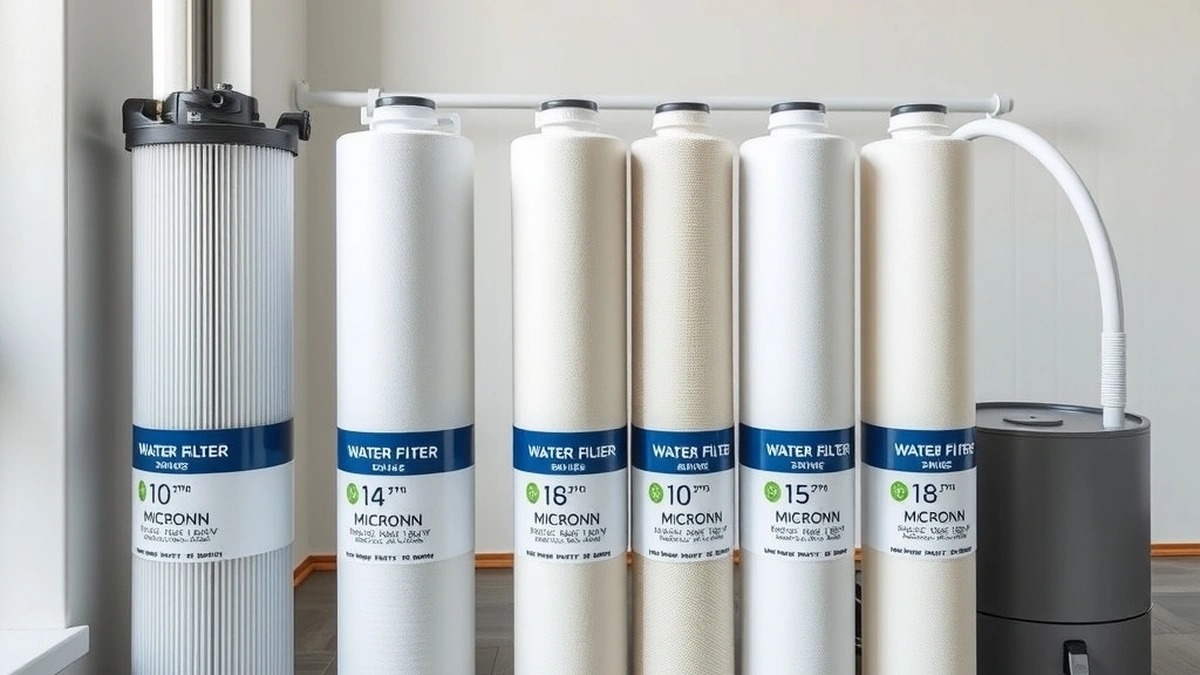
A standard 10-inch cartridge is about 9.75 to 10 inches long and 2.5 inches in diameter, fitting housings with 1/2 or 3/4 inch ports. Big blue housings take 4.5 by 10 inches, and 20-inch housings double the length.
- Standard size
- 2.5 x 10 inches
- Big blue size
- 4.5 x 10 inches
- Long size
- 2.5 x 20 inches
- Change interval
- 3 - 6 months sediment
- Annual cost
- $80 - $300
Some links on this page are affiliate links.If you buy through them we may earn a commission at no extra cost to you. We do not accept payment for rankings. Read the full disclosure.
A 10-inch cartridge is a nominal size, not an exact one: roughly 9.75 to 10 inches long and 2.5 inches in diameter, with a center hole sized for the housing’s standpipe. That standard is why cartridges from different manufacturers interchange, and why the exceptions, big blue and 20-inch, matter so much when you buy the wrong one.
The Three Dimensions That Must Match
A cartridge fits when three things line up: length, diameter, and end configuration. Get any of them wrong and the housing either will not close or will bypass water around the media.
Length. Nominal 10 inch cartridges measure about 9.75 to 10 inches. The variation comes from end caps and gaskets. A cartridge that is a quarter inch too long prevents the housing from sealing; too short and it rattles without sealing at the top.
Diameter. The standard is 2.5 inches. Big blue housings take 4.5 inches. These are not interchangeable in either direction.
End configuration. Most cartridges are open at both ends with a center hole that slips over a standpipe. Some use a bayonet or a proprietary connector. The center hole diameter, typically about 0.5 to 0.6 inch, must match the standpipe.
| Designation | Diameter | Length | Typical use |
|---|---|---|---|
| Standard | 2.5 in | 10 in | Under-sink, fridge, low flow |
| Big blue | 4.5 in | 10 in | Whole house, 8 - 15 gpm |
| Slim long | 2.5 in | 20 in | Higher capacity, low flow |
| Jumbo | 4.5 in | 20 in | High flow, long service |
Why the Standard Exists
Standards reduce cost. Because a 2.5 by 10 cartridge is common, dozens of manufacturers make sediment, carbon block, and specialty cartridges in that form factor, and they compete on price. A homeowner can buy a housing once and then choose media from any brand.
The standard also makes micron grading meaningful. A 5 micron sediment cartridge from one brand is broadly comparable to a 5 micron cartridge from another, because both are pleated media rated to the same particle size. The pleat count and surface area differ, which affects how long the cartridge lasts, but the filtration rating is comparable.
Where the standard breaks down is in carbon block quality. Two cartridges with the same dimensions and the same nominal micron rating can differ substantially in chlorine capacity, because that depends on the carbon’s activity and mass, not its geometry. Dimensions tell you fit; certification tells you performance.
Micron Rating and Pressure Drop
A micron rating describes the particle size the media is rated to capture. Common values are 20, 10, 5, 1, and 0.5 micron. Tighter is not automatically better.
| Rating | Captures | Pressure drop | Change interval |
|---|---|---|---|
| 20 micron | Sand, grit, rust flakes | Low | 3 - 6 months |
| 10 micron | Fine sediment | Low to moderate | 3 - 6 months |
| 5 micron | Fine sediment, protects UV | Moderate | 3 - 6 months |
| 1 micron | Very fine particles, cysts | Higher | 3 - 6 months |
| 0.5 micron | Cysts, fine turbidity | Highest | 3 - 6 months |
The rule of thumb is to stage them. A 20 or 10 micron cartridge ahead of a 5 micron cartridge extends the life of the tighter one, because the coarse stage takes the heavy load. A single 1 micron cartridge on turbid well water clogs in weeks.
Where the Standard Shows Up in a House
Under-sink reverse osmosis systems use 10-inch cartridges for their sediment and carbon stages, which is why replacement filters are cheap and available. Whole-house filters use big blue housings at 4.5 by 10 inches because a 2.5 inch cartridge cannot pass 10 to 15 gpm without excessive pressure drop.
Refrigerator filters are the exception. They use proprietary cartridge shapes keyed to the appliance, so the 10-inch standard does not apply. That is a deliberate design choice by appliance makers and the reason fridge filters cost more per gallon treated. If you are dealing with one, refrigerator water filter covers the cross-reference problem.
Matching a Cartridge to a Job
- Read the housing label. It states the nominal size and the port thread, usually 1/2, 3/4, or 1 inch.
- Measure the old cartridge. Length and diameter with a tape, confirm before ordering.
- Pick the micron rating for the load. Coarse for heavy sediment, tight for UV protection.
- Check the certification. Look for NSF/ANSI 42 for aesthetic claims and 53 for health-related claims.
- Buy one spare. Cartridges fail at inconvenient times and shipping delays turn a $15 part into a week of hard water.
What It Costs
A 2.5 by 10 sediment cartridge runs roughly $5 to $20. A carbon block in the same size runs $10 to $40. Big blue cartridges are larger and cost more, roughly $15 to $60 depending on media. Annual cost for a whole-house filter with a sediment and carbon pair lands in the $80 to $300 range given 6 to 12 month carbon intervals and 3 to 6 month sediment intervals.
The arithmetic for a two-stage big blue setup: sediment at $20 four times a year is $80, carbon block at $45 twice a year is $90, total $170 per year. That is the consumable side of a $500 to $1,800 installed filtration system.
Why Homeowners Get This Wrong
The most common error is buying a cartridge by description rather than dimension. “10-inch carbon filter” describes a family of products that includes 2.5 inch, 4.5 inch, and proprietary shapes. The second most common is buying a 1 micron cartridge to “get cleaner water” on a well with heavy sediment, then replacing it monthly.
The third is mixing brands of housing and cartridge where the end caps differ by a few millimetres. If the housing will not seal, the cartridge is the wrong one, not defective. Measure, then order. For the whole-system picture, see whole house water filtration and how a whole house filter works.
Frequently asked questions
What are the dimensions of a 10-inch filter cartridge?
About 9.75 to 10 inches in length and 2.5 inches in diameter, with the exact length varying slightly by manufacturer and end-cap design.
Will any 10-inch cartridge fit my housing?
Only if the diameter and end configuration match. A 2.5 inch cartridge will not seal in a 4.5 inch big blue housing, and 20-inch housings take a different length entirely.
What is a big blue filter housing?
A larger housing that accepts a 4.5 inch diameter cartridge, giving more media volume and higher flow than a standard 2.5 inch housing.
How often should a 10-inch sediment cartridge be changed?
Every 3 to 6 months depending on sediment load; a cartridge that clogs in weeks means you need a larger housing or a pre-filter.
Are 10-inch and 20-inch cartridges interchangeable?
No. The 20-inch version is twice the length and requires a taller housing, though the diameter and end fittings are usually the same.
Does cartridge micron rating affect flow?
Yes. A tighter rating, such as 1 micron, clogs faster and drops more pressure than a 20 micron cartridge of the same dimensions.
Sources
Some links are affiliate links.If you buy through them we may earn a commission at no extra cost to you. We do not accept payment for rankings. Read the full disclosure.


