
Water hardness test kit
How hardness test kits work, how accurate strips and drop tests are, and how to read the result in grains per gallon.
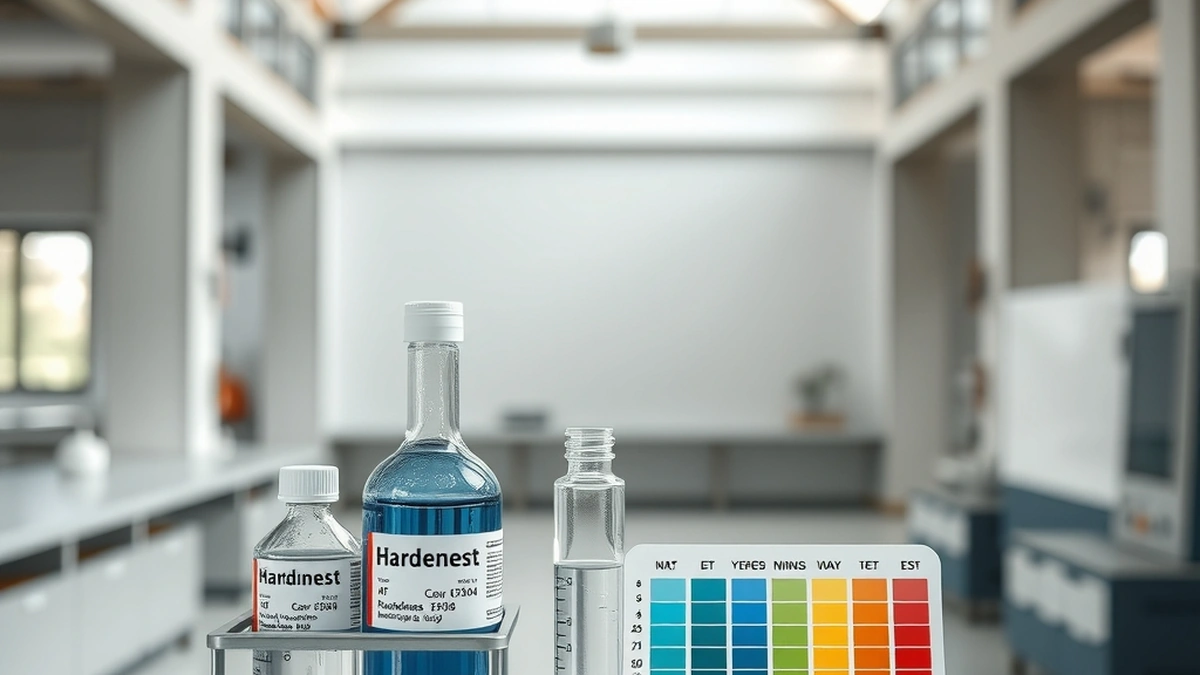
A water hardness test kit measures calcium and magnesium in grains per gallon. Test strips are fast and cheap, drop-count kits are more accurate, and a lab test at $40 to $150 gives the full picture before you size a softener.
- Strips
- Fast, low accuracy
- Drop test
- Moderate accuracy
- Lab test
- $40 - $150
- Soft water
- 0 - 3 gpg
- Very hard
- 10+ gpg
Some links on this page are affiliate links.If you buy through them we may earn a commission at no extra cost to you. We do not accept payment for rankings. Read the full disclosure.
A water hardness test kit measures the calcium and magnesium dissolved in water and reports the result in grains per gallon. Strips give a fast band, drop-count kits give a usable number, and a lab test at $40 to $150 reports hardness alongside iron and pH. The number decides whether a softener is needed and what capacity it must have.
What hardness actually is
Hardness is the concentration of divalent metal ions, mostly calcium and magnesium, expressed as calcium carbonate. It is not a contaminant in the safety sense; it is a scale-forming characteristic.
The US convention is grains per gallon. One grain per gallon equals about 17.1 milligrams per litre. A water report in mg/L is converted by dividing by 17.1.
The bands used across this site are soft at 0 to 3 gpg, moderate at 3 to 7 gpg, hard at 7 to 10 gpg, and very hard above 10 gpg.
Those bands matter because softener sizing uses the hardness number multiplied by daily gallons, and a one-band error at the top of the scale moves the required capacity by thousands of grains.
The three kit types
| Kit type | Accuracy | Time | Best use |
|---|---|---|---|
| Test strip | Plus or minus one band | Seconds | Quick check, confirming a change |
| Drop-count titration | Within about 1 gpg | Minutes | Sizing a softener, checking a blend |
| Lab test | Report-grade | Days by mail | Full panel before buying equipment |
| Digital meter | Varies by model | Seconds | Repeated checks, trend tracking |
Test strips work by colour change. They are cheap and fast, and they are adequate for answering “is this water hard or very hard.” They are not adequate for setting a softener’s grain capacity, because a one-band error at 10 gpg is a 20 percent error in the sizing calculation.
Drop-count kits add a reagent one drop at a time until the colour changes, and the drop count gives the hardness. They cost more than strips and take a few minutes, but the number is reproducible.
Lab tests are the reference. They also catch iron, manganese, and other parameters that affect equipment selection.
Reading the result
A strip that turns dark blue at the top of the chart means very hard water, above 10 gpg. A strip that stays green means soft, under 3 gpg.
For sizing, use the lab number or the drop-count number. Multiply the hardness in gpg by daily household gallons to get grains per day.
Four people at 75 gallons each is 300 gallons per day. At 12 gpg, that is 300 x 12 = 3,600 grains per day. A 36,000-grain softener with a reserve regenerates roughly every nine days at that demand.
If the test says 4 gpg, the same household uses 300 x 4 = 1,200 grains per day, and a 24,000-grain unit would last about 20 days between regenerations. That is a different piece of equipment and a different salt bill.
Testing the water properly
- Run the cold tap for two to three minutes before sampling.
- Fill the sample container to the line, not above it.
- Read the strip at the exact time stated, because the colour keeps developing.
- Record the result with the date and the tap location.
- Test again in six months, or after a change in the water source.
Testing at a softened tap and an unsoftened tap tells you whether the softener is working. A blend valve setting can be checked the same way.
If the water comes from a private well, test hardness alongside bacteria, nitrate, and iron. Hardness alone does not describe a well.
What hardness does to a house
Hard water leaves scale on fixtures, in the water heater, and inside appliances. It also reduces the lather of soap and shampoo, which is why hard water is often noticed in the shower before it is measured.
Scale in a tankless water heater is a maintenance cost, not a health issue. The remedy is softening or periodic descaling, and the choice depends on the hardness number and the volume of water used.
Very hard water above 10 gpg usually justifies a softener on maintenance grounds alone. Moderate water at 4 to 6 gpg is a judgement call that depends on appliance value and personal preference.
Kit or lab
A kit is the right first purchase for a homeowner who wants a number quickly. A lab test is the right first purchase for anyone about to spend $1,200 to $4,500 on an installed softener, because the same report also tells you whether iron or manganese will foul the resin.
Many homeowners do both: a strip to confirm the water is hard, then a lab test to size the system. Keep both results with the equipment paperwork, because a future service call will ask for the raw number rather than a description.
The lab panel also covers the parameters a hardness kit cannot: iron, manganese, nitrate, and bacteria. Iron above 2 to 3 ppm fouls softener resin, and installing a softener without knowing that is how a $450 rebed arrives years early.
For the sizing arithmetic, see water softener sizing and water hardness scale. For the test options in more detail, water hardness test strips compares kits, and water testing cost covers lab pricing.
Bottom line
A water hardness test kit gives the number that decides whether you need a softener and how big it should be. Use strips for a quick band, a drop kit for sizing, and a lab test before spending on equipment.
Frequently asked questions
What does a water hardness test kit measure?
It measures dissolved calcium and magnesium, reported in grains per gallon or milligrams per litre as calcium carbonate.
Are test strips accurate enough?
Strips are accurate enough to place water in a band such as soft, hard, or very hard, but not precise enough for tight softener sizing.
How do I convert mg/L to grains per gallon?
Divide milligrams per litre by 17.1 to get grains per gallon, so 171 mg/L is about 10 gpg.
How much does a lab hardness test cost?
A lab water test typically costs $40 to $150, and it usually reports hardness alongside iron, pH, and other parameters.
What hardness needs a softener?
Water above 7 gpg is hard and usually benefits from softening, and above 10 gpg the case is strong where scale is a problem.
Can I test hardness at home without a kit?
No reliable way. Scale deposits suggest hard water, but only a test gives the number needed to size equipment.
Sources
Some links are affiliate links.If you buy through them we may earn a commission at no extra cost to you. We do not accept payment for rankings. Read the full disclosure.


