Softener error codes: the common ones
Softener error codes point at flow, motor, or sensor faults. See what the common families mean, what to check first, and which need a part.
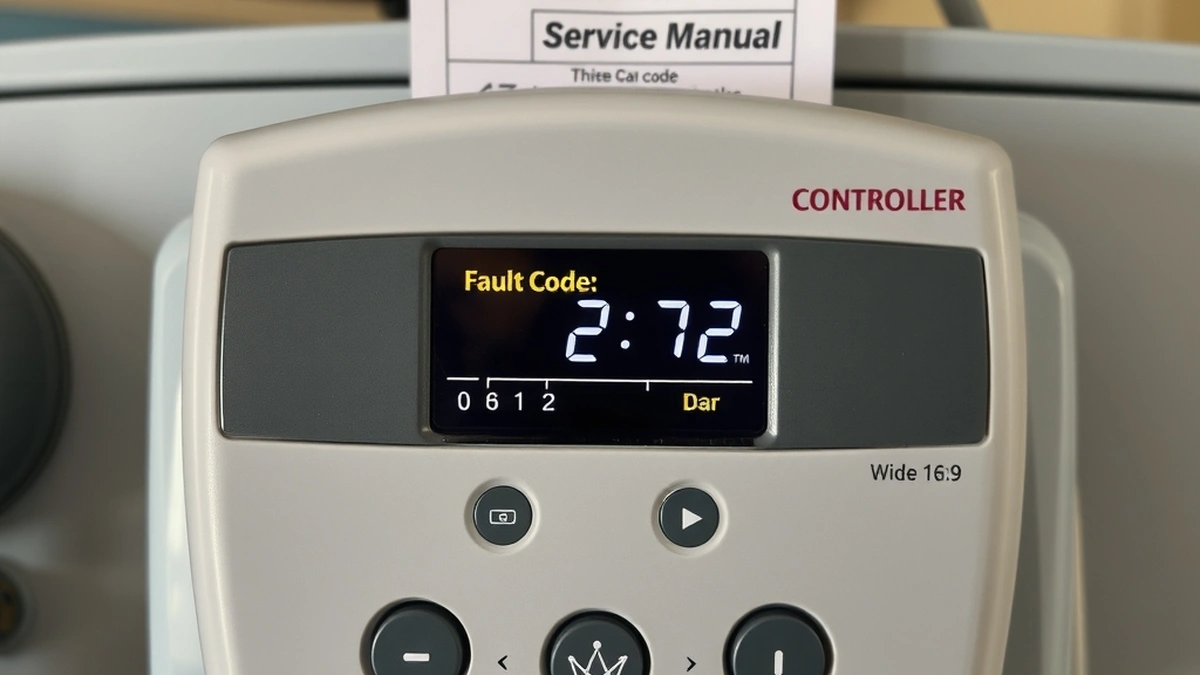
Softener error codes cluster into flow, motor, and sensor faults. A flow error usually means a stuck turbine or a closed bypass, a motor error means a jammed piston or failed drive, and a sensor error means a loose probe or cable.
- Common fault families
- Flow, motor, sensor
- First check
- Bypass position and power
- Reset method
- Hold regen or power cycle
- Typical service cost
- $150 - $400
- Part failures
- Motor, turbine, sensor
Some links on this page are affiliate links.If you buy through them we may earn a commission at no extra cost to you. We do not accept payment for rankings. Read the full disclosure.
Softener error codes are not standardized across brands, but they fall into three families: flow, motor, and sensor. The code tells you which subsystem noticed a problem. It does not tell you what the problem is. Reading it as a family first narrows the diagnosis to a handful of parts.
Why Codes Are Brand-Specific
A Fleck controller and a Kinetico controller use different code numbers for the same fault, and some brands use plain-language messages instead of numbers. That is why the manual matters more than any generic list.
The practical approach is to look up the code in the manual, identify the family, then work the checks for that family. The code is a starting point, not a diagnosis.
| Family | What it monitors | Typical trigger |
|---|---|---|
| Flow | Meter turbine and volume | No movement, or movement with no valve cycle |
| Motor | Valve drive and position | Cam not reaching position in time |
| Sensor | Probe, float, or cable | Open circuit or out-of-range reading |
| Power | Controller supply | Brownout or board fault |
Flow Faults
A flow fault means the controller is not seeing the water movement it expects. Three causes account for most of them.
The unit is in bypass. If the bypass valve is open or half-open, water does not pass through the meter, so the controller sees zero usage. This is the first thing to check and the easiest to fix. The valve layout is in adding a shut-off and bypass.
The turbine is stuck. The meter turbine sits in the water path and spins as water flows. Sediment, iron, or a piece of resin can jam it. Remove the meter, rinse the turbine, and check that it spins freely.
The cable is disconnected. The meter connects to the controller with a small cable. It can work loose during service or corrode at the pins.
A flow fault usually leaves the unit in service but not regenerating on demand, so hardness returns within days. Treat it as urgent if the water is already hard.
Motor Faults
A motor fault means the valve did not reach a position within the expected time. The controller drives a motor that turns a cam or a piston through the cycle, and a position switch confirms each step.
Causes, in order of likelihood:
- A jammed piston from grit or a swollen seal
- A stripped gear in the powerhead
- A failed position switch that reports the wrong state
- A failed motor winding
A motor that hums without moving is jammed or stripped. A motor that does not hum at all is likely an electrical fault. Rebuild kits with seals, a piston, and a gear set run $40 to $120; a complete powerhead runs $150 to $300.
Sensor Faults
Sensor faults cover the brine float, the hardness probe on some models, and any temperature or level sensor. An open circuit or an out-of-range reading triggers the code.
The most common is the brine float switch, which reports whether the brine tank has enough liquid. A float stuck at the bottom, a fouled float, or a disconnected cable all produce the same code. Clean the float, check that it moves freely, and inspect the cable.
What to Check Before Calling
- Confirm power and that the outlet is not on a tripped GFCI.
- Check the bypass is fully in service position.
- Read the manual for the specific code and its listed causes.
- Power cycle the controller and see whether the fault clears.
- Test hardness at the tap to know whether the unit is currently softening.
That sequence takes ten minutes and resolves a meaningful share of faults, mostly the bypass and power-cycle cases.
Repair or Replace
| Situation | Guidance |
|---|---|
| Unit under 8 years, single part | Repair |
| Unit 8 - 10 years, motor plus seals | Compare quotes |
| Unit over 10 years, motor and resin suspect | Replace |
| Board fault on an obsolete controller | Replace |
Equipment runs $600 to $2,500 and installed cost $1,200 to $4,500, so a $400 repair on a five-year-old unit is obviously worth it. A $400 repair on a twelve-year-old unit with a fouled bed is not, because the rebed adds another $300 to $600.
Recording the Fault History
Keep a note of each code, the date, and what fixed it. Controllers often log a fault history, and that log is the single most useful thing a technician can see. A unit that throws the same motor fault three times in a year is telling you the powerhead is failing, even if each individual reset appears to work.
One detail that trips people up: a controller may show a code after a power outage even when nothing is wrong, because the brownout interrupted a cycle mid-way. Clear it, run a manual regeneration, and see whether it returns. A code that appears once after a storm is noise; a code that appears weekly is a fault.
It also helps to know what the unit is doing when the code appears. A code during regeneration points at the valve and motor. A code in the middle of the night when nothing is running points at the meter or the supply. Note the time and the water use at that moment, because the pattern is often more diagnostic than the number itself.
Finally, keep the manual with the unit. Codes change between controller generations, and a manual for the wrong generation will send you chasing a part that does not exist on your valve. The model and serial plate on the valve body or the controller housing is the number to quote when ordering.
If the code clears and hardness returns anyway, the fault may be a symptom rather than the cause. The diagnosis order in softener stopped softening starts from the water, not the display, and water softener repair covers what a service visit includes.
Frequently asked questions
What do water softener error codes mean?
They indicate which subsystem detected a fault: flow codes point at the meter or turbine, motor codes at the valve drive, and sensor codes at a probe or its wiring.
How do I reset a softener after an error?
Most controllers reset with a power cycle or a long press on the regeneration button, but the fault returns if the underlying cause is not fixed.
Why does my softener show a flow error?
Usually because the meter turbine is stuck, the cable is disconnected, or the unit is in bypass and sees no movement, so it flags an abnormal condition after a set period.
Can I run a softener with an error code showing?
It will usually stay in service or in bypass depending on the fault; a persistent error means it is not regenerating on schedule, so hardness will return within days.
How much does a softener repair cost?
Typical repairs run $150 to $400 including a service call, with a motor or powerhead replacement near the top of that range and a turbine or sensor lower.
When should I replace instead of repair?
If the unit is past ten years and the repair exceeds about a third of a replacement quote, replacement is usually the better spend.
Sources
Some links are affiliate links.If you buy through them we may earn a commission at no extra cost to you. We do not accept payment for rankings. Read the full disclosure.