
What Size Water Softener Do I Need? Worked Examples
Size a softener with two numbers: grains per gallon and daily gallons. See worked examples for three households, flow requirements, and reserve capacity.
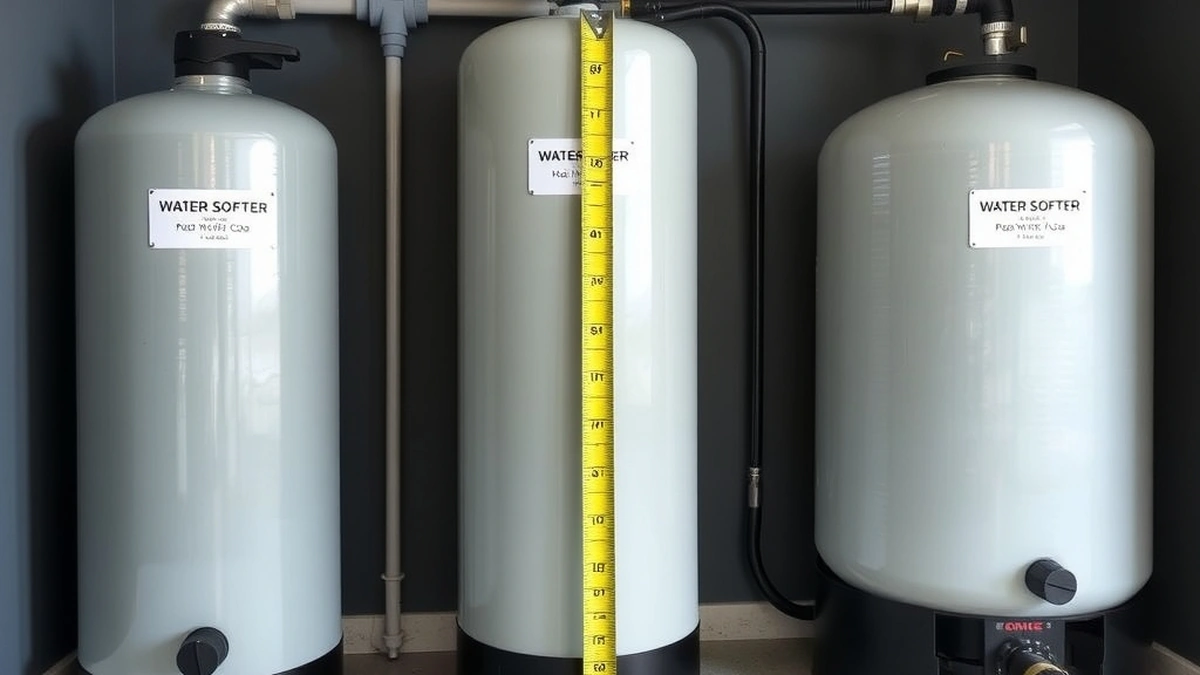
Size a water softener by multiplying hardness in grains per gallon by daily gallons, then choosing a capacity above the weekly load. A family of four at 10 GPG using 250 gallons a day needs about a 24,000 - 32,000 grain unit with reserve.
- Typical capacity
- 24,000 - 64,000 grains
- Daily gallons, 4 people
- 200 - 300 gallons
- Service flow
- 8 - 15 GPM
- Salt per cycle
- 8 - 12 lb
- Installed cost
- $1,200 - $4,500
Some links on this page are affiliate links.If you buy through them we may earn a commission at no extra cost to you. We do not accept payment for rankings. Read the full disclosure.
Size a water softener with two numbers: hardness in grains per gallon and gallons used per day. Multiply them for the daily grain load, multiply by seven for a weekly cycle, and choose a capacity above that with reserve. A family of four at 10 GPG usually lands at 24,000 - 32,000 grains.
The Two Numbers You Need
Hardness comes from a lab test and is reported in grains per gallon. Guessing from symptoms is unreliable, and a $40 - $150 panel settles it.
Daily gallons come from a utility bill, a meter, or a standard estimate. A typical person uses 60 - 75 gallons a day indoors, so a family of four uses 240 - 300 gallons.
Multiply the two. At 10 GPG and 250 gallons, the daily load is 2,500 grains. At 18 GPG and the same volume, it is 4,500 grains.
Worked Example One: Two People
Two people using 150 gallons a day at 8 GPG carry 1,200 grains daily, or 8,400 weekly.
A 24,000-grain unit regenerating at 20,000 grains of usable capacity covers eight days of load with a comfortable reserve. The unit regenerates roughly every 10 - 12 days at this demand.
An 18,000-grain unit would also work, but it leaves less margin for guests and laundry days. The 24,000-grain size is the practical floor for a two-person home.
Worked Example Two: Four People
Four people using 250 gallons a day at 12 GPG carry 3,000 grains daily, or 21,000 weekly.
A 32,000-grain unit regenerating at 24,000 grains covers eight days, which fits a weekly schedule with reserve. This is the most common residential configuration.
At 18 GPG, the same household carries 31,500 weekly grains and needs a 48,000-grain unit to keep a weekly cycle. Skipping to 64,000 grains would waste salt unless the household grows.
Worked Example Three: Five People, Very Hard Water
Five people using 300 gallons a day at 20 GPG carry 6,000 grains daily, or 42,000 weekly.
A 64,000-grain unit regenerating at 48,000 grains covers eight days. A 48,000-grain unit would need to regenerate every six days, which is workable but uses more salt per year.
This is the case where the larger tank earns its price. The difference between 48,000 and 64,000 grains is $300 - $600 in equipment and a meaningful reduction in regeneration frequency.
Capacity vs Resin Volume
| Rated capacity | Resin volume | Typical household | Service flow |
|---|---|---|---|
| 24,000 grains | About 0.75 cu ft | 1 - 2 people | 8 - 10 GPM |
| 32,000 grains | About 1.0 cu ft | 3 - 4 people | 10 - 12 GPM |
| 48,000 grains | About 1.5 cu ft | 4 - 5 people | 12 - 15 GPM |
| 64,000 grains | About 2.0 cu ft | 5+ people, high hardness | 15 GPM |
The rated capacity assumes a salt dose. A tank with 1 cubic foot of resin can be sold as 32,000 grains at a high dose or 24,000 grains at a lower, more efficient dose.
That is why two units with the same tank size can carry different labels. Compare the resin volume and the salt dose, not just the capacity number.
Flow Rate Is the Second Sizing Number
Capacity decides how often the unit regenerates. Flow decides whether the house has pressure while it does.
A house with two showers, a dishwasher, and a washing machine can draw 12 - 15 GPM at once. A softener rated at 8 GPM will cause a pressure drop and may let hard water through during peak demand.
Ask for the service flow at the pressure drop you can tolerate, usually 15 PSI. A unit rated at 12 GPM at 15 PSI is different from one rated at 12 GPM at 25 PSI.
The reserve is the capacity held back so the unit does not exhaust before the next cycle. A common reserve is one day of load, or 20 - 30 percent of capacity.
Without a reserve, a week with extra laundry or guests exhausts the bed, and hard water comes through at the end of the interval. With too large a reserve, the unit regenerates more often than necessary and wastes salt.
Set the capacity so the unit regenerates on a predictable schedule, usually weekly. That makes salt use stable and the water consistently soft.
Iron Changes the Calculation
Iron consumes capacity. Some sizing methods add 5 grains per PPM of iron to the hardness number, and others recommend a larger unit.
The better answer is to remove the iron first. Above 2 - 3 PPM, softener resin fouls faster than salt can clean it, and an iron filter at $800 - $2,500 installed belongs ahead of the softener.
With the iron removed, the softener is sized on hardness alone, which is simpler and more accurate.
Five Mistakes to Avoid
- Sizing from symptoms instead of a lab number.
- Ignoring flow rate and looking only at grain capacity.
- Buying the largest unit on sale for a two-person home.
- Forgetting the iron level before choosing the resin.
- Setting the valve to the default hardness instead of the tested value.
A condo with one bathroom and 120 gallons a day at 8 GPG carries 960 grains daily, or 6,720 weekly. A 24,000-grain cabinet unit is more than enough, and a smaller 18,000-grain unit would work if space is tight.
That is also the case where a portable or cabinet softener makes sense. The equipment is smaller, the install is simpler, and the household does not need the reserve a family of five requires.
For the detailed math, see water softener sizing and water softener grain capacity. For the installation, see how to install a water softener. For costs, see how much are water softeners.
Frequently asked questions
How do I calculate the softener size I need?
Multiply hardness in grains per gallon by daily gallons to get the daily grain load. Multiply by seven for a weekly cycle, then add a reserve of 20-30 percent.
What size softener for a family of four?
At 10 GPG and 250 gallons a day, the load is 2,500 grains daily. A 24,000-32,000 grain unit regenerating weekly covers it with reserve.
Is a bigger softener always better?
No. An oversized unit regenerates less often but can sit with stale brine and waste capacity. Size to the load, not to the largest tank on sale.
What flow rate does a softener need?
Match the service flow to peak demand, typically 8-15 GPM for a home. A unit rated below peak demand causes pressure drop when several fixtures run.
Does iron change the size I need?
Yes. Iron above 2-3 PPM needs an iron filter ahead of the softener, and some sizing methods add a compensation factor for low levels of iron.
How many grains per day does a person use?
At 10 GPG and 60-75 gallons per person per day, one person accounts for roughly 600-750 grains daily. Multiply by household size for the total.
Sources
Some links are affiliate links.If you buy through them we may earn a commission at no extra cost to you. We do not accept payment for rankings. Read the full disclosure.


