
Whole home water filter
A whole home filter treats every tap at the point of entry. See the two-stage setup, the flow and pressure rules, and what it costs to install and run.
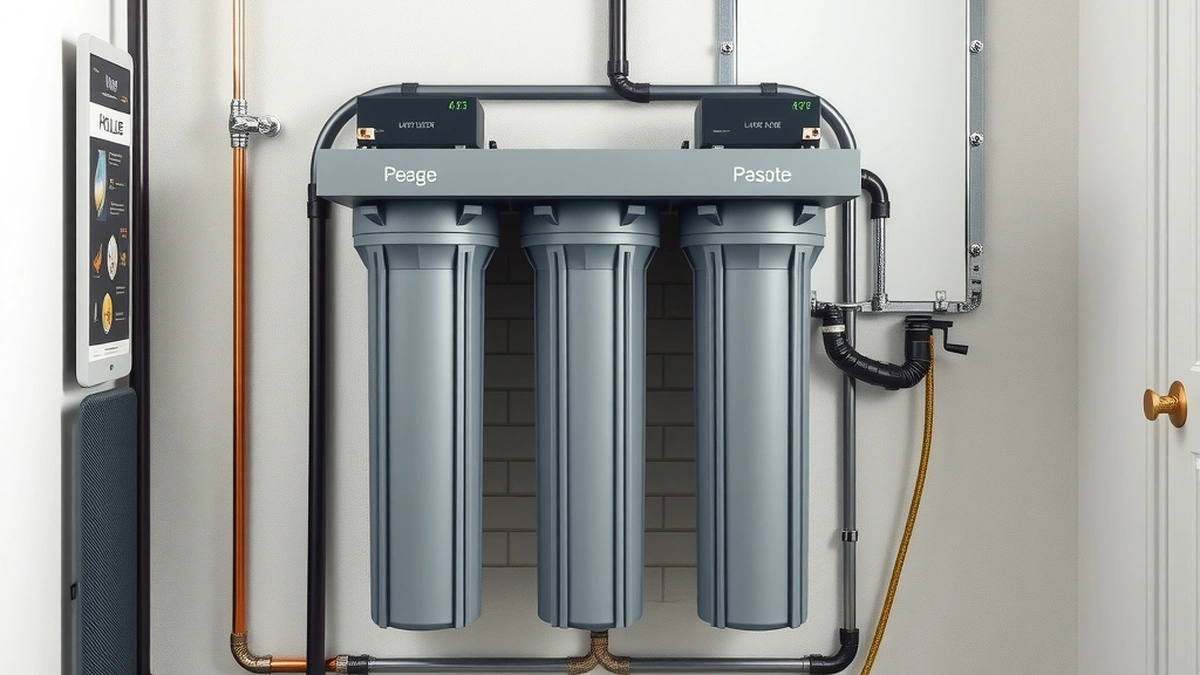
A whole home water filter is a point-of-entry system, usually sediment plus carbon in 4.5 inch housings, installed on the main line for $500 to $1,800. It removes sediment, chlorine, and taste at every fixture but does not soften water.
- Installed cost
- $500 - $1,800
- Annual cartridges
- $80 - $300
- Flow
- 8 - 15 gpm
- Pressure drop
- 2 - 8 psi clean
- Softens water
- No
Some links on this page are affiliate links.If you buy through them we may earn a commission at no extra cost to you. We do not accept payment for rankings. Read the full disclosure.
A whole home water filter is a point-of-entry system on the main supply line, so every shower, tap, and appliance receives filtered water. Most installations use a sediment stage followed by a carbon stage in 4.5 inch housings, cost $500 to $1,800 installed, and run $80 to $300 a year in cartridges.
What It Treats and What It Does Not
The scope is narrower than the name suggests, and understanding that saves money. A whole home filter addresses particles and chlorine, which are the two things that affect every fixture in a house on treated municipal water.
- Sediment includes sand, rust, grit, and turbidity flushed in from the main. It is what makes water look cloudy and what fouls everything downstream.
- Chlorine is added by the utility to keep the distribution system sanitary. It is also what makes water taste like a swimming pool and what degrades softener resin and reverse osmosis membranes.
- Taste and odour compounds are largely organic and are adsorbed by carbon along with the chlorine.
What it does not treat is just as important. It does not remove calcium or magnesium, so hardness passes through and scale continues to form in the water heater and on the shower glass. It does not remove nitrate, which is a dissolved ion that carbon ignores. It does not disinfect, because carbon is not a microbiological barrier and can in fact support bacterial growth if it is left too long between changes.
That boundary is why a whole home filter is often one stage in a chain rather than the whole answer. A house with 14 GPG hardness and a chlorine taste needs a softener and a carbon filter, and the carbon filter does not substitute for the softener.
The Two-Stage Layout
The standard configuration is a sediment cartridge followed by a carbon block, both in 4.5 inch housings, plumbed in series on the main line.
- Sediment, 10 or 20 micron. Takes the coarse load and protects the carbon block behind it.
- Carbon block. Removes chlorine, taste, and odour, and polishes fine particulate.
Order matters. Put carbon first and it blinds with grit in weeks while the sediment cartridge behind it stays clean and useless. The coarse stage exists to spend itself cheaply so the expensive stage lasts.
A third stage is added when the water calls for it: catalytic carbon for chloramine, a specialty media for a specific metal, or a second carbon block for additional contact time. Each stage adds pressure drop, so the total has to stay inside the house’s pressure budget. A system that removes everything and leaves 20 psi at the shower has solved one problem by creating another.
Flow, Pressure, and Housing Size
Housing size is set by flow, and flow is set by the house. A 2.5 inch housing passes 4 to 6 gallons per minute, which is adequate for one fixture and inadequate for a family with two bathrooms running at once. A whole home system needs 4.5 inch housings rated for 8 to 15 gpm.
Pressure drop follows from the same numbers. A clean 4.5 inch system costs 2 to 8 psi across both stages. A loaded cartridge can cost 15 psi or more, which is felt as weak showers and slow fixture fill. That is why cartridge changes are a pressure issue as much as a water quality issue.
The practical test is a pair of gauges, one before the system and one after, read while several fixtures run. Under 15 psi across the system is healthy. Over 20 psi means the system is the bottleneck and either the cartridges are due or the housings are undersized.
What It Costs
Installed cost runs $500 to $1,800 depending on housing size, stage count, and how much pipe has to be cut. Cartridges run $20 to $40 for sediment and $35 to $70 for carbon.
| Item | Range | Interval |
|---|---|---|
| Two-stage system | $500 - $1,800 | once |
| Sediment cartridge | $20 - $40 | 3 - 6 months |
| Carbon cartridge | $35 - $70 | 6 - 12 months |
| Bypass valves | $60 - $200 | once |
Annual arithmetic for a mid-range system: sediment three times at $25 is $75, carbon twice at $50 is $100, total $175. Over ten years, $900 installed plus $1,750 in cartridges is $2,650, or $265 per year.
That is the number to compare against a dealer package or a rental arrangement. The equipment is the smaller part of the ten-year total; the cartridges are the larger part, and their price and availability matter more than the brand on the housing.
Installation Essentials
The system needs a bypass, a level mounting, and enough straight pipe to cut in. A bypass is not optional: without it, every cartridge change means shutting off the house and draining lines.
Mount the housings at chest height with 12 inches of clearance below. A housing mounted low means kneeling on a wet floor twice a year, and a housing mounted high means water running down your arm when you open it.
Put the system before the water heater. Filtering hot water degrades carbon and shortens cartridge life, and the heater does not benefit from filtered water. If a recirculation loop exists, confirm the filter is not on it.
Five Steps to Choose
- Test the water with a $40 to $150 lab panel.
- Measure peak flow by adding simultaneous fixtures.
- Choose 4.5 inch housings for whole-house flow.
- Set the stage order as sediment then carbon.
- Confirm bypass, clearance, and drain-free operation before buying.
Maintenance and Expectations
Sediment every 3 to 6 months, carbon every 6 to 12 months, and write the date on the housing. Keep one spare of each so a change never waits on an order.
Expect better taste, less sediment in the toilet tanks, and longer appliance life from reduced particulate. Do not expect softer water, lower nitrate, or protection from bacteria. Those require a softener, reverse osmosis, and UV respectively.
For the installation detail, see whole-house water filtration filter and how a whole house filter works. For cost, whole house water filter cost breaks down labor and parts.
Frequently asked questions
What does a whole home water filter remove?
Sediment, rust, chlorine, and taste and odour compounds, using a sediment stage followed by a carbon stage; it does not remove hardness, nitrate, or bacteria.
How much does a whole home water filter cost?
Installed systems run $500 to $1,800 with cartridges at $80 to $300 per year, depending on housing size, stage count, and whether a bypass is included.
Where is a whole home filter installed?
On the main supply line after the meter or pressure tank and before the water heater, with a bypass so cartridges can be changed without shutting off the house.
Does a whole home filter reduce water pressure?
A correctly sized system costs 2 to 8 psi when clean; an undersized housing or a loaded cartridge can cost 15 psi or more and should be corrected.
Do I need a softener with a whole home filter?
Yes if hardness is above 7 GPG, because carbon and sediment filtration leave calcium and magnesium in the water and scale continues to form.
How often do whole home filters need changing?
Sediment every 3 to 6 months and carbon every 6 to 12 months, sooner if pressure drops or taste returns before the interval.
Sources
Some links are affiliate links.If you buy through them we may earn a commission at no extra cost to you. We do not accept payment for rankings. Read the full disclosure.


