Bottled water vs a home filter: cost per gallon
Bottled water runs about $1 per gallon; a home filter runs cents. See the five-year arithmetic for pitchers, under-sink RO, and delivered water.
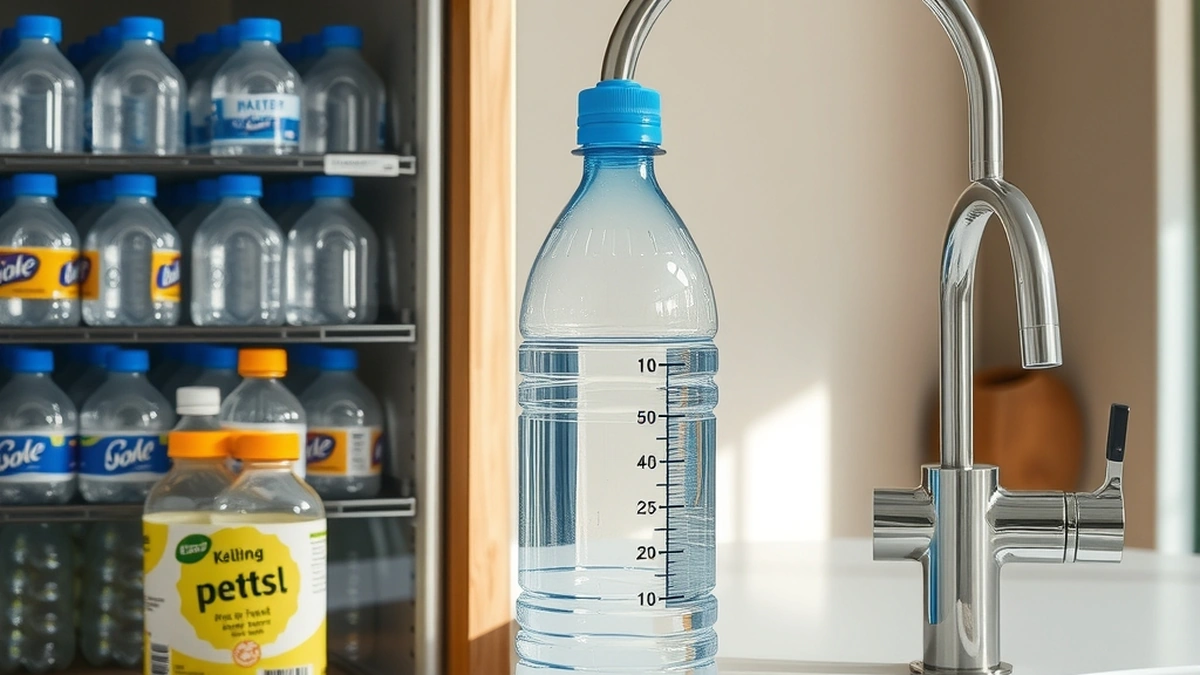
Bottled water costs roughly $0.50 to $2 per gallon depending on package size, while a pitcher filter runs about $0.10 to $0.30 per gallon and under-sink RO about $0.15 to $0.40. A filter pays back within months for a household drinking 2 gallons a day.
- Bottled water
- $0.50 - $2 per gallon
- Pitcher filter
- $0.10 - $0.30 per gallon
- Under-sink RO
- $0.15 - $0.40 per gallon
- RO installed
- $300 - $900
- RO annual running
- $60 - $150
Some links on this page are affiliate links.If you buy through them we may earn a commission at no extra cost to you. We do not accept payment for rankings. Read the full disclosure.
Bottled water costs about $0.50 to $2 per gallon depending on how you buy it. Filtered water at home costs $0.10 to $0.40 per gallon. For a household drinking 2 gallons a day, that gap is worth several hundred dollars a year, and it is the entire case for a filter once the water itself is confirmed safe to treat.
The Cost per Gallon, Worked
Prices vary by package and region, so treat these as estimates.
Single-serve bottles. A 24-pack of 16.9 ounce bottles is 3.17 gallons. At $8 per pack, that is $8 ÷ 3.17 = $2.52 per gallon. At $5 per pack, $1.58 per gallon.
Bulk packs. A 40-pack of 16.9 ounce bottles is 5.28 gallons. At $6, that is $1.14 per gallon.
5 gallon jugs. At $8 per jug delivered, that is $1.60 per gallon including delivery. Refilling at a store for $2 per jug is $0.40 per gallon, before your time and transport.
Pitcher filter. A $30 pitcher plus cartridges at $8 each, changed every two months, treating 40 gallons per cartridge: $8 ÷ 40 = $0.20 per gallon, plus the amortized pitcher.
Under-sink RO. $600 installed over 10 years, plus $100 per year in cartridges and one $60 membrane: $600 + $1,000 + $120 = $1,720 over 10 years. If the household uses 2 gallons a day, that is 7,300 gallons, so $1,720 ÷ 7,300 = $0.24 per gallon.
| Option | Cost per gallon | Upfront |
|---|---|---|
| Single-serve bottles | $1.50 - $2.50 | $0 |
| Bulk bottles | $1.00 - $1.50 | $0 |
| Delivered 5 gallon | $1.20 - $1.60 | deposit |
| Store-refilled 5 gallon | $0.35 - $0.50 | jug cost |
| Pitcher filter | $0.10 - $0.30 | $25 - $50 |
| Under-sink RO | $0.15 - $0.40 | $300 - $900 |
The Five-Year Arithmetic
A household of four drinking and cooking with 2 gallons a day uses 730 gallons a year, or 3,650 gallons over five years.
Bottled at $1.25 per gallon: 3,650 × $1.25 = $4,563. Under-sink RO: $600 installed + 5 × $100 cartridges + $60 membrane = $1,160.
The difference is $3,403 over five years, or about $680 per year. That is the number that matters, and it does not count the trips to the store or the bottles in the recycling bin.
Pitcher filter over the same period: $35 pitcher + 5 × $48 in cartridges = $275, which is even cheaper. The trade is throughput: a pitcher holds about half a gallon and filters slowly, so a family using 2 gallons a day refills it four times.
What You Are Actually Buying
Bottled water is not automatically cleaner. It is regulated as a food product, and some of it is municipal water that has been treated and bottled. A certified filter is matched to the contaminants in your water, which is a narrower claim you can verify with a test.
That is the argument for testing first. If the report shows hardness at 12 GPG and chlorine residual, a $30 pitcher does not fix either. If it shows nitrate near 10 mg/L, a pitcher does not remove nitrate and RO does. The filter has to match the problem.
| Contaminant | Pitcher | Under-sink RO | Bottled |
|---|---|---|---|
| Chlorine taste | Yes | Yes | Varies |
| Hardness | No | Yes | Varies |
| Nitrate | No | Yes | Varies |
| Lead | Some | Yes | Varies |
| Bacteria | No | Not a barrier | Treated at source |
| Convenience away from home | No | No | Yes |
Where Bottled Water Still Wins
Portability is the honest advantage. A filter at home does not help at a job site, in a car, or on a hike. The reasonable pattern for most households is a filter at the kitchen tap plus a reusable bottle, with bottled water reserved for travel.
Emergency supply is the second case. The usual guidance is to keep a few days of water per person on hand, and commercially bottled water has a place in that kit.
The third is a confirmed contaminant that a home filter cannot address at reasonable cost. That is rare, and it is a reason to test rather than a reason to assume.
It is worth saying plainly that taste drives most of this decision. People buy bottled water because they dislike the taste of their tap, and chlorine is the usual reason. A carbon filter removes chlorine for a fraction of the cost, and the taste difference is immediate. If taste is the only complaint and the lab panel is clean, a $500 to $1,800 whole-house carbon system solves it for the whole house rather than one faucet.
Five Steps to Decide
- Test the water. A $40 to $150 lab panel tells you what the filter has to remove.
- Count your real usage. Bottles per week times ounces gives gallons; most households underestimate.
- Match the filter to the contaminant, not to the price.
- Compare five-year totals, not sticker prices.
- Keep a reusable bottle so the filter actually replaces the bottled habit.
The Hidden Costs on Both Sides
Bottled water carries costs that do not appear on the receipt: storage space, trips to the store, and the recycling stream. RO carries a waste water ratio of 3 to 4:1, which at 2 gallons a day is 6 to 8 gallons to drain, costing a few dollars a year at typical rates.
Neither hidden cost changes the conclusion. If the water tests clean enough that a carbon filter handles it, a $500 to $1,800 whole-house carbon system plus a pitcher is the low-cost path. If dissolved contaminants are the issue, under-sink RO at $300 to $900 installed is the right tool, reverse osmosis system cost breaks the quote down, best under-sink reverse osmosis covers the hardware, and reverse osmosis versus carbon compares the two treatments.
Frequently asked questions
How much does bottled water cost per gallon?
Single-serve bottles run $1 to $2 per gallon, while 5 gallon delivered jugs and bulk packs can bring it to $0.50 to $0.80 per gallon, before delivery fees.
How much does filtered water cost per gallon?
A pitcher filter runs roughly $0.10 to $0.30 per gallon including the pitcher and cartridges, and under-sink RO runs about $0.15 to $0.40 including membrane replacement.
How long does a filter take to pay back?
At 2 gallons a day against $1 per gallon bottled water, a $600 under-sink RO system pays back in under a year on the water alone.
Is bottled water better quality than filtered tap water?
Not inherently. Bottled water is regulated as a food product, and a certified filter addresses the specific contaminants in your water, which is a narrower and more verifiable claim.
How much of bottled water's cost is the water?
A small fraction. Most of the price is the bottle, the label, the transport, and the retail margin, which is why the cost per gallon is far above tap water.
Does a filter remove the need for bottled water entirely?
For drinking and cooking at home, usually yes, provided the filter addresses the contaminants in your water; convenience away from home is a separate cost.
Sources
Some links are affiliate links.If you buy through them we may earn a commission at no extra cost to you. We do not accept payment for rankings. Read the full disclosure.