Best under-sink reverse osmosis system
How to pick an under-sink RO system by stage count, tank size, membrane type, and running cost, with the specifications that actually decide the price.
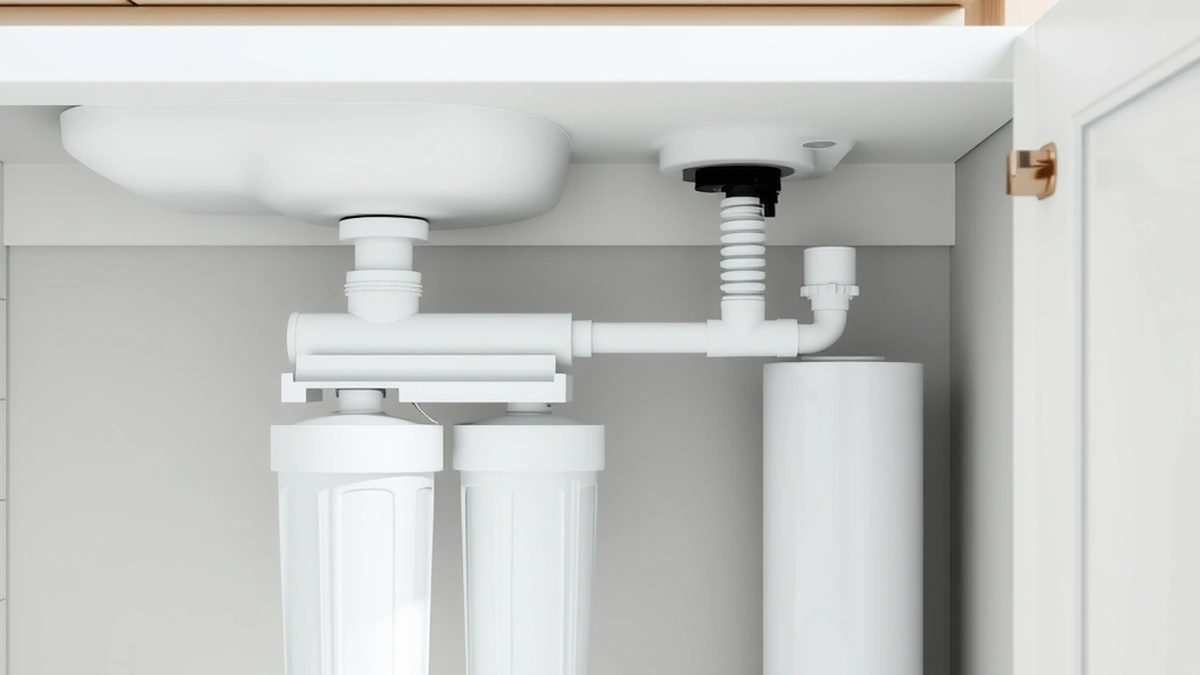
The best under-sink reverse osmosis system for most homes is a four- to five-stage unit with a sediment pre-filter, two carbon stages, a TFC membrane, and a final polishing filter. Expect $200 to $600 for equipment, $300 to $900 installed, and $60 to $150 a year in cartridges.
- Equipment
- $200 - $600
- Installed
- $300 - $900
- Annual consumables
- $60 - $150
- Membrane life
- 2 - 3 years
- Waste ratio
- 3 - 4:1
Some links on this page are affiliate links.If you buy through them we may earn a commission at no extra cost to you. We do not accept payment for rankings. Read the full disclosure.
The best under-sink reverse osmosis system is not the one with the most stages or the highest price. It is the one whose stage count matches your water, whose tank fits your cabinet, and whose cartridges you will actually replace. Those three factors, not brand, decide whether the unit produces good water in year three.
What the Stages Do
A reverse osmosis system is a stack of cartridges in series, ending at a membrane. Each stage has one job:
- Sediment pre-filter catches particles so they do not foul the membrane surface. Usually 5 micron.
- Carbon block removes chlorine, which would otherwise degrade the membrane polymer.
- TFC membrane rejects dissolved ions and larger molecules at 80 to 95 percent.
- Post-carbon polishing filter improves taste and catches anything from the storage tank.
- Optional fifth stage is either a second carbon block for chloramine or a remineralizer.
Any unit advertising seven or eight stages is usually counting the same functions twice. Count the distinct jobs, not the housings.
The Specification That Matters Most
Flow rate and tank size decide whether the system keeps up with a household. A standard unit produces 50 to 75 gallons per day and stores 2 to 4 gallons in a pressure tank. A family that fills water bottles and a stockpot daily will drain a small tank faster than the membrane refills it, which shows up as a slow trickle at the faucet.
Tankless systems produce on demand and store nothing, so they need higher membrane output and adequate supply pressure. They are smaller under the cabinet and avoid the tank’s pressure loss, but they cost more and are less tolerant of low incoming pressure.
| Specification | Practical target | Why it matters |
|---|---|---|
| Stages | 4 - 5 distinct | Coverage without redundancy |
| Membrane | TFC | Chlorine tolerance with carbon pre-filter |
| Production | 50 - 75 gpd | Household drinking and cooking |
| Tank | 2 - 4 gallons | Buffer at the faucet |
| Waste ratio | 3 - 4:1 | Water use and sewer charge |
| Supply pressure | 40 psi minimum | Production rate |
TFC vs CTA, and Why It Decides the Price
Thin film composite membranes reject a broader range of contaminants and tolerate higher pH than cellulose triacetate. They are also less tolerant of chlorine, which is why the carbon pre-filter is mandatory rather than optional on a TFC unit. CTA membranes tolerate chlorine better but reject less and are now uncommon in residential systems.
That trade is the reason a $200 unit and a $600 unit can look identical from outside. The expensive one usually has a better membrane, a larger tank, and metal-bodied fittings instead of plastic. The membrane is the part doing the work; the housing is the part you see. Read RO membrane types for the chemistry in more detail.
Running Costs and the Five-Year Number
Equipment runs $200 to $600 and installation $300 to $900 if you hire it out. Consumables are where the real cost sits: $60 to $150 per year for cartridges, plus a membrane every 2 to 3 years.
A worked example: $450 equipment plus $0 labor for a DIY install, plus five years of cartridges at $100 equals $500, plus one membrane at $60 equals $1,010 over five years, or about $202 per year. Add professional installation at $400 and the five-year figure rises to $1,410, or $282 per year.
Compare that against bottled water at roughly $1 per gallon for a family using 2 gallons a day: 2 × 365 = 730 gallons, or $730 per year. The RO system pays back inside the first year on that basis, before counting the waste water, which at a 3 to 4:1 ratio adds 6 to 8 gallons a day to the sewer bill. See bottled water versus a filter for that comparison in full.
Five Checks Before You Buy
- Measure the cabinet. Height, width, and depth, plus room for the tank. Tank models need roughly 18 inches of height and a footprint beside the unit.
- Read the cartridge part numbers. A unit with proprietary cartridges that cost $60 each three times a year is more expensive than a $100 cheaper unit with standard 10-inch cartridges.
- Confirm the fittings. John Guest push-fit and compression fittings are serviceable; molded proprietary hose ends are not.
- Check the drain adapter. It must fit your sink drain or disposal; some kits include the adapter and some do not.
- Verify certification. Look for a unit tested to NSF/ANSI 58 for RO performance rather than a generic “certified components” claim.
Where Under-Sink RO Fits in a Whole-House Plan
RO is a point-of-use device. It does nothing for the shower, the washing machine, or the water heater. If the report shows hardness above 7 GPG, the membrane will scale unless a softener runs ahead of it, and scaling shortens membrane life from 2 to 3 years to months.
The sensible sequence on well water is sediment, iron removal if needed, softening, then RO at the kitchen tap, which is the same order described in the well water system layout. On municipal water with acceptable hardness, an RO unit can stand alone at the sink and rely on its own pre-filters.
If you are also considering a carbon-only approach at the sink, reverse osmosis versus carbon explains which contaminants each covers. And if installed cost is the deciding factor, reverse osmosis system cost breaks the quote into parts.
What to Ignore in the Marketing
Ignore “alkaline” claims that add a mineral cartridge after the membrane; the cartridge does change pH, but it is a taste preference, not a treatment step. Ignore UV stages on a unit fed by chlorinated municipal water; the chlorine has already done that job. Ignore any claim of a specific removal percentage without a named contaminant and a test condition.
Pay attention to cartridge availability, membrane type, tank size, and whether the vendor publishes a replacement schedule. Those four things determine whether the system is still working in five years, which is the only review that counts.
Frequently asked questions
How many stages should an under-sink RO system have?
Four to five is the practical range: sediment, carbon block, membrane, and a post-carbon polishing filter, with a second carbon stage or a remineralizer as the optional fifth.
Is a tankless RO better than a tank model?
Tankless units save space and avoid a pressure tank, but they cost more and depend on adequate supply pressure; tank models are simpler and cheaper for most kitchens.
What membrane type should I look for?
TFC, or thin film composite, is the standard for residential drinking water because it tolerates municipal chlorine when protected by a carbon pre-filter and rejects a wide range of contaminants.
How much water does an under-sink RO waste?
Three to four gallons to drain for each gallon produced is typical, so a household using 2 gallons a day sends roughly 6 to 8 gallons to drain.
Do I need a permeate pump?
Only if supply pressure is low, below about 40 psi, or if the tank fills slowly; a permeate pump improves recovery and production rate without electricity.
Can I install an under-sink RO myself?
Yes on most kitchens, because the unit taps the cold supply with a saddle valve and drains through the existing dishwasher or sink drain; the main risks are leaks at compression fittings.
Sources
Some links are affiliate links.If you buy through them we may earn a commission at no extra cost to you. We do not accept payment for rankings. Read the full disclosure.