
Culligan water softener
Culligan softeners are sold through dealers with installation and service bundled. See the equipment, the pricing model, and how to compare it fairly.
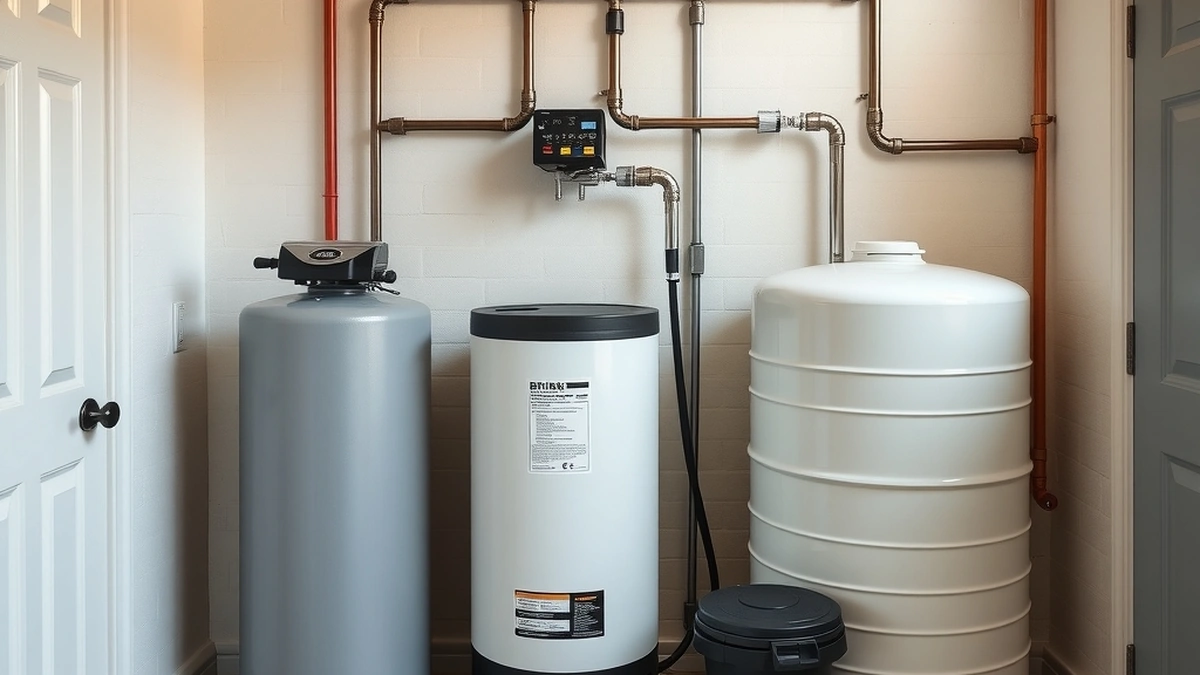
Culligan water softeners are dealer-installed ion exchange systems, quoted after an in-home test rather than sold at retail. Expect installed pricing above the $1,200 to $4,500 generic range because service and salt are often bundled.
- Sales model
- Dealer, with in-home quote
- Generic installed cost
- $1,200 - $4,500
- Salt per year
- $120 - $400
- Equipment life
- 10 - 15 years
- Resin life
- 8 - 12 years
Some links on this page are affiliate links.If you buy through them we may earn a commission at no extra cost to you. We do not accept payment for rankings. Read the full disclosure.
A Culligan water softener is an ion exchange softener sold and installed through a local dealer. The chemistry is the same as any other softener: water passes through strong acid cation resin, calcium and magnesium swap for sodium, and brine regeneration resets the bed. What differs is how you buy it and who services it.
The Equipment
The residential range covers single-tank cabinet units and two-tank systems with a separate brine tank. Capacity spans the usual residential band of 24,000 to 64,000 grains, and valve control is metered on most models, regenerating on gallons used rather than a fixed timer.
| Component | Function | Service life |
|---|---|---|
| Resin tank | Ion exchange bed | 10 - 15 years |
| Resin | Hardness removal | 8 - 12 years |
| Brine tank | Salt storage and brine | 15+ years |
| Control valve | Cycle timing and metering | 10 - 15 years |
| Brine float | Water level control | 5 - 10 years |
Nothing in that table is unusual. The components are the same categories every softener uses, and the failure modes are the same ones covered in softener stopped softening.
How the Dealer Model Works
A dealer quote usually follows an in-home water test. The quote bundles some or all of the following:
- Equipment
- Installation, including bypass and drain
- A service agreement or scheduled maintenance
- Salt delivery
- A warranty tied to dealer service
That bundle is the product. It is legitimate, and it is worth money to a household that does not want to think about the softener again. It also makes direct price comparison difficult, because a $700 online softener and a dealer quote are not the same purchase.
The comparison that works is total cost over the equipment life. A generic system at $2,000 installed plus $250 per year in salt and $450 for a rebed in year nine is $2,000 + $2,500 + $450 = $4,950 over ten years. A dealer system at $3,500 installed with salt and service included might land near the same figure, or above it. Ask for the ten-year total, not the installed price.
Rental and Lease Arrangements
Some dealers offer rental or lease-to-own. The appeal is a low upfront cost. The risk is that the total of payments exceeds the purchase price, and the buyout at the end can be substantial.
| Arrangement | Upfront | Monthly | Ownership |
|---|---|---|---|
| Purchase | Full installed price | $0 | Immediate |
| Lease | Low or zero | Fixed payment | Dealer until buyout |
| Rent | Low | Fixed payment | Dealer |
| Lease to own | Low | Fixed payment | Transfers at term end |
Before signing, ask three questions: what is the total of all payments, what is the buyout, and what happens if you move. A softener is attached to the house, and a lease on a house you sell is a complication.
Sizing Still Decides the Cost
Dealer or not, the sizing math is the same. Load equals people × gallons per person per day × hardness in GPG.
Four people at 75 gallons and 12 GPG is 3,600 grains per day. Weekly regeneration needs about 25,200 grains, so a 32,000 grain unit covers it. At 18 GPG the same household needs 5,400 grains per day, or 37,800 per week, which points at a 48,000 grain unit.
If the quote recommends a capacity far above that calculation, ask why. Oversizing costs more upfront and can leave water sitting in the tank between regenerations. The full method is in water softener sizing.
Capacity is only half the sizing. Peak flow is the other half, and a dealer quote that fixes capacity without addressing flow can still leave a house with weak showers. A four-bathroom home needs a unit that passes roughly 10 to 12 gallons per minute at peak, which means a 1 inch valve and a tank diameter large enough to keep velocity down. Ask for the service flow rating in writing and compare it with your fixture count.
What to Ask a Dealer
- Can I have the water test results in writing?
- What is the total installed price, including permit and drain work?
- What does the service agreement cover, and what is billed separately?
- Is salt included, and at what price per bag?
- What is the warranty, and does it require dealer service?
- If this is a lease, what is the total of payments and the buyout?
Those six answers turn an opaque quote into something comparable.
The Alternative
A generic softener with a Fleck or similar valve installs for $1,200 to $4,500, and parts are available from multiple suppliers. Salt costs $120 to $400 per year and a rebed runs $300 to $600. You arrange your own service, which for most households means one call every several years.
Neither path is wrong. The dealer path buys convenience and a single point of responsibility. The generic path buys lower cost and independence. The water comes out the same either way, because the resin does not know who sold it.
One more consideration that rarely appears in the brochure: what happens when you sell the house. A purchased softener stays with the property and is usually a selling point. A leased softener is a contract attached to a house, and the buyer may inherit it or the seller may have to buy it out. Either way it becomes a line in the closing documents. Ask about transfer terms at signing, not at listing.
If you are comparing brands, Culligan versus Kinetico covers the two dealer-heavy options, and water softener price versus rental works the lease arithmetic in more detail.
Frequently asked questions
How much does a Culligan water softener cost?
Dealer quotes vary by region and system size, and they typically exceed the $1,200 to $4,500 generic installed range because installation, service, and salt may be bundled.
Is a Culligan softener better than a Fleck or generic unit?
The softening mechanism is the same ion exchange resin; the difference is the dealer service model and the cartridge or salt supply arrangement, not the water chemistry.
Does Culligan rent softeners?
Some dealers offer rental or lease arrangements, which lower the upfront cost but can cost more over the term; ask for the total of payments and the buyout terms.
How long does a Culligan softener last?
Equipment life is typically 10 to 15 years, with the resin bed lasting 8 to 12 years before a rebed at $300 to $600.
Do I need a water test before buying?
Yes, and the dealer will usually perform one; ask for the written results so you can compare the recommendation against the actual hardness and iron numbers.
What is the alternative to a dealer softener?
A generic softener with a Fleck or similar valve installs for $1,200 to $4,500 and lets you buy salt and parts anywhere, at the cost of arranging your own service.
Sources
Some links are affiliate links.If you buy through them we may earn a commission at no extra cost to you. We do not accept payment for rankings. Read the full disclosure.


