Buying vs Renting a Softener From a Dealer
Compare buying versus renting a water softener from a dealer using installed cost, salt, and resin rebed numbers.
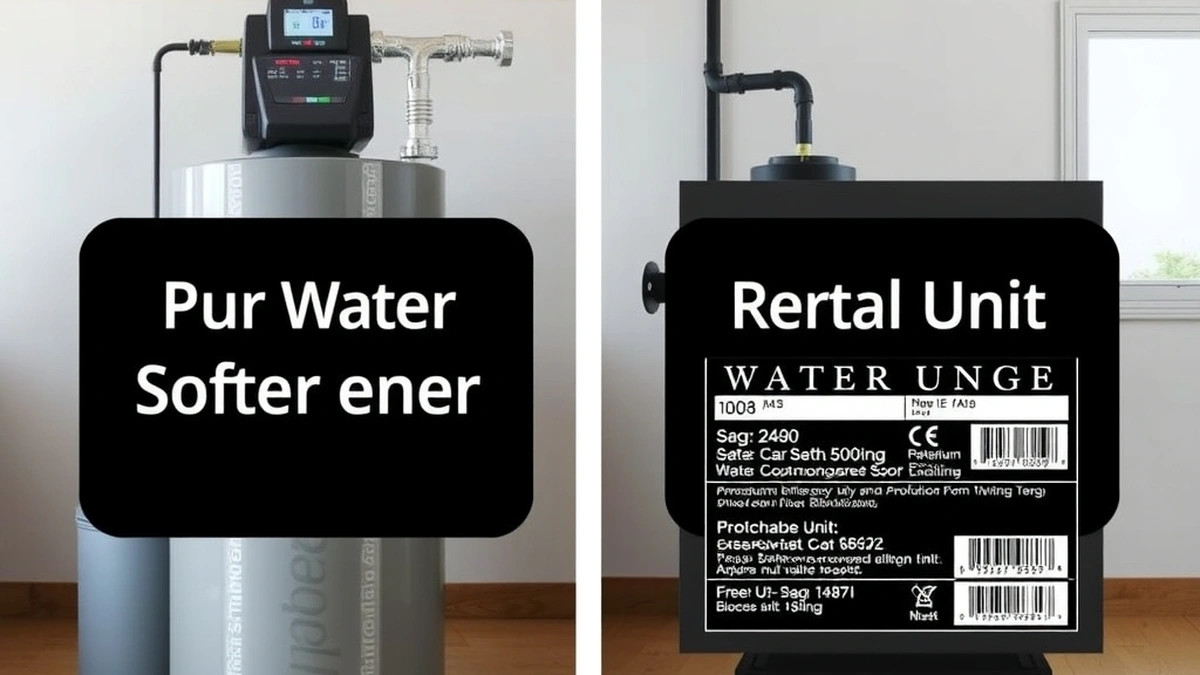
Buying usually costs less over 10 years than renting from a dealer, but renting shifts maintenance and resin rebed costs to the provider.
- Typical purchase installed
- $1,200–$4,500
- Typical rental monthly
- $25–$60
- Salt per year
- $120–$400
- Resin rebed
- $300–$600
- Softener life
- 10–15 years
Some links on this page are affiliate links.If you buy through them we may earn a commission at no extra cost to you. We do not accept payment for rankings. Read the full disclosure.
Buying a softener usually costs less over the life of the equipment than renting from a dealer, but renting shifts maintenance and salt responsibilities to the provider. The right choice depends on how long you plan to stay in the home and whether you want to manage salt and resin yourself. Start with a lab water test to confirm hardness and iron levels before comparing equipment or rental contracts.
How Buying Works
When you buy a softener, you pay for the equipment and installation up front, then cover ongoing salt and maintenance. Equipment typically ranges from $600 to $2,500, with installation adding $500 to $1,500. That puts total installed cost between $1,200 and $4,500.
Salt consumption depends on grain capacity and water hardness. A softener may use 8 to 12 pounds of salt per regeneration. If a household regenerates once per week at 10 pounds, that is roughly 520 pounds of salt per year. At typical retail salt prices, annual salt cost often falls between $120 and $400.
Resin eventually loses capacity. A resin rebed costs $300 to $600 and is commonly needed within the 8- to 12-year resin life, while the softener body may last 10 to 15 years.
Over 10 years, a purchased softener at the midpoint of installed cost—about $2,850—plus salt at $260 per year and one rebed at $450, totals roughly $6,500 before any financing or tax considerations. At the high end, installed cost of $4,500 plus $400 annual salt and one $600 rebed reaches about $9,500 over 10 years.
How Dealer Rentals Work
Dealer rentals typically charge a monthly fee that includes the softener, installation, and service. Monthly rental rates commonly fall between $25 and $60, though some contracts bundle salt delivery while others bill it separately.
Over 10 years, a $45 monthly rental totals $5,400. At $60 per month, the total reaches $7,200. If salt is not included, add $120 to $400 per year, or $1,200 to $4,000 over a decade. That pushes a 10-year rental total to roughly $6,600 at the low end and $11,200 at the high end.
Renting removes the upfront equipment cost and often covers repairs and resin replacement during the contract. However, you never own the equipment, and ending the rental may require returning the unit or paying a buyout fee. Review the contract for monthly escalation clauses, early termination fees, and who owns the resin tank if you cancel.
Side-by-Side 10-Year Estimate
| Cost item | Buying (mid-range) | Renting ($45/month, salt extra) |
|---|---|---|
| Equipment and installation | $2,850 | $0 upfront |
| Monthly rental (120 months) | $0 | $5,400 |
| Salt ($260/year) | $2,600 | $2,600 |
| Resin rebed (once) | $450 | Usually included |
| 10-year total | ~$5,900 | ~$8,000 |
These figures are estimates. Actual costs depend on local water hardness, salt prices, regeneration frequency, and dealer contract terms.
Grain Capacity and Salt Load
Softeners are sized by grain capacity, commonly 24,000 to 64,000 grains. Capacity affects how often the unit regenerates and how much salt it uses. A 32,000-grain softener treating very hard water may regenerate more often than a 64,000-grain unit treating the same water, increasing annual salt use.
If your water tests at 10 grains per gallon or higher, it falls in the very hard range. Iron above 2 to 3 ppm can exceed the effective limit for many softeners, meaning you may need pretreatment before softening. A lab water test costing $40 to $150 can confirm whether a softener alone is appropriate or whether you need an iron filter or other equipment first.
Hidden Costs and Contract Traps
Rental contracts may include annual price increases, minimum terms, or fees for moving the unit if you sell the home. Some dealers require you to use their salt or service technicians at set rates. Buying avoids those restrictions but places repair responsibility on you. Common owner costs include the resin rebed at $300 to $600 and valve or brine tank repairs over a 10- to 15-year life.
If you move frequently, renting may reduce the hassle of uninstalling and reinstalling equipment. If you plan to stay in one home for a decade or more, buying usually wins on total cost. For more on installed pricing, see water softener installation cost. For broader equipment pricing, see how much does a water softener cost.
Alternatives to Consider
If hardness is your only concern, a softener is the standard tool. If you also have sediment, chlorine, or whole-house filtration needs, costs change. A whole-house filter typically runs $500 to $1,800 installed, with cartridge replacement every 6 to 12 months at $80 to $300. Sediment cartridges may need replacement every 3 to 6 months. For drinking water only, an under-sink reverse osmosis system costs $300 to $900 installed and $60 to $150 per year in running costs, with membrane replacement every 2 to 3 years. Whole-house reverse osmosis runs $3,000 to $8,000 installed. See whole house water filter cost and reverse osmosis system cost for details.
If your water test shows iron or sulfur, those require separate treatment. Iron filters cost $800 to $2,500 installed, and sulfur filters cost $1,000 to $3,000 installed. UV systems treat microbiological concerns and use lamps replaced every 12 months at $30 to $90. See iron filter cost and uv water purifier cost.
Bottom Line
Buying a softener costs $1,200 to $4,500 installed plus $120 to $400 per year for salt and occasional resin rebeds of $300 to $600. Renting from a dealer commonly runs $25 to $60 per month, often with service included, but you do not build equity in the equipment. Over 10 years, buying usually costs less unless the rental includes salt and you value hands-off service more than ownership. Test your water first, compare total cost over your expected time in the home, and read the full rental contract before signing.
Frequently asked questions
Is buying cheaper than renting?
Over a 10–15 year softener life, buying usually has a lower total cost if you handle salt and occasional resin rebed yourself.
What does a dealer rental usually include?
Many dealer rentals include the unit, installation, salt delivery, and service, but terms vary by contract.
How long does a softener last?
Softener equipment typically lasts 10–15 years, while resin beds often last 8–12 years before a rebed.
Do I need a water test first?
Yes. Test for hardness and iron before sizing a softener, since iron above 2–3 ppm can exceed softener limits.
What is grain capacity?
Residential softeners commonly range from 24,000 to 64,000 grains, which affects salt use and regeneration frequency.
Can I rent and buy later?
Some dealers offer rental-to-own options, but you should review the contract terms before signing.
Sources
Some links are affiliate links.If you buy through them we may earn a commission at no extra cost to you. We do not accept payment for rankings. Read the full disclosure.