UV water purifier cost: unit, lamp and install
UV purifier equipment runs $400 to $1,200, installation $300 to $600, and lamps cost $30 to $90 every 12 months. Full cost breakdown with arithmetic.
A UV water purifier costs about $700 to $1,800 installed: $400 to $1,200 for the unit and $300 to $600 for labor. Lamps are replaced every 12 months at $30 to $90 each, so the ten-year running cost is roughly $300 to $900 in lamps alone.
- Equipment only
- $400 - $1,200
- Installation labor
- $300 - $600
- Total installed
- $700 - $1,800
- Lamp replacement
- $30 - $90 every 12 months
- Pre-filter requirement
- 5 micron sediment, usually
Some links on this page are affiliate links.If you buy through them we may earn a commission at no extra cost to you. We do not accept payment for rankings. Read the full disclosure.
A UV water purifier costs about $700 to $1,800 installed, made up of $400 to $1,200 for the chamber and lamp and $300 to $600 for plumbing labor. The lamp is a consumable: budget $30 to $90 every 12 months, because the bulb keeps glowing after its disinfecting output has faded. Those three numbers, unit, lamp, and install, are the whole cost picture.
What the Unit Price Actually Buys
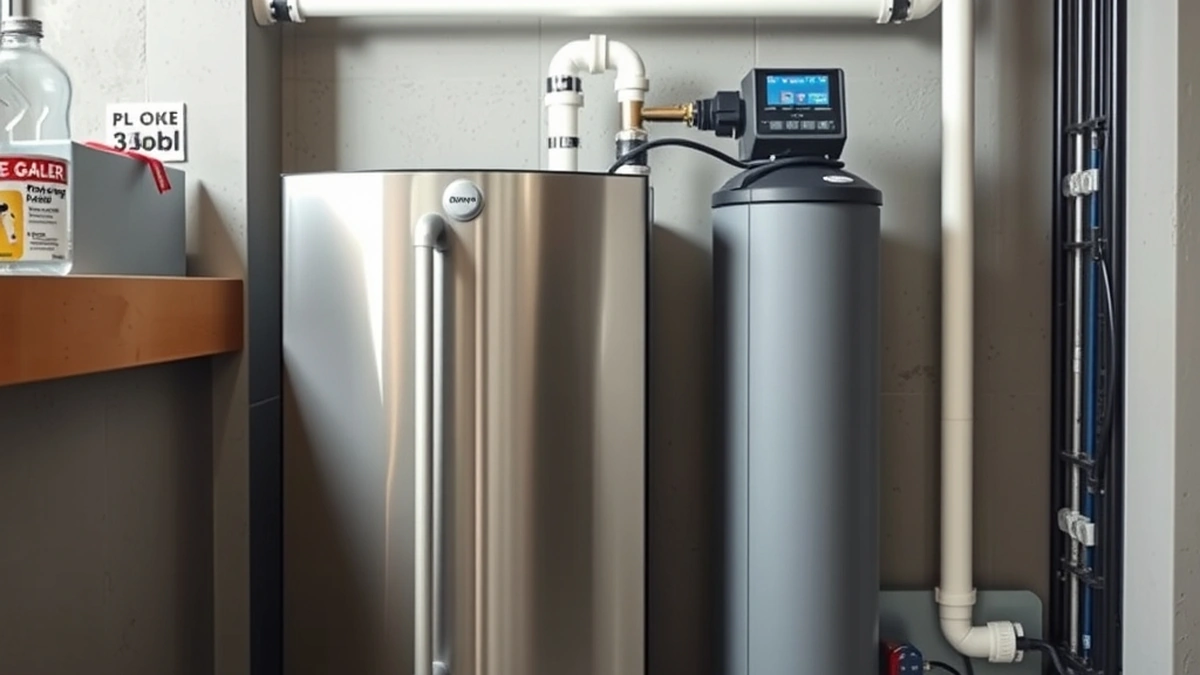
A UV purifier is a stainless steel chamber with a quartz sleeve, a low-pressure mercury lamp, a ballast, and a controller. Water flows past the sleeve and the lamp exposes it to UV-C light. That is the entire mechanism. Nothing is added to the water and nothing is filtered out.
Price tracks three specifications: flow rate in gallons per minute, chamber length, and controller features. A 6 GPM point-of-use unit for a single faucet sits near the bottom of the $400 to $1,200 equipment range. A 12 to 15 GPM whole-house unit with a lamp-life monitor and dry-fire protection sits near the top. A unit sized below your peak flow simply does not deliver the contact time the lamp needs, which is why upsizing for a whole house is normal.
The quartz sleeve is the part buyers forget. It is not the lamp and it is not covered by a lamp purchase unless the listing says so. Sleeves cloud from iron and hardness film and should be cleaned at each lamp change and replaced when cleaning no longer restores clarity.
The Lamp Is a Subscription, Not a Part
UV lamps are rated for about 9,000 hours of continuous operation, which is why the industry convention is 12 months. The lamp will still produce visible violet light at month 30. Visible light is not the same as germicidal output, and the two diverge well before the lamp dies.
Cost arithmetic over a decade is straightforward. One lamp at $60 per year is $600 across ten years. At the low end, $30 per year is $300. At the high end with a sleeve every second year, a realistic ten-year consumable total is closer to $900.
| Cost item | Typical range | Interval |
|---|---|---|
| UV chamber and lamp | $400 - $1,200 | once |
| Installation labor and fittings | $300 - $600 | once |
| Replacement lamp | $30 - $90 | 12 months |
| Quartz sleeve | $25 - $60 | 2 - 4 years |
| Sediment pre-filter cartridge | $10 - $40 | 3 - 6 months |
Note the bottom row. A UV system almost always sits behind a sediment filter, and that cartridge is part of the real operating cost even though it is not part of the UV box.
Why the Install Quote Varies
Labor runs $300 to $600 for a straightforward cut-in. The variables are predictable:
- Pipe material. PEX and copper cut and rejoin quickly. Galvanized steel does not, and a plumber may need to replace a section rather than tap it.
- Bypass. A three-valve bypass lets you service the chamber without shutting the house down. It adds fittings and about an hour.
- Power. The ballast needs a grounded outlet, ideally on a GFCI circuit, within cord reach. Running a new circuit is electrician work and is not in the plumbing quote.
- Access. A chamber mounted at chest height on a basement wall is a 90-minute job. One wedged above ductwork in a crawl space is not.
If your water is very hard, expect the sleeve to film faster and the lamp to work through a dirtier window. Softening ahead of the UV is a common pairing, and the softener cost breakdown explains what that adds.
Where UV Fits Against Other Treatment
UV is not a substitute for filtration or softening. It treats microorganisms only. A useful comparison:
| Concern | UV addresses it? | What does |
|---|---|---|
| Bacteria and viruses | Yes | UV chamber |
| Sediment and turbidity | No, and it blocks UV | Sediment filter |
| Hardness (scale) | No | Ion exchange softener |
| Iron and manganese | No | Iron filter |
| Chlorine taste | No | Carbon filter |
| Dissolved salts, nitrate | No | Reverse osmosis |
That table is the reason a UV quote on its own is rarely the whole answer. If your lab report shows hardness at 12 GPG and iron at 3 ppm, a UV lamp is being asked to shine through a film of both. Pre-treatment is not an upsell in that case; it is what makes the lamp work.
A Five-Step Buying Sequence
- Test the water first. A lab panel runs $40 to $150 and tells you whether the actual problem is microbial, mineral, or both. Without it you are guessing at equipment.
- Measure peak flow. Count bathrooms and fixtures, or read the well pump’s GPM rating. Size the chamber at or above that figure.
- Confirm pre-filtration. A 5 micron sediment cartridge ahead of the chamber is the normal minimum. Add carbon if chlorine or taste is an issue.
- Get two quotes that list the bypass and the outlet. A quote missing either is not comparable to one that includes them.
- Put the lamp on a calendar. Order the replacement lamp before month eleven, not after the water starts tasting odd.
Ten-Year Cost of Ownership
Take a mid-range whole-house unit: $800 equipment plus $450 labor equals $1,250 installed. Lamps at $60 per year for ten years equals $600. Two quartz sleeves at $40 equals $80. Sediment cartridges at $25 every four months is three per year, so $75 per year, or $750 across ten years. The total is $1,250 + $600 + $80 + $750 = $2,680, or about $268 per year.
That is an estimate built on published retail ranges, not a quote. The equipment itself should last 10 to 15 years; the ballast is usually the first electronic part to fail. Compare that annual figure against the alternatives before you decide UV is the right layer: a whole house filter solves taste and sediment for a similar install cost, and an under-sink reverse osmosis system handles dissolved contaminants at one tap for less.
If the test shows hardness rather than microbes, skip UV entirely and read what size softener a family of four needs. Buying a lamp to fix hard water is the most common mistake in this category.
Frequently asked questions
How much does a UV water purifier cost installed?
Most residential installs land between $700 and $1,800, split roughly into $400 to $1,200 for equipment and $300 to $600 for plumbing labor and fittings.
How often does a UV lamp need replacing?
Every 12 months. The lamp keeps glowing long after its UV-C output has dropped below the level needed to inactivate microorganisms, so calendar replacement is the rule.
What does a replacement UV lamp cost?
Replacement lamps typically run $30 to $90 depending on wattage and whether the purchase includes a new quartz sleeve and O-rings.
Does a UV purifier need a sediment filter before it?
Yes in most cases. Particles shield microbes from the light, so a 5 micron sediment cartridge ahead of the chamber is standard practice on well water.
Is installation a DIY job?
It can be on PEX or copper with a nearby outlet and drain, but the chamber is pressurized and needs a bypass, unions, and a grounded circuit, which is why most homeowners hire a plumber.
Does UV treatment change the taste of water?
No. UV light adds nothing to the water, so taste, odor, and mineral content are unchanged; any taste difference comes from the pre-filter, not the lamp.
Sources
Some links are affiliate links.If you buy through them we may earn a commission at no extra cost to you. We do not accept payment for rankings. Read the full disclosure.