
Diamond Crystal Solar Naturals Pellets: Product Guide
Solar Naturals is Diamond Crystal's compressed solar salt pellet line. See purity, bag price, where it is sold, and how it behaves in a brine tank.
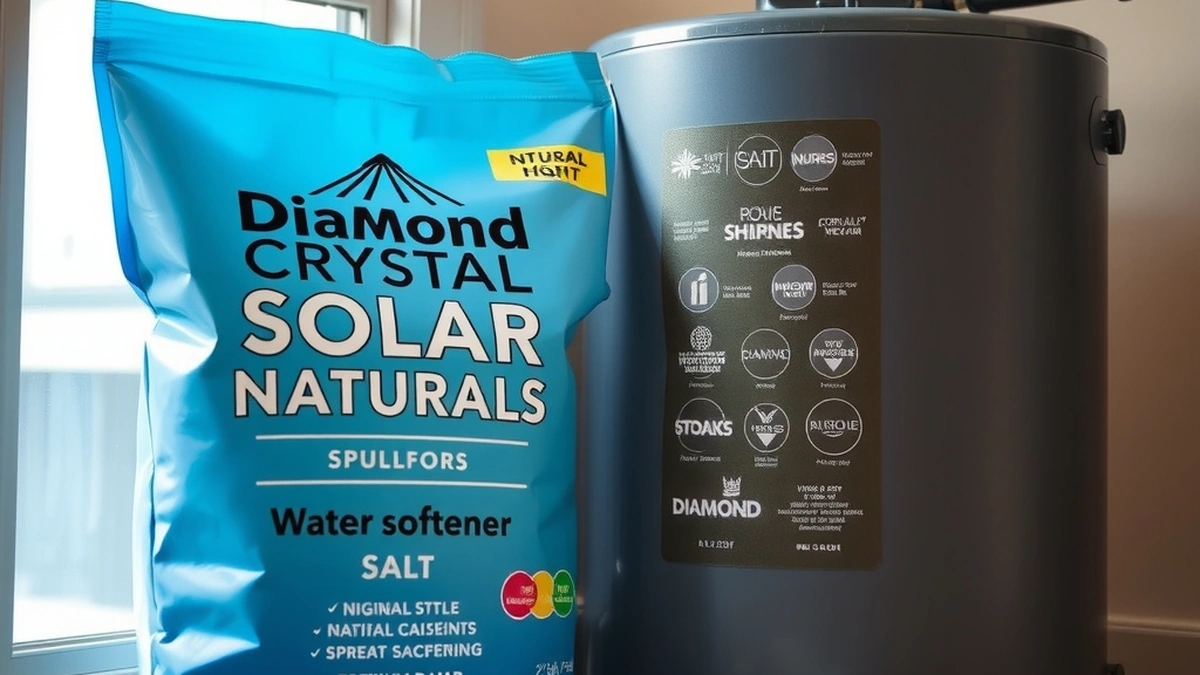
Diamond Crystal Solar Naturals water softener salt pellets are compressed solar salt, about 99.5 percent pure, sold in 40-pound bags for $7 - $12. They dissolve evenly, leave little tank residue, and suit most homes, especially humid basements.
- Bag size
- 40 lb
- Price
- $7 - $12
- Purity
- About 99.5 percent
- Form
- Compressed pellets
- Annual use
- 20 - 30 bags
Some links on this page are affiliate links.If you buy through them we may earn a commission at no extra cost to you. We do not accept payment for rankings. Read the full disclosure.
Diamond Crystal Solar Naturals water softener salt pellets are compressed solar salt sold in 40-pound bags for $7 - $12. They are about 99.5 percent pure sodium chloride, dissolve evenly, and leave little residue in the brine tank, which is why they are a default choice for humid basements.
What the Product Is
Solar Naturals starts as solar salt: brine evaporated in shallow ponds, harvested, washed, and dried. The dried salt is then compressed into small pellets under high pressure and screened for size.
Compression removes the fines that cloud brine and settle as sludge. The result is a dense pellet that dissolves from the outside in and keeps the brine relatively clear.
The “Solar Naturals” name refers to the solar evaporation process, not to an additive or a certification. It is plain sodium chloride unless the bag says otherwise.
Purity and Pellets
The label states roughly 99.5 percent sodium chloride. The remaining fraction is water, calcium sulfate, magnesium salts, and insoluble matter.
In a residential tank, that fraction is small but not zero. A 40-pound bag carries about 3 ounces of non-salt material, and 25 bags a year deposits roughly 5 pounds of sludge in the tank. That is why an annual clean-out is still part of the routine.
Pellets leave less of that material in circulation than coarse crystals because the fines were removed during compression. The sludge still accumulates, just more slowly.
Price and Where to Buy
| Retailer type | 40 lb price | Notes |
|---|---|---|
| Hardware store | $8 - $12 | Common, easy returns |
| Warehouse club | $7 - $10 | Pallets, membership |
| Farm supply | $7 - $10 | Deep stock |
| Grocery store | $9 - $13 | Convenience pricing |
| Water dealer | $10 - $16 | Delivery available |
Prices vary by region and season. Fall promotions drop the bag by $1 - $2, which is $20 - $60 a year at typical use.
Buy from a store with turnover. Bags that have sat in a humid stockroom can harden before they are opened, and hardened pellets dissolve slowly and bridge more readily.
How It Behaves in the Tank
Pellets dissolve evenly and hold their shape until the water reaches them. That makes the salt level easy to read and the brine strength predictable.
They resist bridging better than crystals but are not immune. A tank filled too high, a damp room, or new salt poured onto an old crust can still cause a bridge. Keep the tank half to two-thirds full and break up crusts monthly.
Pellets also flow through narrow fill openings, which matters for cabinet softeners where a scoop cannot reach the corners. Crystals jam at the opening; pellets slide past.
Cost Over a Year
A household using 25 bags a year at $9 per bag spends $225. At $7 per bag, the same use costs $175. At $12, it costs $300. All three sit inside the $120 - $400 annual salt range.
The salt line is small next to the equipment. A softener costs $600 - $2,500, installation adds $500 - $1,500, and the installed total is $1,200 - $4,500. Salt is the running cost that never stops, but it is not the reason to choose one unit over another.
Using the Pellets Correctly
- Fill the brine tank to two-thirds at most.
- Pour slowly and let the pellets settle.
- Never tamp or pack the salt.
- Keep the level above the brine line and below the overflow.
- Check monthly and stir if a crust forms.
- Clean the tank annually, removing sludge before refilling.
Do not mix pellets and crystals in layers. Finish one bag before opening the next, because mixed forms dissolve at different rates and can cause channeling.
When Another Form Fits Better
Crystals cost less per bag and dissolve faster, which suits a dry utility room and a household that cleans the tank on schedule. Potassium chloride fits a sodium-restricted household at three to four times the price.
Additive pellets fit water with 1 - 2 PPM iron, where a resin cleaner slows fouling. They do not replace an iron filter, and above 2 - 3 PPM the resin will foul regardless of the salt.
Storing a Year of Pellets
Twenty-five bags is half a ton, and half a ton of salt in a damp garage will not stay loose for twelve months. Buy six to ten bags at a time unless the storage is genuinely dry.
Stack on a pallet, not on the slab. Concrete wicks moisture into the bottom layer, and the bags that sit lowest are the ones that harden first. Keep the stack away from exterior walls and any floor drain.
Cover the stack loosely rather than sealing it. A tarp keeps dust and drips off while letting the salt breathe. A sealed plastic wrap traps condensation and does more harm than good.
Use the oldest bags first. Rotate the stack when new bags arrive so a forgotten bag does not sit at the back for two years and turn into a brick.
A pallet of pellets is 40 - 50 bags, or 1,600 - 2,000 pounds. That is more than most households use in two years, and it only makes sense with dry, raised storage. For a single-family home, six to ten bags is the practical unit of purchase.
Check the bag before pouring. Pellets that have absorbed moisture feel soft and clump in the hand. Break up clumps and pour them anyway; they will dissolve, just more slowly than fresh pellets.
For the brand overview, see Diamond Crystal water softener salt. For the form comparison, see water softener salt pellets. For annual pricing, see water softener salt cost.
Frequently asked questions
What are Solar Naturals pellets made of?
Compressed solar salt, which is sodium chloride harvested from evaporation ponds and pressed into pellets. The product is about 99.5 percent pure sodium chloride.
How much do Solar Naturals pellets cost?
A 40-pound bag typically sells for $7-$12 depending on the retailer and region, with seasonal promotions dropping the price by $1-$2.
Are Solar Naturals pellets better than crystals?
They dissolve more evenly and leave less tank residue, which means less cleaning. Crystals cost less per bag but require more maintenance.
Can I use these pellets in any water softener?
Yes. Compressed pellets work in cabinet and two-tank softeners, and they flow well through narrow fill openings.
Do Solar Naturals pellets contain additives?
The standard product is plain sodium chloride. Diamond Crystal sells separate lines with resin cleaners or rust inhibitors for households with iron.
How many bags will I use in a year?
Most households use 20-30 bags of 40 pounds, or 800-1,200 pounds, depending on hardness, occupancy, and regeneration settings.
Sources
Some links are affiliate links.If you buy through them we may earn a commission at no extra cost to you. We do not accept payment for rankings. Read the full disclosure.


