What Water Softener Salt Costs Per Year
Annual water softener salt costs typically run $120–$400 depending on hardness, usage, and regeneration settings.
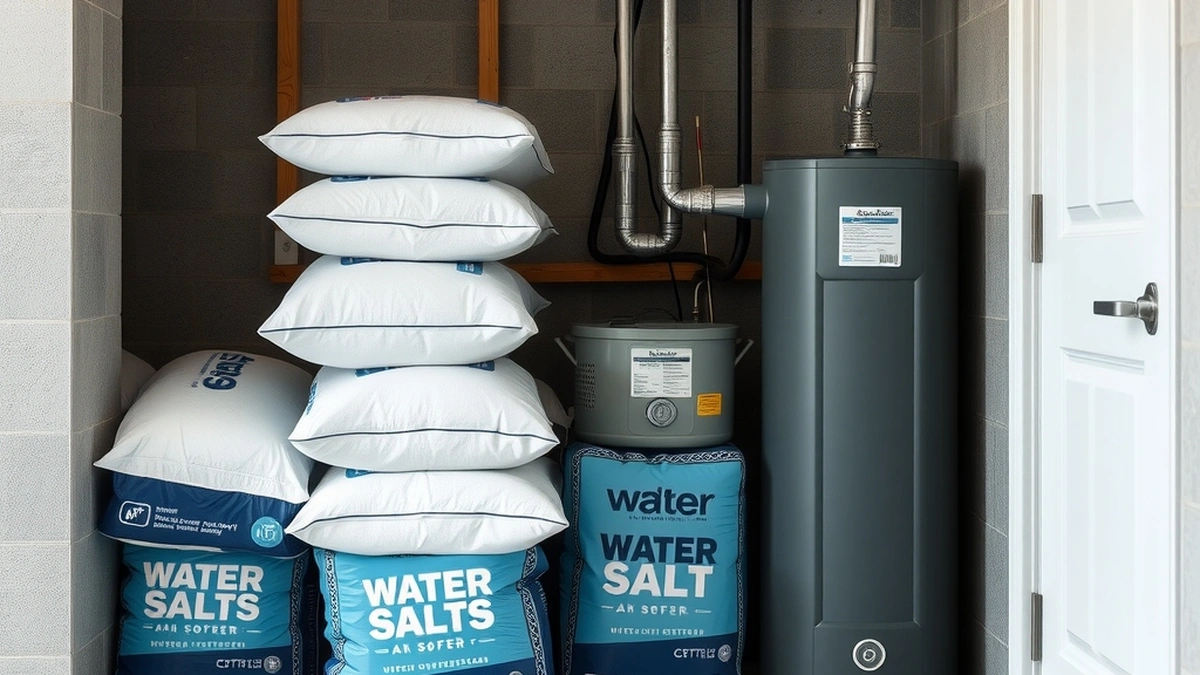
Most households spend $120 to $400 per year on water softener salt, depending on water hardness, household size, and regeneration frequency.
- Annual salt cost
- $120–$400
- Salt per regeneration
- 8–12 lbs
- Softener lifespan
- 10–15 years
- Installed softener cost
- $1,200–$4,500
Some links on this page are affiliate links.If you buy through them we may earn a commission at no extra cost to you. We do not accept payment for rankings. Read the full disclosure.
Most households spend $120 to $400 per year on water softener salt. The exact figure depends on water hardness, daily water use, and how often the softener regenerates. This guide breaks down the arithmetic behind those numbers so you can estimate your own annual cost before buying equipment.
How Salt Fits Into Softener Operating Costs
A water softener removes hardness minerals through ion exchange, and the resin bed must be recharged with salt periodically. Salt is a consumable, separate from the equipment and installation. Installed softener costs typically range from $1,200 to $4,500, but salt is an ongoing expense that recurs every year for the life of the system.
Annual salt cost depends on three variables:
- How many pounds of salt each regeneration uses
- How many regenerations occur per year
- The price per pound or per bag of salt
Canonical ranges for residential softeners put salt use at 8 to 12 pounds per regeneration and annual salt spend at $120 to $400. Those are estimates; your actual cost will vary with local salt prices and water conditions.
Calculating Annual Salt Usage
To estimate your own cost, start with regeneration frequency. A softener regenerates when its resin capacity is exhausted. Capacity is measured in grains, with common residential units ranging from 24,000 to 64,000 grains.
Here is a simplified example using mid-range numbers:
- Assume water hardness of 7 grains per gallon (gpg).
- Assume household water use of 300 gallons per day.
- Daily hardness load: 7 gpg × 300 gallons = 2,100 grains per day.
- Assume a 32,000-grain softener set to regenerate at roughly 80 percent capacity, or about 25,600 usable grains.
- Regeneration interval: 25,600 ÷ 2,100 ≈ 12 days.
- Regenerations per year: 365 ÷ 12 ≈ 30 cycles.
- Salt per regeneration: 10 pounds (midpoint of 8–12 lbs).
- Annual salt: 30 × 10 = 300 pounds.
If salt costs $0.40 to $0.80 per pound depending on bag size and purity, 300 pounds costs $120 to $240 per year. Very hard water or higher usage can push regenerations and salt use higher, moving annual cost toward the $400 end of the range.
Salt Price and Packaging
Salt is typically sold in 40-pound bags. At $5 to $10 per bag, the per-pound cost is roughly $0.13 to $0.25 for bulk or standard solar salt, while higher-purity pellets or potassium chloride can cost more. Buying in larger quantities or direct from a supplier often lowers the per-pound price, but storage space and handling are practical considerations.
Using the 300-pound example above:
- 300 lbs ÷ 40 lbs per bag = 7.5 bags, or about 8 bags per year.
- At $15 per bag: 8 × $15 = $120 per year.
- At $25 per bag: 8 × $25 = $200 per year.
Households with very hard water (10+ gpg) or large families may need 12 to 15 bags per year, which can exceed $300 annually depending on the product selected.
Comparing Salt Cost to Other Maintenance Expenses
Salt is not the only recurring cost for a softener. Resin eventually loses capacity and may need rebedding, typically estimated at $300 to $600. Softener lifespan is commonly estimated at 10 to 15 years, while resin life is often estimated at 8 to 12 years.
Over a 10-year period, salt at $120 to $400 per year totals $1,200 to $4,000. A single resin rebed at $300 to $600 adds to that total if needed within the system’s life. These are estimates, and actual service intervals depend on water quality, usage, and equipment design.
For context, other treatment systems carry different ongoing costs:
- Carbon filter cartridges: $80 to $300 per year, replaced every 6 to 12 months.
- Sediment cartridges: replaced every 3 to 6 months.
- Reverse osmosis membranes: replaced every 2 to 3 years, with running costs estimated at $60 to $150 per year for an under-sink unit.
- UV lamps: replaced every 12 months at $30 to $90 per lamp.
Salt cost for a softener sits in the middle of that range, but it is predictable and easy to budget because salt is a commodity product with stable pricing.
Hardness and Usage Drive Regeneration Frequency
Water hardness is measured in grains per gallon. Common classifications are:
- Soft: 0–3 gpg
- Moderate: 3–7 gpg
- Hard: 7–10 gpg
- Very hard: 10+ gpg
Softer water means fewer regenerations and less salt. Very hard water means the resin exhausts faster, triggering more regeneration cycles and higher salt consumption. Household size and water-using appliances also matter. A two-person household using 150 gallons per day will regenerate less often than a five-person household using 400 gallons per day, even with identical water hardness.
Iron can also affect softener performance. Softeners are generally limited to roughly 2–3 ppm of clear-water iron; higher levels may require pretreatment before softening, which changes the equipment and cost picture. Testing first is the standard approach: a lab water test typically costs $40 to $150 and establishes hardness, iron, and other parameters before equipment selection.
Salt Type and Equipment Compatibility
Most residential softeners use sodium chloride salt in solar, pellet, or block form. Potassium chloride is an alternative for households that want to avoid adding sodium, but it usually costs more per pound and may require adjustments to regeneration settings. Equipment manuals specify compatible salt types, and using the wrong form can cause bridging or mushing in the brine tank.
Salt quality also affects maintenance. Lower-grade salt may contain more insoluble impurities, which accumulate in the brine tank and require occasional cleaning. Higher-purity salt dissolves more cleanly but costs more per bag. The choice affects annual cost more through price per pound than through volume used.
Putting It All Together
Annual water softener salt cost is an operating expense layered on top of equipment and installation. With softener equipment at $600 to $2,500 and installation at $500 to $1,500, the installed total is typically $1,200 to $4,500. Salt adds $120 to $400 per year on top of that.
To estimate your cost:
- Test water for hardness and iron.
- Estimate daily household water use.
- Match softener grain capacity to your load.
- Calculate expected regenerations per year.
- Multiply regenerations by salt per regeneration (8–12 lbs).
- Multiply total pounds by your local salt price per pound.
That arithmetic gives you a realistic annual salt budget before you compare softener models or alternative treatment options such as salt-free conditioners, carbon filters, or reverse osmosis systems.
Next, compare how much does a water softener cost, water softener installation cost, whole house water filter cost before you commit.
Frequently asked questions
How much does water softener salt cost per year?
Most households spend $120 to $400 per year on softener salt, depending on water hardness, daily water use, and how often the unit regenerates.
How many pounds of salt does a softener use per regeneration?
A typical regeneration cycle uses 8 to 12 pounds of salt, though the exact amount depends on the softener’s grain capacity and programming.
Does very hard water increase salt cost?
Yes. Water above 10 grains per gallon generally requires more frequent regeneration, which increases annual salt consumption and cost.
Can I use potassium chloride instead of sodium chloride salt?
Potassium chloride works in most softeners but usually costs more per bag and may require different regeneration settings.
Is salt part of the installed softener price?
No. Installed cost covers equipment and labor; salt is an ongoing operating expense purchased separately.
How often should I add salt to the brine tank?
Check the brine tank monthly and add salt as needed; frequency depends on regeneration schedule and household water usage.
Sources
Some links are affiliate links.If you buy through them we may earn a commission at no extra cost to you. We do not accept payment for rankings. Read the full disclosure.