
House water filter
How to choose a whole-house water filter, size it by flow rate, and match the cartridge to what the water test actually shows.
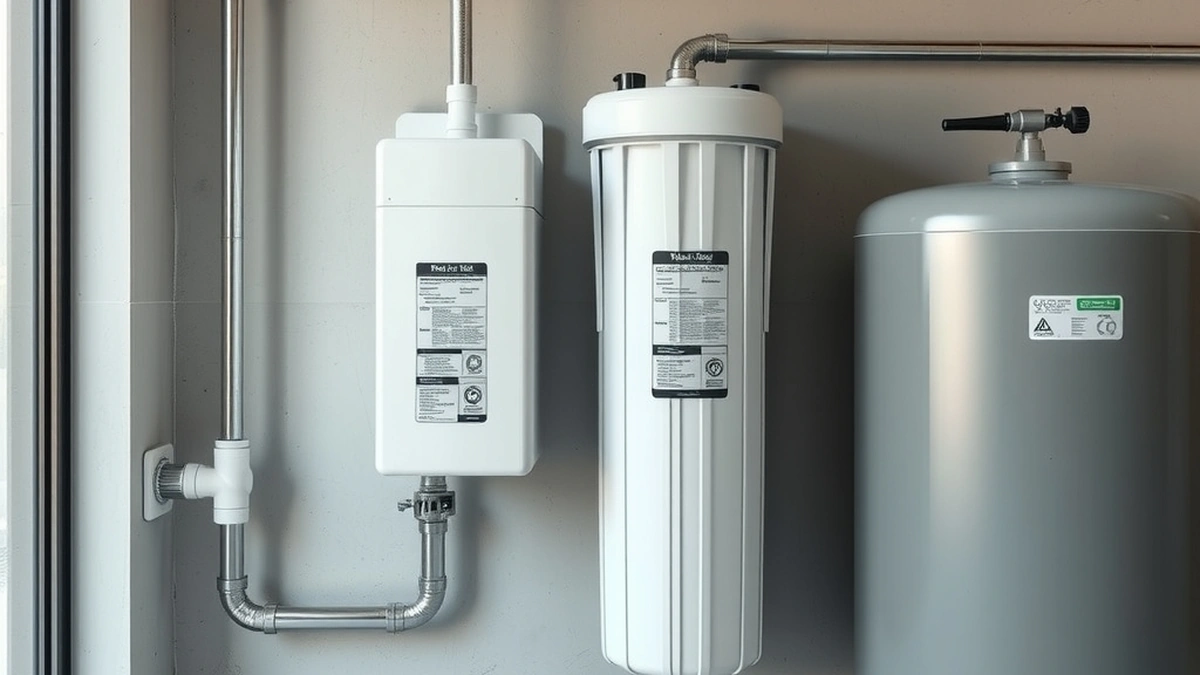
A house water filter treats all the water entering the home, usually with a sediment pre-filter and a carbon stage. Installed cost is $500 to $1,800, with cartridges at $80 to $300 per year, and sizing starts with the flow rate rather than the filter brand.
- Installed cost
- $500 - $1,800
- Cartridges per year
- $80 - $300
- Carbon cartridge life
- 6 - 12 months
- Sediment cartridge life
- 3 - 6 months
- Typical flow rate
- 8 - 15 gpm
Some links on this page are affiliate links.If you buy through them we may earn a commission at no extra cost to you. We do not accept payment for rankings. Read the full disclosure.
A house water filter treats every gallon that enters the home, usually through a sediment stage followed by carbon. Installed cost is $500 to $1,800, with cartridges at $80 to $300 per year. Sizing starts with the flow rate the house needs and the results of a water test, not with the filter’s marketing label.
What a whole-house filter is
A whole-house filter is a point-of-entry system installed on the main line after the meter or pressure tank. Water passes through one or more cartridges before it reaches any tap, appliance, or fixture.
The most common configuration is a sediment pre-filter followed by a carbon block or granular carbon stage.
The sediment stage catches sand, rust, and grit. The carbon stage reduces chlorine, taste, and odour, and some carbons target chloramine or specific compounds.
A filter is not a softener. It does not remove calcium and magnesium, and it does not change the water’s hardness.
Test before you buy
A lab water test costs $40 to $150 and reports hardness, iron, manganese, pH, and other parameters. That report decides the cartridge selection.
Hardness is measured in grains per gallon. Soft is 0 to 3 GPG, moderate is 3 to 7, hard is 7 to 10, and very hard is above 10. If hardness is the issue, a filter will not solve it and a softener will.
Iron matters because a carbon filter can foul quickly at higher concentrations. Most softeners handle 2 to 3 ppm of iron, and above that a dedicated iron filter at $800 to $2,500 installed is usually needed upstream.
If the water is from a private well, test for bacteria and nitrate as well. A filter is not a disinfection device, and carbon can support bacterial growth if the water is not pre-treated.
Sizing by flow rate
Filters are rated in gallons per minute. A house with two bathrooms, a dishwasher, and a washing machine can draw 8 to 15 gpm at peak.
| Household demand | Peak flow | Filter rating to specify |
|---|---|---|
| One bathroom, two people | 6 - 8 gpm | 10 gpm |
| Two bathrooms, four people | 10 - 12 gpm | 15 gpm |
| Three or more bathrooms | 15 gpm or more | 20 gpm |
An undersized filter restricts pressure and wears out cartridges faster. A filter rated at 8 gpm on a house that peaks at 12 gpm will show a pressure drop whenever two showers run.
Check the pressure drop at rated flow, not just the maximum flow. A filter that claims 15 gpm but drops 15 psi at that rate is not usable in a house with marginal pressure.
What the installation includes
| Item | Typical share | Notes |
|---|---|---|
| Filter housing and cartridge | 40% - 60% | Varies by stages and brand |
| Bypass valve | 10% - 15% | Needed for cartridge changes |
| Plumbing and fittings | 20% - 30% | Copper or PEX, shut-offs |
| Labour | 15% - 25% | Usually half a day |
A bypass valve is not optional in practice. Without it, every cartridge change means shutting water off to the whole house.
Mount the housing where it can be reached without a ladder and where a leak will not damage finished space. A garage wall or a utility room is typical.
Cartridge life and running cost
Sediment cartridges typically last 3 to 6 months. Carbon cartridges typically last 6 to 12 months, though chloramine and high sediment loads shorten that.
At $80 to $300 per year for cartridges, the running cost is modest compared with the installed price. The bigger risk is forgetting the change and running a spent carbon block that no longer reduces taste or chlorine.
Set a reminder tied to the cartridge type rather than to a season. A sediment cartridge in a well-water house may need changing every 3 months, while a carbon cartridge on municipal water may last a year.
Filter or softener
| Issue | Filter | Softener |
|---|---|---|
| Sediment | Yes | No |
| Chlorine and taste | Yes | No |
| Hardness | No | Yes |
| Iron up to 2 - 3 ppm | Partial | Yes |
| Scale on fixtures | No | Yes |
| Cost | $500 - $1,800 installed | $1,200 - $4,500 installed |
Many homes need both, in series: a sediment filter, then a softener, then a carbon filter if chlorine taste matters.
The order is not arbitrary. Sediment first keeps grit out of the softener valve, and the softener ahead of the carbon keeps scale off the carbon block so the cartridge lasts its full interval. Reversing the last two stages is a common mistake that shows up as frequent carbon changes rather than as a water quality complaint.
How to choose
- Get a lab water test at $40 to $150 and read the hardness, iron, and sediment results.
- Measure the peak flow the house needs, based on bathrooms and appliances.
- Decide which contaminants matter: sediment, chlorine, chloramine, or iron.
- Choose a housing sized above the peak flow with a bypass valve.
- Confirm the cartridge is certified to a recognised standard for the claim being made.
- Price the annual cartridge cost before comparing installed prices.
Certification matters. A filter claiming to reduce lead or cysts should carry a listing to the relevant NSF/ANSI standard, and the listing should name the exact model.
For a comparison of point-of-use and point-of-entry approaches, see whole house versus under sink filter. For the carbon stage in detail, activated carbon water filter covers the media types, and whole house water filter cost breaks down the pricing.
Bottom line
A house water filter is a sediment and carbon system sized by flow rate and chosen after a water test. Expect $500 to $1,800 installed and $80 to $300 per year in cartridges. If hardness is the problem, the filter is the wrong tool.
Frequently asked questions
What does a house water filter do?
It treats all the water entering the home, removing sediment, chlorine, taste, and odour depending on the cartridge stages installed.
How much does a whole-house filter cost?
Installed cost is typically $500 to $1,800, with replacement cartridges running $80 to $300 per year depending on the stages.
How often do cartridges need changing?
Sediment cartridges typically last 3 to 6 months and carbon cartridges 6 to 12 months, depending on water quality and usage.
What flow rate do I need?
Most homes need 8 to 15 gallons per minute, and the filter should be rated above the peak demand of the fixtures running at once.
Does a house filter soften water?
No. A filter removes particles and some chemicals, while a softener uses ion exchange to remove hardness minerals.
Should I test the water first?
Yes. A lab test at $40 to $150 shows hardness, iron, and other parameters so the filter stages match the actual water.
Sources
Some links are affiliate links.If you buy through them we may earn a commission at no extra cost to you. We do not accept payment for rankings. Read the full disclosure.


