
How a Water Softener Works, Step by Step
A step-by-step look at ion exchange, regeneration, salt use, and what a softener does and does not remove from home water.
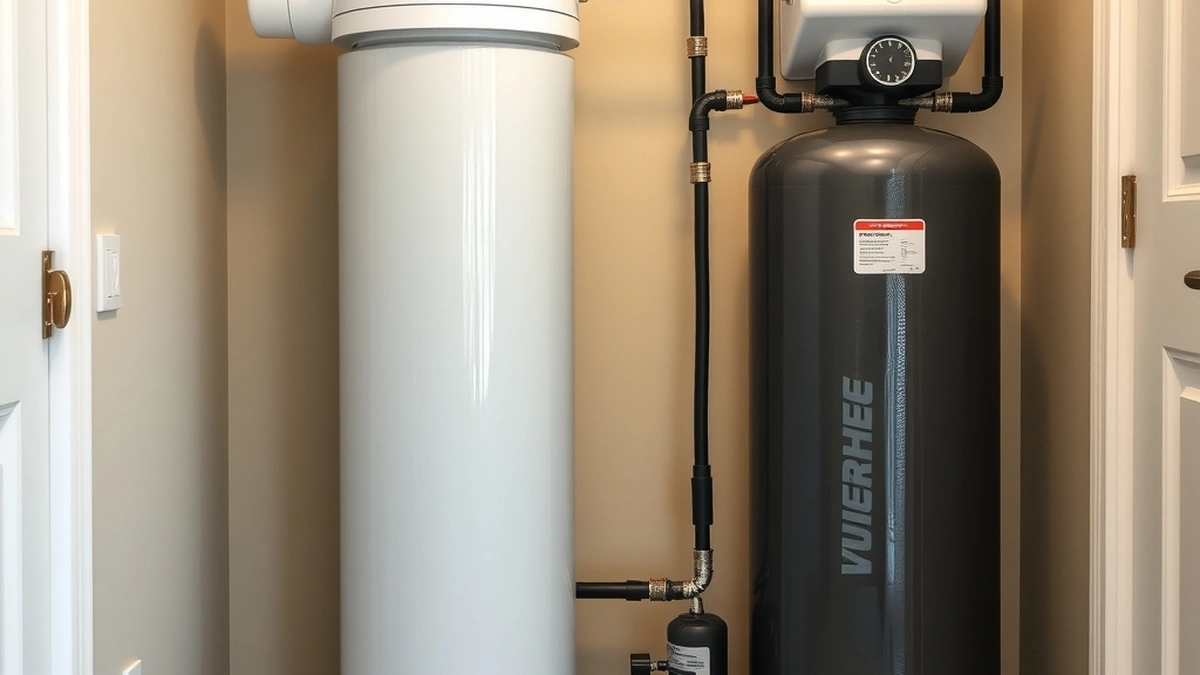
A water softener passes hard water through resin beads that trade sodium for calcium and magnesium, then flushes the beads with brine to restore capacity.
- Equipment cost
- $600–$2,500
- Installed cost
- $1,200–$4,500
- Salt per year
- $120–$400
- Resin bed life
- 8–12 years
- System life
- 10–15 years
Some links on this page are affiliate links.If you buy through them we may earn a commission at no extra cost to you. We do not accept payment for rankings. Read the full disclosure.
A water softener removes dissolved calcium and magnesium from household water using ion exchange. As hard water moves through a resin bed, the beads hold onto hardness minerals and release sodium in their place. The system periodically cleans itself with a salt brine so it can continue softening water.
1. Hard water enters the softener
Water enters the softener tank from the main supply line, usually where plumbing enters the home. Before buying equipment, a water test should measure hardness in grains per gallon (GPG) and check for iron, manganese, and other contaminants. Hardness is commonly classified as soft at 0–3 GPG, moderate at 3–7 GPG, hard at 7–10 GPG, and very hard at 10+ GPG.
If the test shows iron above roughly 2–3 ppm, a standard softener may not handle it effectively, and dedicated iron treatment may be needed. Softener equipment typically costs $600–$2,500, with installed costs of $1,200–$4,500 depending on plumbing and labor.
2. Water flows through the resin bed
Inside the mineral tank is a bed of small polystyrene beads, known as resin. The beads are coated with sodium ions. As water passes through, calcium and magnesium ions in the water attach to the resin, and sodium ions are released into the water. This exchange removes the minerals that cause scale buildup in pipes and water heaters.
Resin capacity is measured in grains, with common residential systems ranging from 24,000–64,000 grains. To estimate daily softening load, multiply household water use by hardness. For example, a home using 300 gallons per day with 10 GPG hardness produces 3,000 grains of hardness per day (300 × 10). A 32,000-grain system would theoretically handle that load for roughly 10 days between regenerations, though actual programming and reserve capacity affect the schedule.
3. Softened water exits to the home
Once water has passed through the resin bed, it flows out through a distributor and into the home’s plumbing. At this point, the water contains sodium instead of calcium and magnesium. The amount of sodium added is proportional to the hardness removed; very hard water results in more sodium exchange.
People on sodium-restricted diets should consider this when deciding whether to soften all household water or use a bypass for drinking water taps. A softener does not remove chlorine, bacteria, nitrate, or most dissolved solids. Those issues require different equipment, such as carbon filtration, reverse osmosis, or ultraviolet treatment.
4. The system tracks capacity and triggers regeneration
The softener’s control valve monitors water usage or operates on a timer. When the resin approaches its capacity limit, the system starts a regeneration cycle. During regeneration, the softener stops normal softening and begins cleaning the resin bed.
Most residential softeners regenerate automatically based on metered usage, though timer-based models exist. Metered systems generally use salt and water more efficiently because they regenerate only when needed.
5. Brine draws from the salt tank
The control valve draws a concentrated salt solution, or brine, from the brine tank and pushes it through the resin bed. The high concentration of sodium in the brine forces calcium and magnesium off the resin beads. The hardness minerals and excess brine are then flushed to the drain.
Regeneration typically uses 8–12 pounds of salt per cycle, depending on system size and settings. Salt costs average $120–$400 per year for a typical household, though usage varies with water hardness and consumption.
6. Rinse and return to service
After the brine draw, the system rinses the resin bed with fresh water to remove remaining hardness minerals and brine residue. The brine tank refills with water to dissolve salt for the next cycle. Once rinsing is complete, the softener returns to normal operation and resumes softening water.
A full regeneration cycle can take roughly 60–90 minutes, depending on the model and programming. During this time, some systems bypass hard water rather than soft water, so household water use may be limited during regeneration.
7. Ongoing maintenance and replacement
Resin beds typically last 8–12 years before performance declines enough to consider rebedding, which costs roughly $300–$600. The full softener system has an expected life of 10–15 years. Salt must be added to the brine tank regularly, and the brine tank should be inspected for salt bridges or buildup.
Softener salt costs run $120–$400 per year. If a home also needs whole-house filtration for sediment, chlorine, or other contaminants, those systems add separate equipment and cartridge costs. Whole-house filters commonly flow at 8–15 GPM, and carbon cartridges usually need replacement every 6–12 months at $80–$300 per year.
Comparing softeners to alternatives
Salt-free conditioners cost roughly $500–$1,800 installed and do not remove hardness minerals through ion exchange. Carbon filters cost about $500–$1,800 installed and address taste, odor, and chlorine but not hardness. Under-sink reverse osmosis systems cost $300–$900 installed and use membranes with 80–95% rejection rates, but they waste 3–4 gallons for every gallon produced and are not whole-house softening solutions.
Whole-house reverse osmosis costs $3,000–$8,000 installed and is rarely used solely for hardness because of cost, waste ratio, and plumbing complexity. For hardness alone, ion-exchange softening remains the standard approach, provided the water test confirms the issue and iron levels are within the softener’s limits.
Cost example
Assume a household installs a mid-range softener for $1,500 equipment plus $1,000 installation, for $2,500 total installed. Annual salt is $250. Over a 12-year system life, salt totals $3,000. If the resin bed is replaced once at year 8 for $450, the 12-year cost is roughly $5,950, or about $496 per year before water and sewer costs for regeneration.
This estimate excludes increased water usage from regeneration and any pre-treatment needed for iron, sulfur, or sediment. A lab water test costs $40–$150 and is the recommended first step before sizing or purchasing any equipment.
Hardness minerals cause scale in water heaters, appliances, and plumbing, which can reduce efficiency over time. The U.S. Department of Energy notes that water heating is a major home energy use, and scale buildup on heating elements can affect performance. Softening water does not guarantee energy savings, but it removes the minerals responsible for scale formation.
A water softener is a single-purpose tool: it exchanges hardness minerals for sodium and regenerates on a schedule. It is not a filter for bacteria, chemicals, or sediment. Testing first, then matching equipment to the test results, keeps costs and maintenance predictable.
Internal resources
Readers exploring related equipment can review water softener cost, water softener installation cost, and whole-house water filter cost for pricing context. Those with well water may also want well water treatment cost, while reverse osmosis system cost applies to point-of-use drinking water. Iron filter cost and UV water purifier cost cover separate contamination issues, and water softener salt cost details ongoing consumable expenses.
Next, compare how much does a water softener cost, water softener installation cost, whole house water filter cost before you commit.
Frequently asked questions
Does a softener remove chlorine?
No. A standard softener targets hardness minerals; chlorine reduction typically requires carbon filtration.
How often does a softener regenerate?
Frequency depends on water hardness, household usage, and programmed settings; it can range from every few days to weekly.
Can a softener remove iron?
Only limited amounts, roughly 2–3 ppm in many standard models; higher levels usually need dedicated iron treatment.
Is softened water safe to drink?
Softened water contains added sodium; people on sodium-restricted diets should check with a medical professional.
How much salt does a regeneration use?
Typical models use about 8–12 pounds of salt per regeneration, depending on size and programming.
What is the difference between a softener and a conditioner?
Softeners remove hardness minerals through ion exchange; salt-free conditioners alter mineral behavior without removing them.
Sources
Some links are affiliate links.If you buy through them we may earn a commission at no extra cost to you. We do not accept payment for rankings. Read the full disclosure.


