How to choose a water softener
Choose a softener by hardness and daily gallons, not by brand. See the grain-capacity math, valve types, and the $1,200-$4,500 installed range.
Choose a water softener by multiplying hardness in grains per gallon by daily household gallons, then adding a reserve. A family of four at 10 gpg needs roughly 32,000 grains of capacity, which costs $1,200-$4,500 installed.
- Sizing formula
- Hardness x daily gallons
- Typical capacity
- 24,000 - 64,000 grains
- Installed cost
- $1,200 - $4,500
- Salt per year
- $120 - $400
- System life
- 10 - 15 years
Some links on this page are affiliate links.If you buy through them we may earn a commission at no extra cost to you. We do not accept payment for rankings. Read the full disclosure.
Choose a water softener by two numbers: hardness in grains per gallon and daily household gallons. Multiply them, add a reserve, and you have the capacity. Everything else — brand, valve, tank style — is a decision made after the size is settled.
Start with a lab number, not a strip
A water softener is sized on hardness, and hardness has to come from a test that reports a real number. Strips read in wide bands, often 25-50 ppm, which is not precise enough to choose between a 32,000 and 48,000 grain unit.
A lab panel at $40-$150 reports hardness in grains per gallon along with iron, manganese, and pH. Those three matter because iron above 2-3 ppm fouls resin, and low pH corrodes the valve.
Hardness bands put the decision in context: soft is 0-3 gpg, moderate 3-7, hard 7-10, and very hard above 10. A softener is usually justified above 7. Between 3 and 7 it is a preference about soap and scale, not a necessity.
The sizing arithmetic
Capacity in grains equals hardness times daily gallons times days between regenerations, plus a reserve.
Work it through for a family of four at 10 gpg. Four people at 75 gallons each is 300 gallons per day. At 10 gpg, that is 3,000 grains removed per day. Over seven days, 21,000 grains. Add 20 percent reserve and the tank needs about 25,000 grains, so a 32,000-grain unit is the sensible pick.
At 20 gpg the same household needs 50,000 grains, which puts it in a 48,000 or 64,000 grain unit. At 5 gpg, 16,000 grains would do, and a 24,000-grain unit leaves comfortable headroom.
Oversizing wastes salt and floor space. Undersizing means the house runs hard before the next regeneration, which shows up as spots on glasses on day six.
Valve type decides the salt bill
| Valve type | Cost premium | Behavior | Best for |
|---|---|---|---|
| Timer | Baseline | Regenerates on a fixed schedule | Predictable water use |
| Metered | $150 - $350 | Regenerates when capacity is used | Most households |
| Demand with hardness sensor | $300 - $500 | Adjusts to actual hardness | Variable water sources |
A metered valve is the default recommendation. It regenerates based on gallons treated, so a week with guests does not run the house hard and a week away does not waste salt.
A timer valve is not obsolete. In a household with identical daily use, it performs the same and costs less. It becomes a problem when use swings.
Tank, resin, and salt
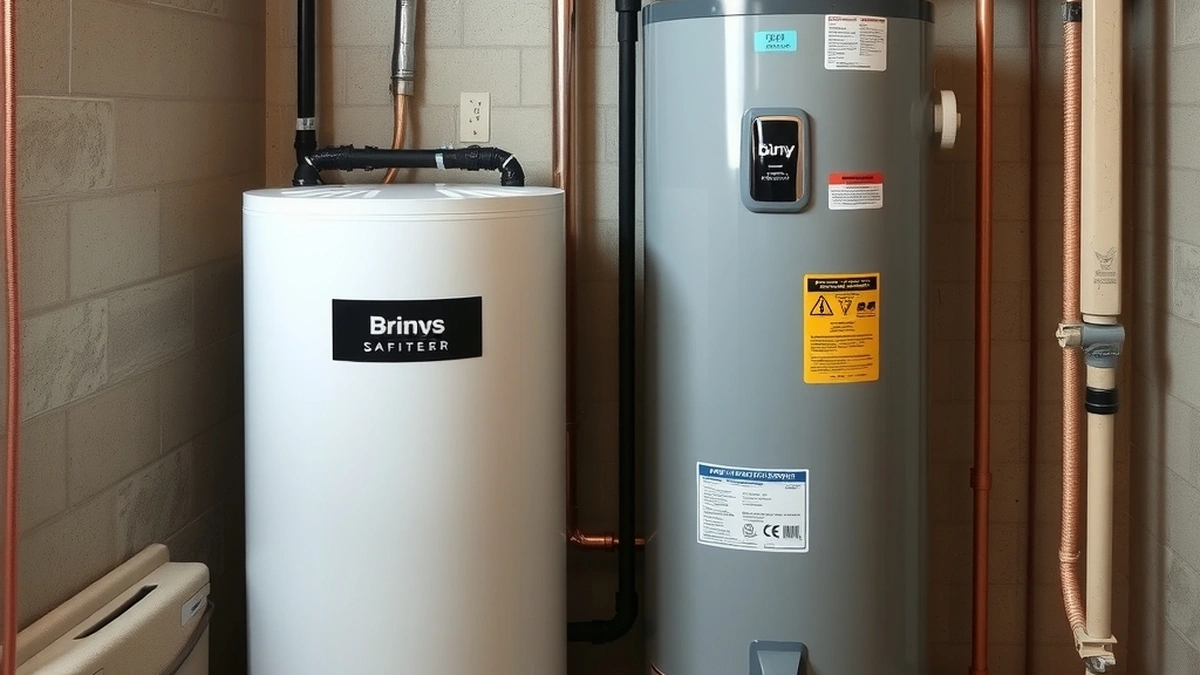
A standard softener uses a fiberglass pressure vessel with a plastic valve and a brine tank, holding 24,000-64,000 grains of capacity. Resin life is 8-12 years, and a rebed costs $300-$600.
Salt dose is 8-12 pounds per regeneration, and annual salt spend is $120-$400. Pellets are the safe default; solar salt is cheaper and dirtier; potassium chloride costs two to three times as much.
Tank size follows capacity. A 32,000-grain unit typically uses a 10-inch by 54-inch tank; a 64,000-grain unit uses a 12-inch by 52-inch or a taller vessel. Measure the space before ordering, including the brine tank.
Installation constraints
A softener needs a drain within 10-15 feet, a grounded 120V outlet, and about 4 square feet of floor space for the two tanks. A bypass valve is mandatory so the house can run during service.
Homes without a floor drain can use a standpipe or a laundry sink. Homes without an outlet need one at $150-$350, which is a line item people forget.
A crawlspace install is possible but adds labor and difficulty. A garage install needs freeze protection. A condo or apartment may have no main-line access at all, which is why water softener in a condo exists as a separate problem.
Comparing formats before buying
A single tank at $1,200-$4,000 installed is right for most homes. A dual tank at $1,800-$4,500 adds continuous soft water during regeneration and doubles the footprint.
A salt-free conditioner at $500-$1,800 does not remove hardness, so it is not a substitute if the goal is a lower hardness reading. Salt-based versus salt-free softener sets out the difference plainly.
An ion exchange system also removes some iron and manganese at low levels, but not above 2-3 ppm. If the lab report shows more, budget for an iron filter at $800-$2,500 ahead of the softener.
A buying sequence that works
- Pull a lab panel and record hardness, iron, manganese, and pH.
- Count household occupants and estimate daily gallons at 60-80 per person.
- Multiply hardness by daily gallons by seven, then add 20 percent.
- Pick the next standard capacity above that number.
- Choose a metered valve unless water use is perfectly stable.
- Confirm drain, outlet, and floor space before ordering.
- Get two quotes that list valve brand, tank size, and resin volume.
What to ignore
Ignore grain counts advertised as “maximum” rather than “efficient.” A unit rated at 64,000 grains at a 15-pound salt dose delivers far less at a normal dose.
Ignore tank color and cabinet styling. The valve and the resin volume are what you are buying.
Ignore lifetime warranties that exclude labor and resin. Read what is actually covered, and for how many years.
For the cost side in more detail, how much does a water softener cost breaks out equipment and labor, and water softener grain capacity walks the sizing math with more examples. “”
Frequently asked questions
What size water softener do I need?
Multiply hardness in grains per gallon by daily household gallons, then size the tank for a week of capacity with a reserve. A family of four at 10 gpg and 300 gallons per day needs about 32,000 grains.
Is a metered valve worth the extra cost?
Usually yes. A demand-initiated valve regenerates when capacity is used rather than on a fixed timer, which saves salt and water. The premium is $150-$350.
How much does a water softener cost installed?
One thousand two hundred to four thousand five hundred dollars, including equipment at $600-$2,500 and installation at $500-$1,500.
Do I need a softener if hardness is 5 grains per gallon?
It is optional at that level. Softening is usually justified above 7 grains per gallon, where scale and soap consumption become noticeable.
What is the difference between a softener and a conditioner?
A softener removes calcium and magnesium through ion exchange. A conditioner changes how those minerals behave but does not remove them, so a hardness test still reads the same.
How long does a water softener last?
Ten to fifteen years for the tank and valve, with a resin rebed at 8-12 years at $300-$600. Salt runs $120-$400 per year.
Sources
Some links are affiliate links.If you buy through them we may earn a commission at no extra cost to you. We do not accept payment for rankings. Read the full disclosure.