iSpring reverse osmosis review
An owner's-view review of iSpring under-sink RO systems: stage layout, cartridge costs, tank sizing, install effort, and where the design falls short.
iSpring under-sink RO systems are fair value for a four- to five-stage unit at $200 to $400, with widely available cartridges and a standard pressure tank. They suit DIY installs on municipal water and are wrong for hard well water or low pressure.
- Typical equipment
- $200 - $400
- Installed by a plumber
- $300 - $900 total
- Annual cartridges
- $60 - $150
- Membrane life
- 2 - 3 years
- Waste ratio
- 3 - 4:1
Some links on this page are affiliate links.If you buy through them we may earn a commission at no extra cost to you. We do not accept payment for rankings. Read the full disclosure.
iSpring sells standard under-sink reverse osmosis systems in the $200 to $400 equipment range, built around common cartridge sizes and a conventional pressure tank. That is the whole case for them: ordinary parts, ordinary install, ordinary price. Whether that is enough depends on your water and your cabinet, and this review works through both.
What the Systems Are
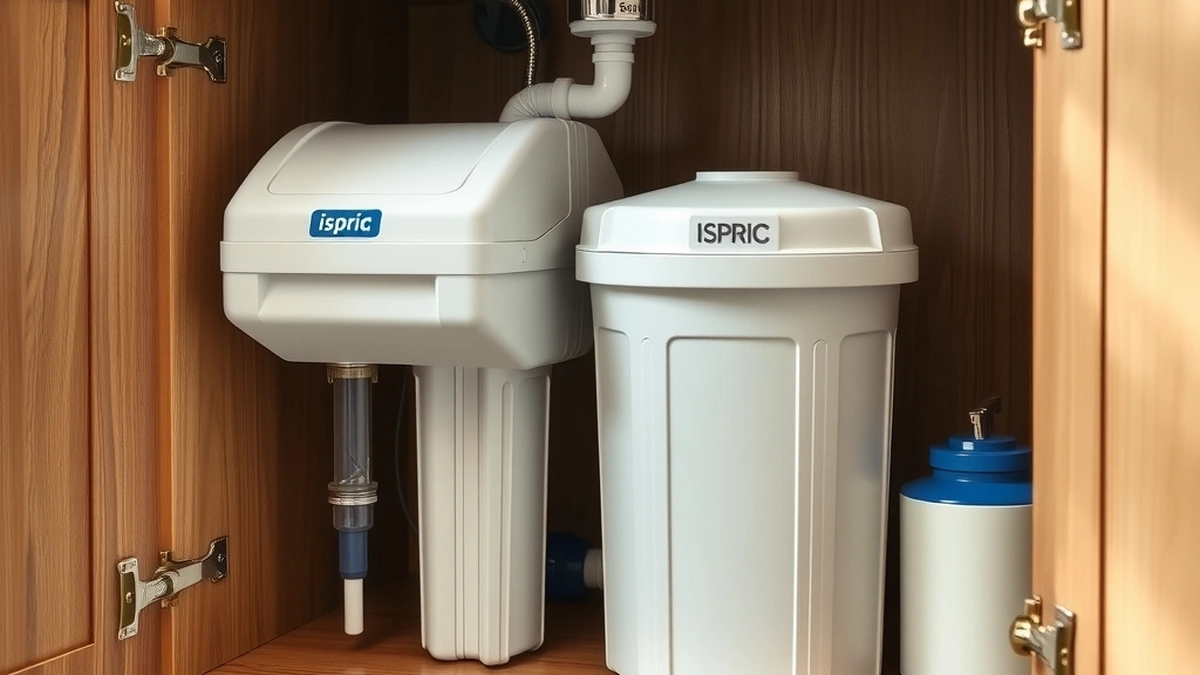
The core product is a four- or five-stage unit. Water enters through a sediment pre-filter, passes a carbon block, reaches a TFC membrane, and finishes at a post-carbon polishing filter. Five-stage versions add a second carbon stage, usually aimed at chloramine or at taste. A pressurized storage tank sits beside the unit and a dedicated faucet goes through the countertop.
The build is what you would expect at the price: plastic housings, push-fit fittings, a metal or plastic faucet depending on the kit, and a tank with a butyl bladder. None of that is a criticism at this price point. It is the same architecture sold by most brands in this segment, and the differences between them are mostly in the fittings and the cartridge supply.
The Numbers That Decide Value
Equipment runs $200 to $600 across the category, and iSpring sits at the lower half of that. Installed cost lands at $300 to $900 including labor. Cartridges run $60 to $150 per year and the membrane needs replacement every 2 to 3 years.
Work the five-year total honestly. Take a $300 unit, $80 per year in filters, and one $50 membrane: $300 + ($80 × 5) + $50 = $750, or $150 per year. Add a plumber at $350 and the total is $1,100, or $220 per year. That is competitive with any brand selling standard cartridges, and cheaper than any brand selling proprietary ones at $60 per cartridge.
| Cost line | Range | Interval |
|---|---|---|
| System | $200 - $400 | once |
| Installation | $0 - $400 | once |
| Pre and post filters | $60 - $150 | 12 months |
| Membrane | $40 - $80 | 2 - 3 years |
| Faucet or adapter kit | $0 - $60 | once |
What the Design Does Well
Cartridge compatibility. The filters are common form factors, so third-party replacements exist and the brand cannot lock you into a subscription. That single fact matters more to long-term cost than any specification on the box.
Standard architecture. Because the layout is conventional, a plumber can service it, and parts are available. A proprietary all-in-one unit that fails at year four can become unfixable.
Tank sizing. The included tank is adequate for a household using the faucet for drinking and cooking. It is not adequate for filling a 5 gallon kettle twice a day without waiting.
Where It Falls Short
Low supply pressure. These units want about 40 psi at the inlet. In older homes with 35 psi at the kitchen, production drops and the tank takes much longer to refill. A permeate pump helps, and it is an extra purchase rather than a standard inclusion.
Well water. Nothing in the design addresses hardness, iron, or manganese. A membrane rated for 2 to 3 years on municipal water can fail in under a year on hard well water, which makes the annual cost comparison misleading. Soften first. See reverse osmosis maintenance for the failure pattern.
Fitting quality. Push-fit connections are reliable when the tube is cut square and inserted fully. They leak when it is not. If you are not comfortable with that, pay for installation rather than discovering it under the sink.
Documentation. Manuals are adequate but generic across models, so confirm the exact cartridge part numbers for your specific unit before you need them, not after.
iSpring vs the Alternatives
| Brand tier | Equipment | Cartridge access | Best for |
|---|---|---|---|
| Budget standard | $200 - $400 | Common sizes, third party | DIY on treated water |
| Mid premium | $400 - $600 | Mixed, some proprietary | Larger tanks, metal fittings |
| Tankless | $500 - $900 | Often proprietary | Tight cabinets, on-demand |
| Whole house RO | $3,000 - $8,000 installed | Service contract | Specific water chemistry |
The budget standard row is where iSpring competes, and it competes on parts availability rather than on features. If you want a metal faucet, a larger tank, or a booster pump included, you are shopping in the mid premium row and this brand is not the answer.
Five Steps to Buy the Right Unit
- Test the water first. A $40 to $150 lab panel tells you whether the membrane will see hardness, iron, or chlorine.
- Measure cabinet height. Tank models need about 18 inches; measure before ordering.
- Check inlet pressure with a $10 gauge on the kitchen cold line. Below 40 psi, budget for a permeate pump.
- Confirm cartridge numbers and price them for a full year before buying.
- Decide install or DIY. The job is a saddle valve, a drain adapter, and a faucet hole; if any of those are unfamiliar, hire it out.
Who This System Suits
It suits a homeowner on chlorinated municipal water with hardness in the soft to moderate range, a standard 18-inch cabinet, and a willingness to change cartridges once a year. It suits a renter who can install a temporary supply connection and remove it later. It suits a buyer who wants a working four-stage RO at the lowest hardware price and does not care about branding.
It does not suit a well with 15 GPG hardness and 4 ppm iron, a kitchen with 28 psi at the tap, or anyone who wants a single-cartridge annual change with no membrane service. For those cases, best under-sink reverse osmosis covers what to look for instead, and iSpring versus Waterdrop compares the two most commonly shortlisted brands in this price band.
Frequently asked questions
Is iSpring a good reverse osmosis brand?
It is a mid-market brand that builds standard four- to five-stage systems with common cartridge sizes, which makes long-term upkeep simpler than proprietary designs.
How much does an iSpring RO system cost to run?
Budget $60 to $150 per year in pre-filters and post-filters, plus a membrane every 2 to 3 years, which puts five-year consumables near $400 to $600.
Does iSpring make a tankless model?
Yes, the brand sells tankless units that produce on demand, but they cost more than the tank models and need at least 40 psi of supply pressure to perform.
Can an iSpring system handle well water?
Only with pre-treatment. Hardness above 7 GPG scales the membrane and iron fouls it, so a softener and iron filter belong ahead of the RO unit on well water.
How hard is the installation?
It is a DIY-level job for most kitchens: a supply saddle valve, a drain adapter, and a faucet hole. The main risk is a leak at a push-fit fitting, so test under pressure for an hour.
Where is the best place to buy one?
Buy from a retailer with a return window and confirm the cartridge part numbers are listed, because the cartridge supply is what determines the real cost of ownership.
Sources
Some links are affiliate links.If you buy through them we may earn a commission at no extra cost to you. We do not accept payment for rankings. Read the full disclosure.