
Point-Of-Use Vs Point-Of-Entry Guide
Compare point-of-entry and point-of-use water treatment by cost, capacity, and installation so you can match equipment to your water test results.
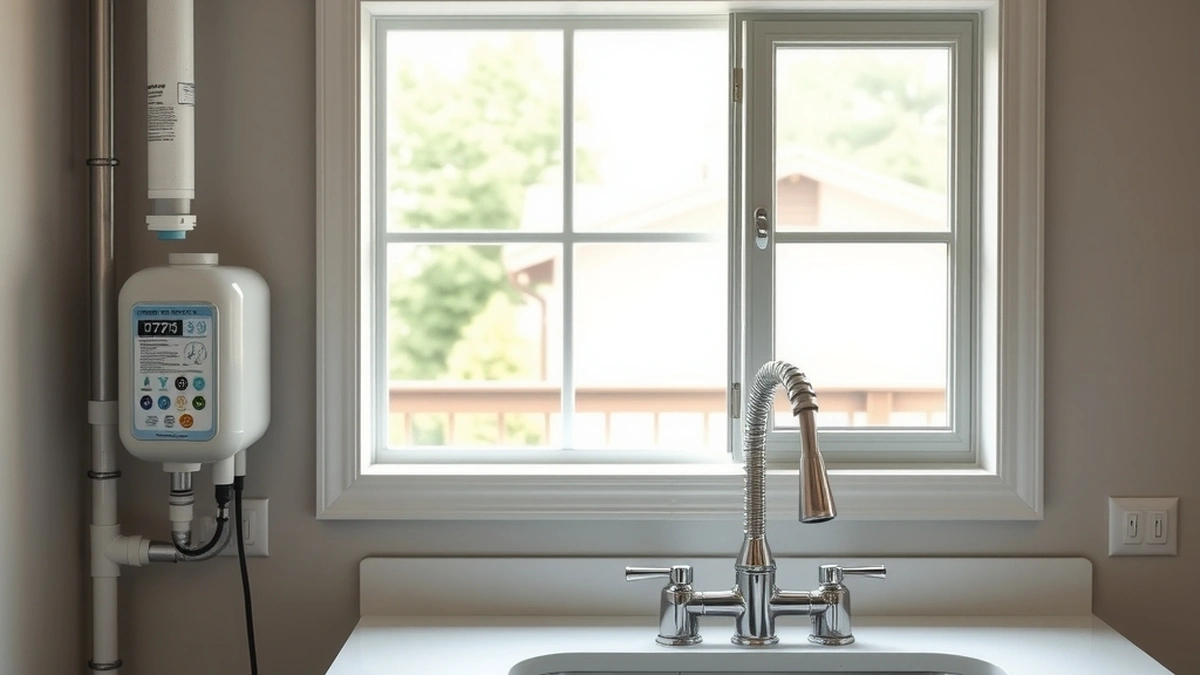
Point-of-entry treats all water entering the home; point-of-use treats water at a single tap. Choose based on what your water test shows and which fixtures need protection.
- Point-of-entry typical installed cost
- $500–$8,000 depending on technology
- Point-of-use typical installed cost
- $300–$900 for under-sink reverse osmosis
- Whole-house flow rate
- 8–15 GPM
- Reverse osmosis waste ratio
- 3–4:1
Some links on this page are affiliate links.If you buy through them we may earn a commission at no extra cost to you. We do not accept payment for rankings. Read the full disclosure.
Point-of-entry (POE) treatment installs on the main water line and conditions every gallon that enters the home. Point-of-use (POU) treatment installs at a single tap, such as a kitchen sink, and only treats water drawn from that fixture. The right choice depends on what your water test finds and whether the problem affects the whole plumbing system or just drinking and cooking water.
What Point-of-Entry Treatment Covers
Point-of-entry equipment sits where the water line enters the building, before the water splits to the water heater, faucets, showers, and appliances. A whole-house filter, water softener, iron filter, or ultraviolet system treats all household water at once. This is the logical place for hardness treatment because scale can build up in water heaters, pipes, and fixtures throughout the home.
Installed costs vary widely by technology. A water softener typically runs $1,200–$4,500 installed, including $600–$2,500 for equipment and $500–$1,500 for installation. Whole-house carbon filtration is usually $500–$1,800 installed. Iron filters cost about $800–$2,500 installed, and sulfur filters about $1,000–$3,000 installed. Whole-house reverse osmosis is the most expensive common POE option at roughly $3,000–$8,000 installed.
Flow rate matters for POE sizing. Whole-house filters commonly handle 8–15 GPM, which is enough for most homes without noticeable pressure loss at peak use. If a POE system restricts flow too much, showers and appliances can run slowly at the same time.
Ongoing costs are part of the comparison. A softener uses about 8–12 pounds of salt per regeneration, and salt typically runs $120–$400 per year. Resin rebeds cost about $300–$600 and may be needed over a softener life of 10–15 years. Resin itself often lasts 8–12 years. Carbon cartridges cost $80–$300 per year and usually need replacement every 6–12 months. Sediment cartridges often need replacement every 3–6 months.
What Point-of-Use Treatment Covers
Point-of-use equipment treats water at one location. Common examples include under-sink reverse osmosis, countertop filters, faucet-mounted carbon filters, and refrigerator filters. Because the device only sees water for that tap, it does not protect pipes, water heaters, or showers from hardness, sediment, or other whole-house issues.
Under-sink reverse osmosis equipment costs about $200–$600, with installed prices around $300–$900. Running costs are roughly $60–$150 per year for cartridges and membrane care. The membrane typically lasts 2–3 years. RO systems reject about 80–95 percent of dissolved solids, depending on the model and water chemistry, and they typically send 3–4 gallons to the drain for every gallon of product water. That waste ratio matters if you pay for both water and sewer volume.
POU is often the better fit for drinking-water concerns such as nitrate, lead, or dissolved solids because it treats a small volume at a high level of removal. It is also easier to retrofit in an existing home because it does not require cutting into the main water line.
Cost Arithmetic: Softener Example
To compare real ownership costs, consider a household with moderately hard water choosing a softener. Equipment plus installation lands in the $1,200–$4,500 range. At the midpoint, that is roughly $2,850 installed. Salt at $120–$400 per year adds $1,200–$4,000 over a 10-year life. A resin rebed at $300–$600 may appear once or twice in that period. Total 10-year ownership could therefore fall between roughly $2,700 and $9,100, not including water or sewer costs for regeneration.
For comparison, an under-sink RO system at $300–$900 installed plus $60–$150 per year in running costs totals roughly $900–$2,400 over 10 years. That is a lower upfront number, but it only protects one tap. If the same household also needs whole-house hardness protection, the softener cost is not avoidable by adding RO at the sink.
When to Choose Point-of-Entry
Choose POE when the water quality issue affects plumbing, appliances, fixtures, or multiple taps. Hardness is the classic example. Water hardness is commonly classified as soft at 0–3 grains per gallon, moderate at 3–7 GPG, hard at 7–10 GPG, and very hard at 10 GPG or higher. A softener rated at 24,000–64,000 grains can be matched to household water hardness and daily water use. Salt-free conditioners, installed at roughly $500–$1,800, are another POE option, though they do not remove hardness minerals in the same way a softener does.
Iron is another POE consideration. Many softeners handle only about 2–3 parts per million of iron, so higher levels may require a dedicated iron filter before or instead of a softener. Whole-house carbon filtration is appropriate for chlorine taste, odor, or certain organic contaminants across the entire home.
UV treatment is a POE option for microbiological concerns in some private water supplies. The lamp typically runs for 12 months and costs $30–$90 to replace. Because UV treats water as it passes through the chamber, it must be installed on the main line if the goal is whole-house protection.
When to Choose Point-of-Use
Choose POU when the concern is limited to drinking and cooking water or when installing whole-house equipment is impractical. Under-sink RO is common for reducing dissolved solids, nitrate, or other contaminants at the kitchen sink. Because RO waste ratios run 3–4:1, a POU system sends far less water to drain than a whole-house RO unit would for the same drinking-water volume.
POU also works as a polishing step after POE treatment. A household might install a whole-house softener or carbon filter for general protection, then add an RO unit at the kitchen sink for drinking water. This layered approach avoids treating all shower and laundry water to drinking-water standards, which would waste salt, water, and cartridge life.
Renters or homeowners in older buildings sometimes prefer POU because it does not require modifying the main water line. A countertop or faucet-mounted unit can be removed when moving, while POE equipment usually stays with the property.
Maintenance and Testing First
Water treatment decisions should start with a lab water test, which typically costs $40–$150. The results determine whether you need hardness reduction, iron removal, carbon filtration, RO, or UV. Testing also establishes a baseline so you can tell whether equipment is performing to its stated removal rates and capacity.
Maintenance schedules differ by technology. Carbon cartridges usually need replacement every 6–12 months at $80–$300 per year. Sediment cartridges often need replacement every 3–6 months. Softener resin lasts 8–12 years on average, with full softener life around 10–15 years. RO membranes last 2–3 years. UV lamps last 12 months. Skipping maintenance can reduce removal rates and, in some cases, allow bacteria to grow on carbon media.
Choosing by Household Load
Household water use affects POE sizing and regeneration frequency. A softener with 24,000–64,000 grains of capacity must be matched to grains of hardness removed per day. For example, a household using 300 gallons per day with water at 10 GPG removes 3,000 grains daily (300 gallons × 10 GPG). A 32,000-grain softener would theoretically last about 10 days between regenerations at that load, before efficiency and reserve factors are applied. Actual regeneration intervals vary by valve settings, water use, and salt dosage.
POU systems do not need whole-house flow capacity, but they do need enough daily production for drinking and cooking. An under-sink RO unit produces a limited gallons-per-day rating, and storage tanks hold a reserve. If a household uses a lot of water for cooking or fills large pitchers daily, production rate and tank size matter more than whole-house GPM.
Internal links fit naturally here: a reader comparing softener pricing can visit /how-much-does-a-water-softener-cost/, installation details are at /water-softener-installation-cost/, and whole-house filter pricing is covered at /whole-house-water-filter-cost/.
Bottom Line
Point-of-entry treats all water entering the home and suits whole-house problems such as hardness, iron, sediment, and chlorine. Point-of-use treats one tap and suits drinking-water concerns or retrofits where main-line installation is impractical. Start with a water test, match the technology to the contaminant, and compare installed cost plus ongoing maintenance before buying equipment.
Next, compare how much does a water softener cost, water softener installation cost, whole house water filter cost before you commit.
Frequently asked questions
What is the main difference between POU and POE?
Point-of-entry treats all water where it enters the home, while point-of-use treats water at one specific tap or appliance.
Can a point-of-use system protect the whole house?
No. A point-of-use device only treats water at its installation point, so other faucets, showers, and appliances receive untreated water.
Is a water softener point-of-entry or point-of-use?
Water softeners are typically point-of-entry systems because they treat all household water to protect plumbing, fixtures, and water heaters.
How often do reverse osmosis membranes need replacement?
RO membranes typically last 2–3 years, while carbon and sediment cartridges require replacement more frequently.
Does whole-house reverse osmosis cost more than under-sink RO?
Yes. Whole-house RO runs about $3,000–$8,000 installed, compared with $300–$900 for under-sink equipment.
Should I test water before choosing POU or POE?
Yes. A lab water test identifies hardness, iron, nitrate, and other contaminants so the treatment technology matches the actual problem.
Sources
Some links are affiliate links.If you buy through them we may earn a commission at no extra cost to you. We do not accept payment for rankings. Read the full disclosure.


