
Reverse osmosis systems
The main types of reverse osmosis system, how to size one, and what each type costs to buy and run.
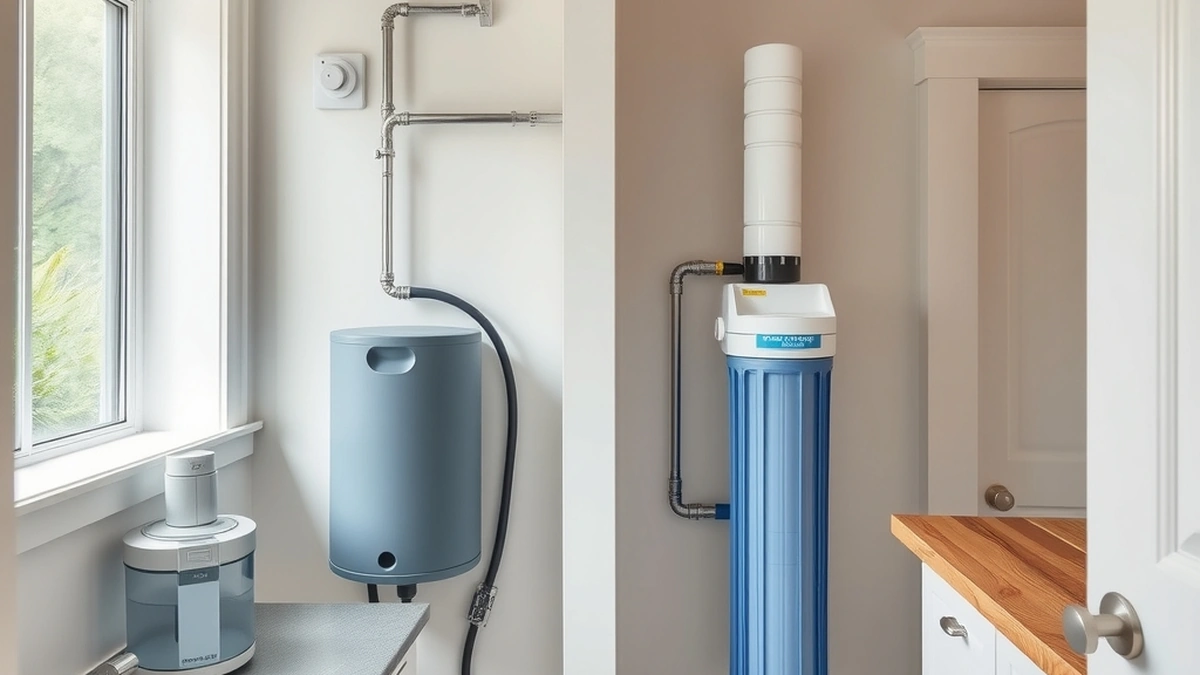
Reverse osmosis systems range from a $300 to $900 under-sink unit to a $3,000 to $8,000 whole-house system. Choose by how much water you need treated, what the water test shows, and whether the goal is drinking water or every tap.
- Under-sink installed
- $300 - $900
- Whole-house installed
- $3,000 - $8,000
- Running cost
- $60 - $150 per year
- Membrane life
- 2 - 3 years
- Waste ratio
- 3 - 4:1
Some links on this page are affiliate links.If you buy through them we may earn a commission at no extra cost to you. We do not accept payment for rankings. Read the full disclosure.
Reverse osmosis systems range from a $300 to $900 under-sink unit to a $3,000 to $8,000 whole-house system. The choice depends on how much water needs treating and what the test shows. Most households want drinking water at one tap, and one tap is a very different purchase from every tap.
The four system types
| Type | Where it sits | Installed cost | Best for |
|---|---|---|---|
| Under-sink | Kitchen cabinet | $300 - $900 | Drinking water at one tap |
| Countertop | On the counter | Lower equipment, no plumbing | Rentals, small volumes |
| Tankless | Under sink, no tank | $300 - $900 | Tight spaces, on-demand |
| Whole-house | Main line | $3,000 - $8,000 | Every tap, whole-home treatment |
The under-sink system is the standard residential choice. It uses a storage tank so the faucet delivers a usable flow, and it treats only the cold water at the kitchen sink.
A countertop unit needs no plumbing and suits a rental, but it produces water slowly and occupies counter space.
A tankless system removes the storage tank and produces water on demand, which suits a small cabinet but can be slow to fill a pot.
A whole-house system treats everything, which is rarely necessary for hardness alone and is usually specified when a specific contaminant must be reduced at every tap.
Sizing by volume and quality
Start with the water test at $40 to $150. Hardness, iron, and chlorine all affect the membrane and the pre-filters.
A household uses 2 to 4 gallons per day for drinking and cooking. An under-sink system with a 3-gallon tank covers that comfortably, though a family that fills large pots for cooking may want the tankless model for recovery speed.
Hardness above 7 gpg is the point where a softener upstream becomes important. Scale fouls the membrane, and a membrane that should last 2 to 3 years can fail in one.
Iron above 2 to 3 ppm needs an iron filter at $800 to $2,500 before the RO system, because iron fouling is not reversible with normal cleaning.
Chlorine is handled by the carbon pre-filter on municipal water. Chloramine needs a catalytic carbon stage, which is a different cartridge.
Under-sink versus whole-house
| Factor | Under-sink | Whole-house |
|---|---|---|
| Water treated | One tap | Every tap |
| Installed cost | $300 - $900 | $3,000 - $8,000 |
| Waste water | 3 - 4 gallons per gallon | Much larger volume |
| Maintenance | Annual filters | Larger filters, more frequent |
| Best for | Drinking and cooking | Specific whole-home contaminant |
A whole-house RO system generates a large waste stream because it treats every gallon used for showers, laundry, and irrigation. That is why it is specified for a contaminant problem rather than for taste.
Running costs
| Item | Typical range | Interval |
|---|---|---|
| Sediment pre-filter | Included in annual cost | 6 - 12 months |
| Carbon stages | $60 - $150 per year | 6 - 12 months |
| Membrane | Varies by model | 2 - 3 years |
| Whole-house pre-treatment | Higher | 6 - 12 months |
An under-sink system costs $60 to $150 per year in filters plus a membrane every 2 to 3 years. A whole-house system costs more because the filters are larger and the volume is greater, and because pre-treatment cartridges load faster on a whole-house flow.
Choosing a system
- Test the water and note hardness, iron, chlorine, and any contaminant of concern.
- Decide how many taps need treated water.
- Choose a system type that matches the volume and the space.
- Confirm the certification names the model for the reduction claim.
- Check that filters and membranes are standard and available.
- Price the first two years of consumables.
The last step changes the comparison. A cheap system with proprietary cartridges can cost more over five years than a mid-priced system with standard filters.
Installation considerations
An under-sink system needs a cold feed connection, a drain saddle or air gap, a faucet hole, and space for the tank.
A tankless system saves the tank space but needs a dedicated power outlet on most models.
A whole-house system needs a bypass, a drain, pre-treatment, and often a permit. It is not a homeowner install in most cases.
Maintenance that protects the membrane
Change the pre-filter on schedule. A clogged sediment filter sends grit to the membrane and shortens its life.
Keep the softener working if one is installed. Hard water is the most common cause of premature membrane failure.
Sanitise the tank and lines when changing the membrane, following the manufacturer’s procedure. A faint odour at the tap after a filter change usually means the system needs that sanitising step rather than a new membrane.
For the buying comparison, see under sink water filter cost and reverse osmosis system cost. For the whole-house option, whole house reverse osmosis cost covers the larger scope.
Bottom line
Reverse osmosis systems are chosen by volume: one tap is a $300 to $900 under-sink unit, every tap is a $3,000 to $8,000 whole-house system. Test the water, protect the membrane with softening where hardness demands it, and price the consumables before the box.
Frequently asked questions
What types of reverse osmosis systems exist?
Under-sink, countertop, tankless, and whole-house systems, each suited to a different volume of water and a different installation.
How much does an RO system cost?
Under-sink systems run $300 to $900 installed, while whole-house systems run $3,000 to $8,000 installed.
Which RO system is best for drinking water?
An under-sink unit with a storage tank is the standard choice for one kitchen tap, because it delivers a usable flow without treating the whole house.
Do I need a softener before RO?
Yes where hardness is high, because scale fouls the membrane; a softener at $1,200 to $4,500 installed protects the RO system.
How much water does RO waste?
A typical system sends 3 to 4 gallons to drain for every gallon produced, though the exact ratio depends on pressure and the membrane.
How often do filters need changing?
Sediment and carbon stages typically need changing every 6 to 12 months, and the membrane every 2 to 3 years.
Sources
Some links are affiliate links.If you buy through them we may earn a commission at no extra cost to you. We do not accept payment for rankings. Read the full disclosure.


