What a RV water filter costs
RV water filters run $30-$200 depending on type, with $40-$90 per season in cartridges. See canister, inline, and under-sink setups priced out.
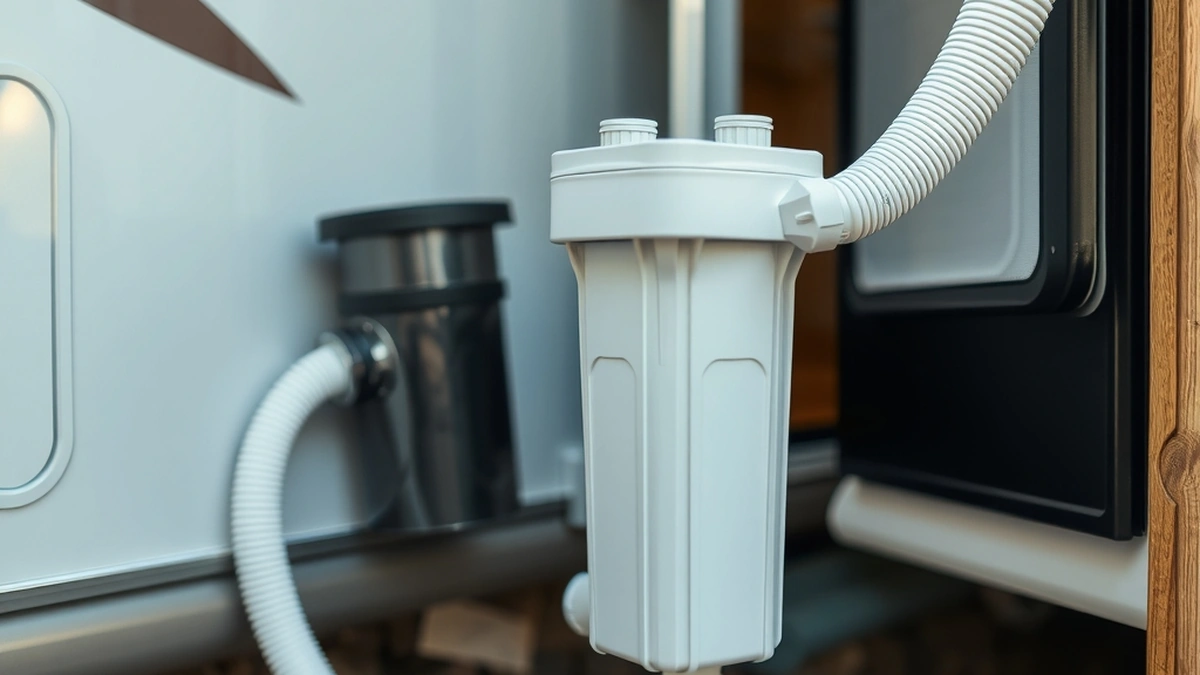
An RV water filter costs $30-$200: inline hoses run $20-$45, exterior canister units $60-$180, and under-sink two-stage kits $120-$200. Cartridges add $40-$90 per season, and a campground hose and regulator add $30-$60.
- Inline filter
- $20 - $45
- Exterior canister
- $60 - $180
- Under-sink kit
- $120 - $200
- Season cartridges
- $40 - $90
- Hose and regulator
- $30 - $60
Some links on this page are affiliate links.If you buy through them we may earn a commission at no extra cost to you. We do not accept payment for rankings. Read the full disclosure.
An RV water filter costs $30-$200 depending on format: an inline hose filter is $20-$45, a two-stage exterior canister runs $60-$180, and an under-sink kit with its own faucet is $120-$200. Cartridges add $40-$90 per season. The filter is the cheap part; the hose, regulator, and fittings are where first-year spending creeps up.
Three formats, three price points
An RV water filter is a point-of-use device that treats water between the campground spigot and the rig’s plumbing. Three designs dominate, and they are not interchangeable in cost or capability.
Inline filters screw onto a hose and pass water through a carbon block in a disposable plastic body. At $20-$45 they are the cheapest entry and the least capable: small media volume, no sediment stage, and a short life at high flow.
Exterior canister units mount on a bracket or stand and hold a standard 10-inch cartridge, sometimes two in series. At $60-$180 they cost more up front but use commodity cartridges that cost $15-$40 each and are stocked everywhere.
Under-sink kits install inside the galley cabinet with a dedicated faucet. At $120-$200 they are the most expensive and the most convenient, because drinking water does not pass through the rig’s tank and pump.
What the first season actually costs
| Item | Cost | Life |
|---|---|---|
| Inline hose filter | $20 - $45 | 1 season |
| Two-stage canister | $60 - $180 | Housing reusable |
| Sediment cartridge | $12 - $25 | 2 - 4 months |
| Carbon cartridge | $18 - $40 | 3 - 6 months |
| Drinking water hose | $20 - $45 | 2 - 3 seasons |
| Pressure regulator | $12 - $30 | Several seasons |
| Under-sink kit | $120 - $200 | Housing reusable |
A first-season setup with a two-stage canister, one spare sediment cartridge, one carbon cartridge, a hose, and a regulator lands at $60 + $20 + $30 + $30 + $20 = $160, before the canister’s second carbon cartridge. That is the realistic number, not the $29.99 on the shelf tag.
The per-gallon arithmetic
Assume a household of two using 40 gallons per day in the rig and staying out 90 nights. That is 3,600 gallons per season. A two-stage canister with a $20 sediment and $30 carbon cartridge handles that for $50, or $0.014 per gallon.
An inline filter at $30 replaced twice in the same season costs $60 for the same volume, or $0.017 per gallon. The canister is cheaper per gallon after the first year and far cheaper over five seasons, because the housing is bought once.
Under-sink kits change the math. If you use 1.5 gallons per day for drinking and cooking across 90 days, that is 135 gallons. A $180 kit with a $40 annual cartridge is $1.33 per gallon in year one and $0.30 per gallon in later years. You are paying for taste and convenience at one tap, not for whole-rig treatment.
Canister versus inline
The tradeoff is straightforward. Inline filters win on price, storage, and simplicity: no bracket, no housing to sanitize, no cartridge to stock. They lose on sediment capacity, because a small carbon block clogs fast when a campground runs off a well.
Canister units win on cost per gallon, on cartridge availability, and on the ability to run a sediment stage ahead of carbon. They lose on space and on winterizing, since a housing full of water will crack if it freezes.
A practical compromise many full-timers use: a coarse inline sediment filter at the spigot to catch sand, then a two-stage canister at the rig. The inline filter is $15-$25 and protects the more expensive cartridges downstream.
Sizing to the rig, not the catalog
Gallons per day is the first number. A couple in a Class C uses 30-50 gallons per day; a family of four in a travel trailer with a shower habit can hit 80-100. Flow rate is the second: most RV fixtures want 1.5-3 GPM, and a filter that restricts below that makes showers unpleasant.
Pressure is the number people skip. Campground spigots commonly run 60-100 psi, and some exceed that. A $12-$30 regulator set to 45-55 psi protects the filter housing, the pump, and the rig’s PEX. Without it, a $100 canister can split on the first hookup.
If the campground water is questionable, filtration is not treatment. Bacteria in well water explains what a filter does and does not do with a microbiological problem, and shock chlorinating a well covers the sanitizing side for private supplies.
Five steps before you buy
- Measure your daily water use for one trip, then multiply by your typical nights out.
- Check the campground’s water source; well-fed parks need a sediment stage.
- Buy a drinking-water hose rated for potable use, not a garden hose.
- Add a pressure regulator and set it to 45-55 psi.
- Store one spare cartridge of each type so a clogged filter does not end a trip.
Where the quote moves
Four things shift the number: whether the housing is stainless or plastic ($40-$90 difference), whether the kit includes a dedicated faucet, whether you need a heater-hose or freeze protection, and whether you are buying a name-brand cartridge or a commodity 10-inch one.
The last item matters more than the rest. A proprietary cartridge at $45 that is only sold by the manufacturer costs more over five seasons than a $120 canister that takes $18 commodity cartridges. Check cartridge availability before you buy the housing, not after.
For the home side of the same decision, under sink water filter cost prices the kitchen equivalent, and point of use versus point of entry explains why an RV is always a point-of-use case.
Frequently asked questions
How much does a good RV water filter cost?
A two-stage exterior canister with a sediment and carbon cartridge typically costs $100-$180. Inline hose filters at $20-$45 are cheaper but handle less sediment and last one season.
How long does an RV water filter last?
A season, typically 3-6 months of use, or about 1,000-2,000 gallons. Inline hoses often clog faster at campgrounds with high sediment.
Do I need a pressure regulator with an RV filter?
Yes. Campground spigots can exceed 100 psi, and most RVs are rated for 40-60 psi. A $15-$30 regulator protects the filter housing and the rig's plumbing.
Can I use a household water filter in an RV?
An under-sink two-stage kit designed for RVs works well because it handles vibration and low flow. A full-size whole-house tank does not fit or tolerate road movement.
What does an RV filter remove?
Sediment and chlorine taste and odor are the realistic targets, with some units adding lead or cyst reduction. It is not a substitute for treating a microbiologically unsafe supply.
How much should I budget per season for RV filtration?
Plan $40-$90 for cartridges plus $30-$60 for a drinking-water hose and regulator in the first year. Total first-season cost is usually $90-$250 including the filter itself.
Sources
Some links are affiliate links.If you buy through them we may earn a commission at no extra cost to you. We do not accept payment for rankings. Read the full disclosure.