Salt Pellets vs Crystals vs Block: Which to Buy
Compare softener salt forms by price, purity, bridging risk, and best use case before your next purchase.
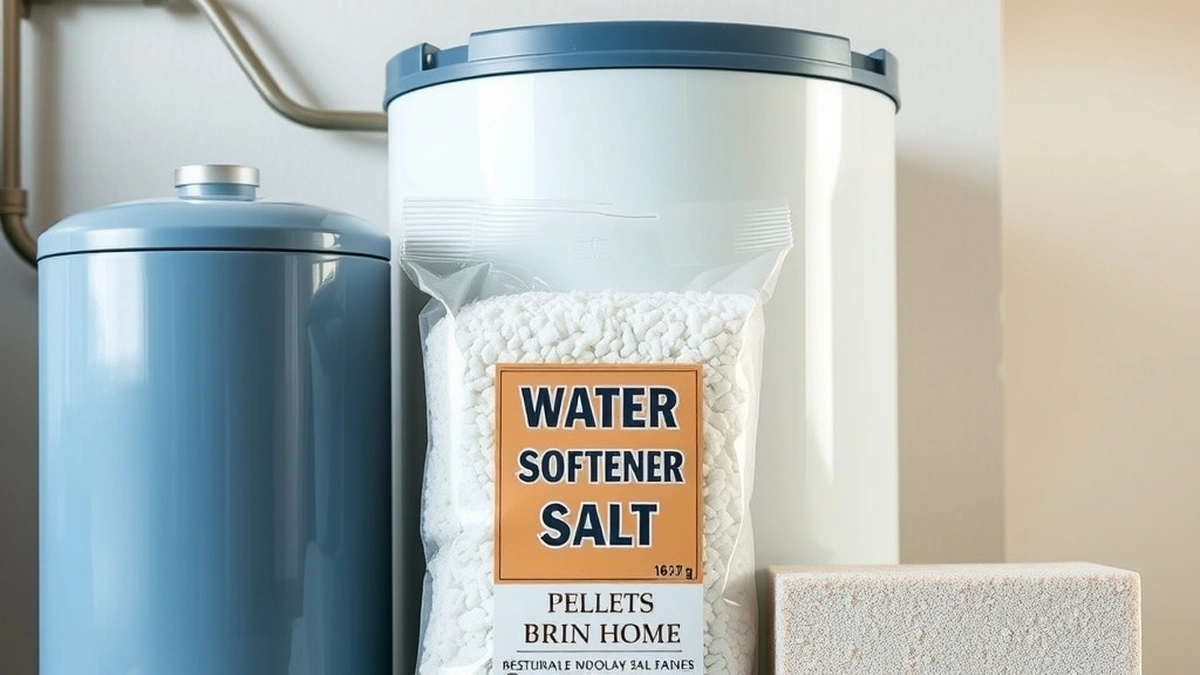
Buy pellets for most residential softeners; crystals work if you dissolve them first, and block salt is usually the wrong shape for standard brine tanks.
- Best all-around choice
- Salt pellets
- Typical price range
- $6–$12 per 40-lb bag
- Main risk with crystals
- Bridging and mush in the brine tank
- Block salt suitability
- Low; most residential tanks are not built for it
Some links on this page are affiliate links.If you buy through them we may earn a commission at no extra cost to you. We do not accept payment for rankings. Read the full disclosure.
For most residential water softeners, buy salt pellets. Crystals can work in some tanks but are more likely to bridge or create a salt mush, and block salt usually does not fit standard brine tanks. The right form depends on your tank design, how much you want to spend, and how often you want to clean the brine well.
What Each Salt Form Actually Is
Water softener salt is sodium chloride, but it is processed differently. The form affects how it behaves in the brine tank, not how the resin exchanges ions.
Salt pellets are compressed into uniform, dense shapes. They dissolve slowly and evenly, resist bridging, and are the default recommendation for most cabinet and two-tank softeners. A typical 40-pound bag costs roughly $6 to $10, depending on region and purity.
Salt crystals are solar-evaporated chunks. They are irregular in size and can dissolve unevenly. In humid conditions, fine particles can collect at the bottom of the brine tank and form a crust or bridge above the water. Crystals often cost slightly less than pellets, around $5 to $9 per 40-pound bag, but the labor of breaking up bridges can erase the savings.
Block salt is a solid, compressed slab. It is common in some industrial or European systems, but most U.S. residential brine tanks are not built for it. A block may sit above the water line and fail to dissolve, or it may take up space without making brine. Unless your manual specifically calls for block salt, avoid it.
How Salt Enters the Regeneration Cycle
Your softener does not use salt to soften water directly. It uses salt to create brine, which flushes hardness minerals off the resin during regeneration. A typical regeneration uses 8 to 12 pounds of salt, depending on the softener’s grain capacity and the programmed salt dose.
If your softener holds 32,000 grains and regenerates once a week using 10 pounds of salt per cycle, that is:
10 pounds × 52 weeks = 520 pounds of salt per year
At roughly 10 bags of 40 pounds, and a mid-range price of $8 per bag, your annual salt cost is about $80. If your water is very hard or your household uses more water, you might regenerate twice a week, pushing salt use toward 1,040 pounds and roughly $160 per year. These figures fall inside the broader estimate of $120 to $400 per year for softener salt, which varies with local prices, hardness, and water use.
Salt form does not change grain capacity. A 40,000-grain softener remains a 40,000-grain softener whether you use pellets or crystals. What changes is how reliably the brine tank makes strong brine on schedule.
Pellets vs. Crystals: Side-by-Side
| Feature | Pellets | Crystals | Block |
|---|---|---|---|
| Shape | Uniform compressed | Irregular chunks | Solid slab |
| Bridging risk | Low | Moderate to high | N/A; often won’t dissolve |
| Residue in tank | Low | Moderate | Low if fully dissolved |
| Typical cost per 40 lb | $6–$10 | $5–$9 | $7–$12 |
| Best for | Most residential softeners | Tanks with agitation or frequent cleaning | Manuals that specify block |
Pellets are the safer default because they flow down to the water and dissolve predictably. Crystals can save a dollar or two per bag, but if a bridge forms, the softener regenerates with soft water instead of brine. The resin does not recharge, hardness passes through, and you may not notice until the water feels hard again.
When Crystals Make Sense
Crystals are not automatically wrong. If your softener has a brine tank with a grid plate, a salt agitator, or if you are diligent about breaking up crusts monthly, crystals can perform adequately. Some owners also prefer crystals for very small tanks where large pellets do not flow well.
The key maintenance task with crystals is checking for a salt bridge. A bridge is a hard crust that forms an empty space between the salt and the water. The tank looks full, but no brine is being made. You can test for a bridge by pushing a broom handle straight down into the salt. If it hits a hard surface well above the water, you likely have a bridge. Breaking it up and switching to pellets usually prevents recurrence.
Why Block Salt Is Usually the Wrong Choice
Block salt is sold in large slabs, sometimes 40 pounds or more. It works in systems designed with a dedicated brine well and enough water contact to erode the block slowly. Most U.S. residential softeners use a brine well or float assembly meant for granular salt. A block can wedge against the wall, dissolve too slowly, or leave dry salt above the water line.
If your owner’s manual lists block salt as acceptable, follow the manufacturer’s instructions. Otherwise, do not force block salt into a standard brine tank just because it looks economical. The cost of a service call or a resin bed that never recharges is higher than the price difference between salt forms.
Purity and Insoluble Matter
All softener salt contains some insoluble impurities. Pellets, especially evaporated or high-purity grades, tend to have less dirt and debris than solar crystals. Insoluble matter settles at the bottom of the brine tank and can eventually clog the brine line or valve.
If you use crystals, plan to clean the brine tank more often—perhaps every 6 to 12 months depending on usage. With pellets, you can often go longer between cleanings. This is a maintenance consideration, not a water quality claim. The resin bed itself lasts an estimated 8 to 12 years, and keeping the brine system clean helps it reach that life span.
Cost Arithmetic for a Full Year
Assume a household with moderately hard water uses a 32,000-grain softener that regenerates weekly with 10 pounds of salt per regeneration.
Annual salt use: 10 pounds × 52 weeks = 520 pounds
Number of 40-pound bags: 520 ÷ 40 = 13 bags
Cost at $8 per bag (pellets): 13 × $8 = $104 per year
Cost at $7 per bag (crystals): 13 × $7 = $91 per year
The savings is about $13 per year. If one bridge causes a missed regeneration and you run hard water for a month, or if you pay a technician to clean the tank, the crystal savings disappears quickly. For most owners, pellets are the lower-hassle option at a nearly identical annual cost.
These salt costs sit inside the overall softener ownership picture. Equipment typically runs $600 to $2,500, installation adds $500 to $1,500, and a full installed system lands around $1,200 to $4,500. Resin rebedding runs $300 to $600 and is usually needed after 8 to 12 years. Salt is a recurring operating cost, but it is small compared with equipment and installation.
Buying and Storage Tips
Buy salt in 40-pound bags and store it in a dry place. Humidity causes clumping and bridging, especially with crystals. Keep the brine tank about two-thirds full unless your manual specifies a different level. Do not overfill; salt above the water line does not make brine and can compact into a bridge.
Check the tank monthly. If you see a crust, break it up. If you see mush at the bottom, schedule a tank cleaning. When you switch from crystals to pellets, run the existing crystals down first rather than mixing forms, because different dissolution rates can create uneven brine strength.
If you are shopping for a new softener or comparing treatment options, it helps to look at full installed cost first. You can review softener pricing at /how-much-does-a-water-softener-cost/, installation ranges at /water-softener-installation-cost/, and salt-specific pricing at /water-softener-salt-cost/. For broader home treatment comparisons, see /whole-house-water-filter-cost/.
Bottom Line
Buy pellets for most residential water softeners. They dissolve evenly, resist bridging, and cost about the same as crystals over a year. Crystals are acceptable if your tank is built for them and you maintain it actively. Block salt is usually the wrong shape for standard U.S. brine tanks unless your manual explicitly approves it. Check your brine tank monthly, keep salt dry, and match the salt form to your equipment rather than to the lowest price per bag.
Next, compare how much does a water softener cost, water softener installation cost, whole house water filter cost before you commit.
Frequently asked questions
What is the difference between salt pellets and crystals?
Pellets are compressed and denser, while crystals are irregular chunks that can dissolve unevenly and cause bridging in some brine tanks.
Can I use block salt in a standard water softener?
Usually no. Most residential brine tanks are designed for granular salt, and block salt may not dissolve properly or contact the water correctly.
How much does softener salt cost per year?
Expect roughly $120 to $400 per year, depending on water hardness, usage, and local salt prices.
Do salt types change softening capacity?
No. Grain capacity depends on the resin and salt dose per regeneration, not whether you use pellets or crystals.
Which salt leaves the least residue?
High-purity evaporated pellets generally leave the least insoluble residue compared with solar crystals or rock salt.
How often should I check the brine tank?
Check monthly and keep salt above the water line, filling to about two-thirds full unless your manual says otherwise.
Sources
Some links are affiliate links.If you buy through them we may earn a commission at no extra cost to you. We do not accept payment for rankings. Read the full disclosure.