Softener vs Conditioner: What the Label Hides
Compare salt-based softeners and salt-free conditioners by grain capacity, installed cost, and ongoing expense before you buy.
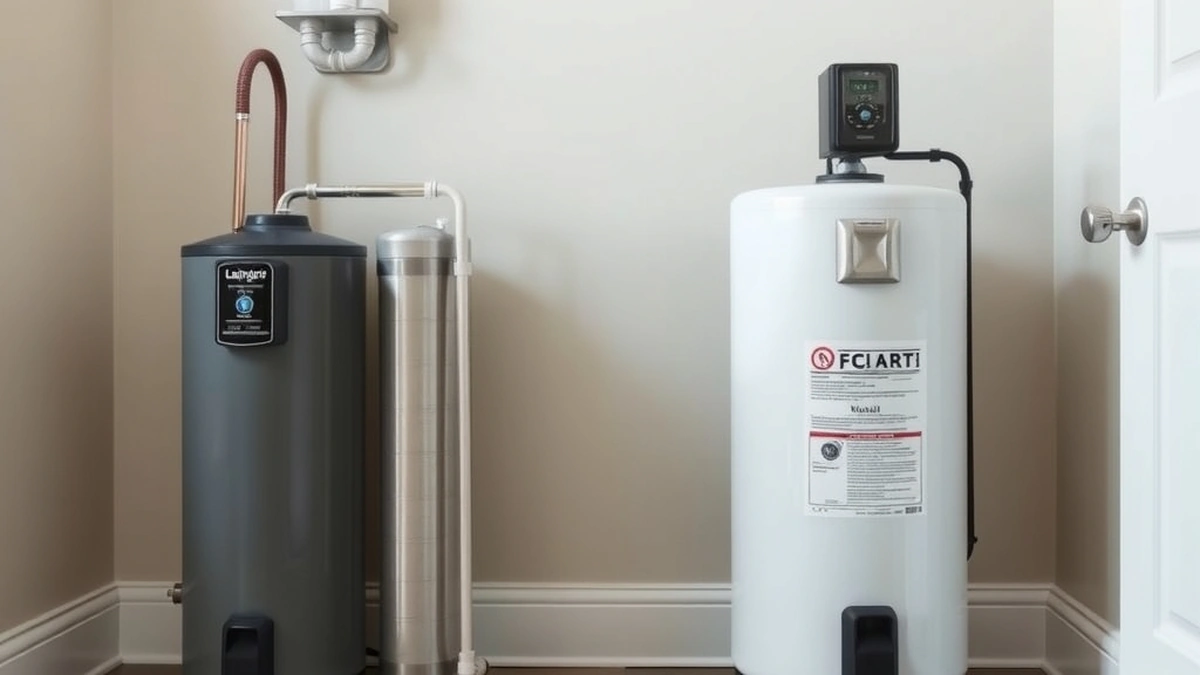
A softener removes hardness minerals through ion exchange and requires salt; a conditioner alters hardness behavior without removing minerals and typically uses no salt.
- Softener equipment
- $600–$2,500
- Softener installed total
- $1,200–$4,500
- Salt-free conditioner installed
- $500–$1,800
- Softener salt per year
- $120–$400
- Softener resin life
- 8–12 years
Some links on this page are affiliate links.If you buy through them we may earn a commission at no extra cost to you. We do not accept payment for rankings. Read the full disclosure.
A water softener removes hardness minerals from water; a salt-free conditioner does not. Softeners use ion-exchange resin and salt to trade calcium and magnesium for sodium, while conditioners typically change how hardness minerals behave without removing them. If your goal is lower scale buildup and softer-feeling water, the distinction on the label determines what you actually get.
What a Softener Actually Does
A salt-based softener passes hard water through a resin bed charged with sodium ions. Calcium and magnesium in the water swap places with sodium on the resin, so the water leaving the tank has had those hardness minerals removed. Once the resin is saturated, the system regenerates by flushing it with a salt brine solution.
Capacity is measured in grains. Residential systems commonly range from 24,000 to 64,000 grains. To estimate the size you need, multiply your daily water use by your hardness in grains per gallon, then multiply by the number of days between regenerations.
For example, a household using 300 gallons per day with water hardness of 10 grains per gallon produces 3,000 grains of hardness per day. If the system regenerates every seven days, that is 21,000 grains per cycle, which fits within a 24,000-grain unit but leaves little margin. A 32,000- or 40,000-grain system would be more practical.
Salt use is typically 8 to 12 pounds per regeneration. At weekly regeneration, that is roughly 416 to 624 pounds of salt per year. At $120 to $400 per year for salt, operating costs add up over a 10- to 15-year equipment life. Resin usually lasts 8 to 12 years, and a rebed runs about $300 to $600.
Equipment costs $600 to $2,500, and installation adds $500 to $1,500, for an installed total of $1,200 to $4,500. More detail on pricing is available in our guide to how much a water softener costs and water softener installation cost.
What a Salt-Free Conditioner Actually Does
Salt-free conditioners do not remove calcium and magnesium. Instead, they use technologies such as template-assisted crystallization or electromagnetic treatment to change the physical form of hardness minerals so they are less likely to bind to pipes and fixtures. Because no ion exchange occurs, no sodium is added to the water and no regeneration cycle is needed.
That means no salt bags, no brine drain, and no electricity for regeneration in most models. Installed, these systems typically cost $500 to $1,800. The trade-off is that hardness minerals remain in the water. You may still see spots on glassware and mineral buildup in appliances, even if scale inside pipes is reduced.
If your water test shows hardness above 7 grains per gallon, a conditioner may not deliver the same results as a softener. Below 3 grains per gallon, water is already considered soft, so either option is largely optional for hardness alone.
How to Read the Label
Marketing language often blurs the line between softening and conditioning. Look for these signals:
- “Water softener” or “ion exchange”: Removes hardness minerals. Requires salt and regeneration.
- “Salt-free” or “saltless softener”: Technically not a softener by the ion-exchange definition. Does not remove hardness minerals.
- “Conditioner,” “descaler,” or “scale inhibitor”: Alters scale formation but does not soften water in the conventional sense.
- Grain capacity listed: Indicates a true softener. Conditioners usually do not list grain capacity because they do not capture hardness.
A label that says “softens water without salt” is describing a conditioner, not a softener. The performance difference matters most in very hard water, defined as 10 grains per gallon or higher.
Cost Comparison Over Ten Years
Use installed cost plus consumables to compare real ownership cost. These are estimates based on typical usage and local pricing.
| Item | Softener | Salt-Free Conditioner |
|---|---|---|
| Equipment | $600–$2,500 | $500–$1,800 |
| Installation | $500–$1,500 | Included in installed range |
| Installed total | $1,200–$4,500 | $500–$1,800 |
| Salt or media, per year | $120–$400 | $0–$100 |
| Resin or media replacement | $300–$600 every 8–12 years | Varies by model |
| 10-year cost estimate | $2,100–$9,100 | $500–$2,800 |
A softener costs more upfront and requires salt, but it removes hardness. A conditioner costs less to install and operate, but it leaves hardness minerals in the water. Over ten years, the gap can be several thousand dollars, mostly driven by salt and resin maintenance on the softener.
When Hardness Levels Matter
Water hardness is measured in grains per gallon (gpg):
- Soft: 0–3 gpg
- Moderate: 3–7 gpg
- Hard: 7–10 gpg
- Very hard: 10+ gpg
If your lab test reads 12 gpg and your household uses 400 gallons per day, that is 4,800 grains of hardness per day. A 32,000-grain softener would need regeneration roughly every six to seven days. A conditioner would not remove those 4,800 grains daily, so scale-sensitive appliances may still accumulate minerals.
Iron is another factor. Many softeners can handle clear-water iron up to about 2 to 3 ppm, but higher concentrations can foul resin. If your test shows more than that, an iron filter may be required before the softener. See our iron filter cost guide for equipment and installation ranges.
What to Test Before Buying
Order a lab water test before selecting equipment. A lab test typically costs $40 to $150 and should measure hardness, iron, pH, and total dissolved solids. Do not rely on in-store test strips alone for a major equipment purchase.
If your water comes from a private well, the EPA and CDC recommend routine testing because well water is not regulated like municipal supplies. Hardness and iron levels vary widely by geology, so a neighbor’s system size is not a reliable guide for yours.
Once you have numbers, size the softener by grain capacity rather than by physical dimensions. A larger cabinet does not necessarily mean higher capacity. Check the grain rating and salt dose per regeneration to estimate ongoing cost.
Other Treatment Options to Consider
Hardness is only one water quality issue. If your test shows other contaminants, a softener or conditioner alone will not address them:
- Carbon filters: Installed whole-house carbon systems run $500 to $1,800. Cartridges cost $80 to $300 per year and usually need replacement every 6 to 12 months. Sediment cartridges typically need replacement every 3 to 6 months.
- Reverse osmosis: Under-sink RO equipment costs $200 to $600, with installed totals of $300 to $900. Running costs are about $60 to $150 per year. Membranes last 2 to 3 years. Waste ratios are typically 3 to 4 gallons per gallon produced, with rejection rates of 80 to 95 percent. Whole-house RO systems cost $3,000 to $8,000 installed.
- UV disinfection: Lamps last about 12 months and cost $30 to $90 to replace.
For well water with multiple concerns, treatment is often staged: sediment filter, then iron or sulfur reduction, then softener, then point-of-use RO for drinking water. Our whole house water filter cost and reverse osmosis system cost guides break down those investments.
Bottom Line
A softener removes hardness minerals and requires salt; a conditioner treats scale behavior without removing minerals and typically uses no salt. Check your water test for grains per gallon, match the system grain capacity to your daily load, and compare installed cost plus ten-year consumables before choosing. The label may say “softener,” but the specification sheet tells you what the equipment actually does.
Frequently asked questions
What is the main difference?
A softener exchanges hardness minerals for sodium using resin and salt; a conditioner treats water without removing hardness minerals and usually needs no salt.
Does a conditioner soften water?
No. Conditioners may change how hardness behaves in plumbing, but they do not remove calcium and magnesium like an ion-exchange softener.
How much does a softener cost installed?
Installed softener systems typically run $1,200 to $4,500, including equipment at $600 to $2,500 and labor at $500 to $1,500.
How often do you buy salt?
Most households budget $120 to $400 per year for salt, depending on water hardness, usage, and regeneration frequency.
Can a softener handle iron?
Softeners can handle limited clear-water iron, generally around 2 to 3 ppm; higher levels usually need a dedicated iron filter before the softener.
Should I test water first?
Yes. A lab water test costs $40 to $150 and tells you hardness, iron, and other parameters so you size equipment correctly.
Sources
Some links are affiliate links.If you buy through them we may earn a commission at no extra cost to you. We do not accept payment for rankings. Read the full disclosure.