What a sulfur filter costs
Sulfur filter prices by type, what drives the installed cost, and how to size one for a well with hydrogen sulfide odour.
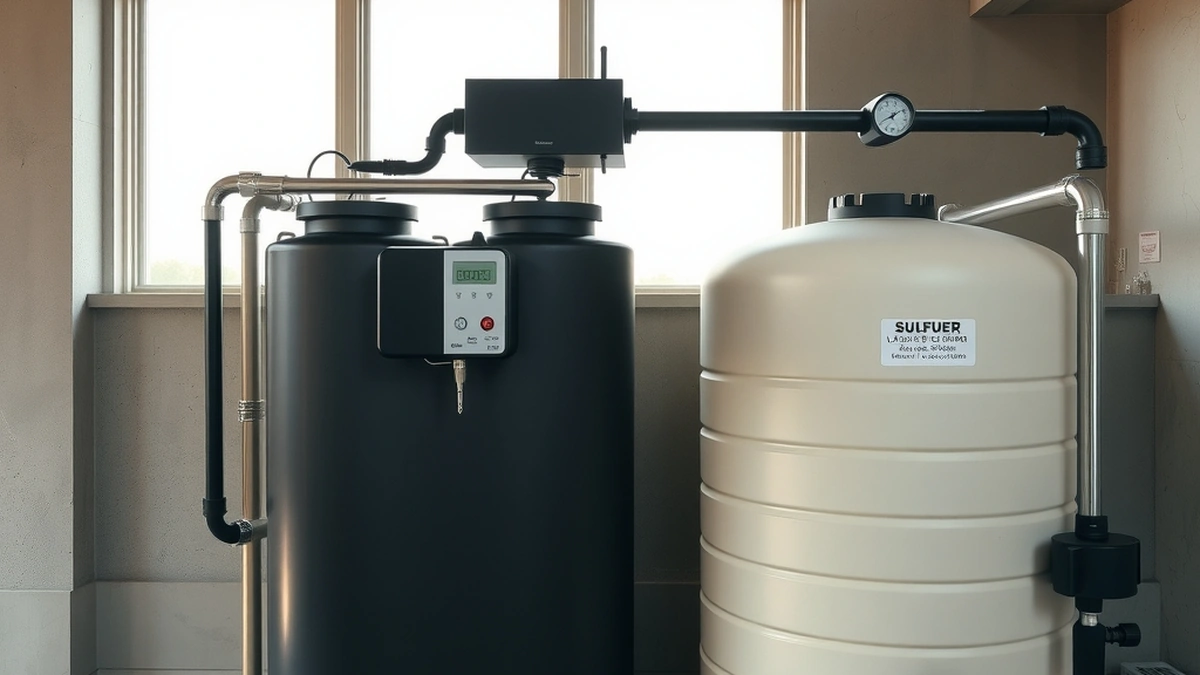
A sulfur filter costs $1,000 to $3,000 installed, depending on the media and whether aeration is included. Running costs are low apart from backwash water, and the filter must be sized to the pump's flow.
- Installed cost
- $1,000 - $3,000
- Media types
- Air injection, greensand, carbon
- Backwash
- Required
- Household flow
- 8 - 15 gpm
- Water test
- $40 - $150
Some links on this page are affiliate links.If you buy through them we may earn a commission at no extra cost to you. We do not accept payment for rankings. Read the full disclosure.
A sulfur filter costs $1,000 to $3,000 installed, depending on the media and whether aeration is part of the system. The filter removes hydrogen sulfide, the gas behind the rotten-egg smell, and it needs to be sized to the pump’s flow as well as the household demand. A filter that is too large for the pump is worse than one that is slightly small.
What the filter is treating
Hydrogen sulfide produces the odour. It is a dissolved gas, and it can also be produced by sulfur bacteria living in the well, the pump, or the plumbing.
That distinction matters. A filter treats the water, but if bacteria are growing in the well, the odour returns and the filter is blamed. A positive bacteria test changes the order of work: disinfect first, then filter.
A water test at $40 to $150 should establish the concentration and check for bacteria. Shock chlorination may be needed before the filter is installed, and the filter should not be commissioned until the well has been cleared.
The media options
| Media | How it works | Typical installed cost | Best for |
|---|---|---|---|
| Air injection | Oxidizes gas, then vents | $1,500 - $3,000 | Most residential wells |
| Greensand | Oxidizes and filters | $1,200 - $3,000 | Higher concentrations |
| Catalytic carbon | Adsorbs and oxidizes | $1,000 - $2,000 | Lower levels, taste |
| Oxidizing media | Combined oxidation and filtration | $1,200 - $2,500 | Moderate levels |
Air injection uses a compressor or a venturi to add air, which oxidizes the sulfide into particles that the filter traps. It handles higher concentrations and needs a vent and periodic maintenance on the air system. The compressor is the part that fails first, and it is worth asking about its replacement cost.
Greensand uses a manganese-coated media that oxidizes and filters in one tank. It needs regular backwash and potassium permanganate regeneration on some designs, which adds a chemical to the maintenance list.
Carbon is the cheapest option and works on lower concentrations. It exhausts and needs replacement, and on a strong sulfur smell it may last only a few months.
What the price includes
| Line | Typical range |
|---|---|
| Filter tank and media | $700 - $1,800 |
| Aeration or injection equipment | $300 - $900 |
| Plumbing and bypass | $200 - $500 |
| Labour | $300 - $700 |
| Total installed | $1,000 - $3,000 |
A basic carbon tank on a low concentration sits at the bottom. An air-injection system with a compressor and vent sits at the top, and the difference is mostly equipment rather than labour.
Sizing by flow
Whole-house filters are rated in gallons per minute. A household with two bathrooms peaks at 8 to 15 gpm.
Backwash is a separate requirement. A filter that needs 10 gpm to backwash will not clean itself on a pump that delivers 8 gpm, and the media will eventually compact.
Ask the installer to measure the pump’s flow at the system pressure. A pump that has lost performance with age may need attention before a filter is added, and replacing a pump after the filter is installed is the more expensive order.
Running costs
Backwash uses water, typically a few hundred gallons per cycle, and the cycle runs every few days. On a metered supply or a low-yield well, that water use is a real constraint rather than a footnote.
Media replacement depends on the type. Carbon may need replacement every few years; greensand lasts longer but needs regeneration chemicals on some designs.
Aeration systems have a compressor or a venturi that needs occasional service, and the vent has to terminate where the gas will not be drawn back into the house.
Comparing with other odour fixes
| Method | Treats hydrogen sulfide | Ongoing cost | Notes |
|---|---|---|---|
| Sulfur filter | Yes | Media, backwash | Whole-house |
| Carbon filter | Partly | Cartridges | Shorter life on high levels |
| Softener | No | Salt | Not designed for sulfide |
| Shock chlorination | Bacteria, not gas | Low | Prep step, not a permanent fix |
A softener installed to fix a sulfur smell is a common and expensive mistake. The odour persists, the resin may foul, and the homeowner has spent $1,200 to $4,500 on equipment that was never going to solve the problem.
Before you buy
- Test the water for hydrogen sulfide and bacteria.
- Treat bacteria first if the test is positive.
- Measure the pump flow and confirm the backwash rate.
- Choose the media by concentration, not by price alone.
- Confirm the system includes a bypass and a vent where needed.
- Ask about media replacement cost and interval.
The media replacement cost is the number that determines the ten-year price. A cheap tank with expensive media can cost more than a better system with longer intervals, so ask for both numbers before deciding.
For the treatment comparison, see sulfur removal options and hydrogen sulfide treatment. For the well side, shock chlorinate well covers the prep step.
Bottom line
A sulfur filter costs $1,000 to $3,000 installed, and the right media depends on the concentration and the pump. Test first, treat bacteria before the odour, and size the backwash to the well.
Frequently asked questions
How much does a sulfur filter cost?
Installation typically runs $1,000 to $3,000 depending on the media, the aeration equipment, and the plumbing required.
What causes sulfur smell in well water?
Hydrogen sulfide gas produces the rotten-egg odour, and it can also come from sulfur bacteria in the well or the plumbing.
Which sulfur filter is best?
Air injection suits many wells, greensand handles higher concentrations, and carbon is used for lower levels with taste and odour control.
Does a sulfur filter need maintenance?
Yes. It backwashes on a schedule, and the media needs inspection and eventual replacement; aeration systems also have moving parts.
Can a softener remove sulfur?
No. A softener is not designed for hydrogen sulfide, and the odour will persist while the resin may foul.
How is the filter sized?
By the household peak flow of 8 to 15 gallons per minute and by the pump's ability to supply the backwash rate.
Sources
Some links are affiliate links.If you buy through them we may earn a commission at no extra cost to you. We do not accept payment for rankings. Read the full disclosure.