
sulfur filter installation: what it involves
Sulfur filter installation takes 3-6 hours and costs $1,000-$3,000 installed. See oxidation choices, venting, backwash drain, and sizing by ppm.
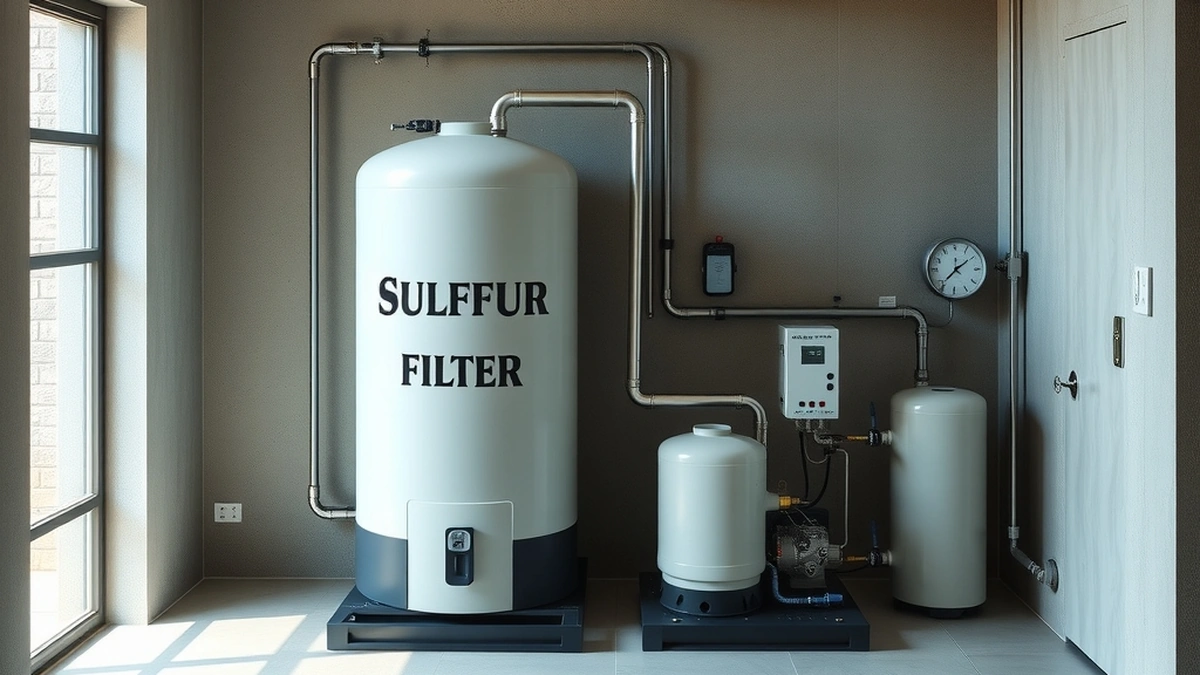
Sulfur filter installation takes 3-6 hours and costs $1,000-$3,000 installed. The job needs a bypass, a backwash drain, a vent or chemical feed depending on design, and sizing based on hydrogen sulfide concentration.
- Installed cost
- $1,000 - $3,000
- Labor time
- 3 - 6 hours
- Drain required
- Yes, 10 - 15 feet
- Vent required
- Air injection only
- Backwash
- Every 3 - 7 days
Some links on this page are affiliate links.If you buy through them we may earn a commission at no extra cost to you. We do not accept payment for rankings. Read the full disclosure.
Sulfur filter installation takes 3-6 hours and costs $1,000-$3,000 installed. The job requires a bypass, a backwash drain within 10-15 feet, and either a vent for air injection or a chemical feed system. Sizing is driven by hydrogen sulfide concentration and peak flow.
What the filter is removing
A sulfur filter is a point-of-entry treatment tank that oxidizes dissolved hydrogen sulfide into elemental sulfur and sulfate, then filters the solids out of the water. Hydrogen sulfide is the gas behind the rotten-egg smell in well water.
The concentration sets the design. Under about 1 ppm, a catalytic carbon stage can sometimes handle the load. Above that, oxidation is required: air injection, ozone, or chemical feed with chlorine or hydrogen peroxide.
The install changes accordingly. A carbon tank is a plumbing job. An air injection unit adds a compressor and a vent. A chemical system adds a metering pump, a solution tank, and a contact tank.
Air injection versus chemical oxidation
| Design | Installed cost | Best for | Extra hardware |
|---|---|---|---|
| Air injection | $1,000 - $2,000 | 1 - 5 ppm, no bacteria | Compressor, vent, drain |
| Catalytic carbon | $900 - $1,800 | Under 1 ppm, mild odor | Drain only |
| Chemical oxidation | $1,800 - $3,000 | 5+ ppm, iron bacteria | Pump, solution tank, contact tank |
| Ozone | $2,000 - $3,000 | High load, no chemical storage | Ozone generator, contact tank, vent |
The overlap is real: a large air injection tank can cost as much as a small chemical system. Tank size and valve quality usually explain the invoice more than the design label does.
Vent, drain, and the parts people forget
Backwash is mandatory. A sulfur filter runs a cycle every 3-7 days at 5-10 GPM for 10-15 minutes, discharging 50-150 gallons to drain. The drain must handle that flow, slope continuously, and terminate with an air gap.
Air injection adds a vent. The compressor pulls ambient air into the tank head, and excess air has to escape, usually through a vent line to the outdoors or a utility space. A vent that terminates in a closed closet just moves the smell indoors.
Chemical oxidation adds storage. A 15-30 gallon solution tank, a metering pump on a timer or flow switch, and a contact tank sized for 10-20 minutes of retention. That is 3-4 feet of additional floor space and a second electrical draw.
All designs need a bypass so the house can run while the tank is serviced. A three-valve bypass costs $60-$150 and saves a plumber visit later.
Sizing by concentration and flow
Hydrogen sulfide above 1 ppm needs an oxidation stage. Above 5 ppm, most installers specify air injection with a larger tank or chemical feed, because the oxidant demand is high enough that media alone exhausts quickly.
Flow sets tank diameter. Whole-house units support 8-15 GPM, and backwash needs 5-10 GPM of that. A well that produces 6 GPM can support a filter that backwashes at 5 GPM, but not one that demands 10.
Worked example: 3 ppm hydrogen sulfide, 4 bathrooms, peak flow 10 GPM. An air injection tank with 2 cubic feet of media and a 12-inch diameter handles it, backwashing at 8 GPM. If the well yields 5 GPM, the backwash schedule has to be spread out or the tank downsized.
Iron usually accompanies sulfur. Above 2-3 ppm, the same oxidation step handles both, which is why a combined iron and sulfur filter is common. Iron in well water covers the test values.
Installation sequence
- Test hydrogen sulfide, iron, manganese, pH, and hardness before selecting a design.
- Confirm well yield against backwash demand and check the pressure tank.
- Locate the tank near a drain, with vent routing if the design requires it.
- Cut in a bypass and set the tank level on a dry, stable base.
- Install the drain line with an air gap, and the vent or chemical feed hardware.
- Run a manual backwash, verify media expansion, and set the cycle schedule.
What goes wrong after install
The most common failure is a filter that works for six months and then stops. Three causes account for most of them.
First, backwash volume. A clogged drain line or a flow restrictor sized wrong leaves media fouled. Second, exhausted media. Carbon and catalytic beds have a finite capacity even with backwash, typically 2-5 years. Third, sulfur bacteria in the well. If the toilet tank grows slime, the well is reinfecting the system, and no filter fixes that. Hydrogen sulfide treatment explains the difference between the gas and the bacteria.
A fourth cause is pH. Oxidation media work best above pH 7. Acid water at pH 6 corrodes the media and shortens its life. A neutralizer ahead of the filter is the fix, and it adds $500-$1,500 to the project.
What changes the quote
Design complexity is the first driver, drain distance the second, and vent routing the third. A basement with a floor drain and an exterior wall for the vent is the easy case at 3 hours. A crawlspace with no drain and a vent run through a finished ceiling is the 6-hour case.
Electrical work is the fourth. Air injection needs an outlet for the compressor; chemical feed needs one for the pump as well. Adding a circuit costs $150-$350.
For the carbon stage that often follows, catalytic carbon filter installation covers that tank. And if the smell appears only after rain, well water smells after rain explains why the source, not the filter, may be the issue.
Frequently asked questions
How much does sulfur filter installation cost?
One thousand to three thousand dollars installed, depending on design. Air injection units sit at the low end; chemical oxidation with a retention tank sits at the high end.
Does a sulfur filter need a vent?
Air injection designs do, because they draw air into the tank and must vent excess. Catalytic and chemical designs generally do not need a roof vent but do need a drain.
How long does sulfur filter installation take?
Three to six hours. Adding a retention tank, a metering pump, or a new electrical circuit pushes toward a full day.
What concentration of hydrogen sulfide needs a filter?
Any detectable odor is worth treating. Above roughly 1 ppm, carbon alone is usually insufficient and an oxidation filter becomes the practical choice.
Can a sulfur filter go before a softener?
Yes, and it should. Sulfur and iron foul resin, so oxidation and filtration come first, then softening, then any polishing carbon stage.
Why does my sulfur filter stop working after a few months?
Usually a failed backwash, an exhausted media bed, or a well that is reinfecting the system with sulfur bacteria. Check backwash flow and shock chlorinate the well.
Sources
Some links are affiliate links.If you buy through them we may earn a commission at no extra cost to you. We do not accept payment for rankings. Read the full disclosure.


