Water filter pitcher reviews
What separates a good pitcher from a bad one: certification, cost per gallon, refill frequency, and cartridge availability. A buying framework, not scores.
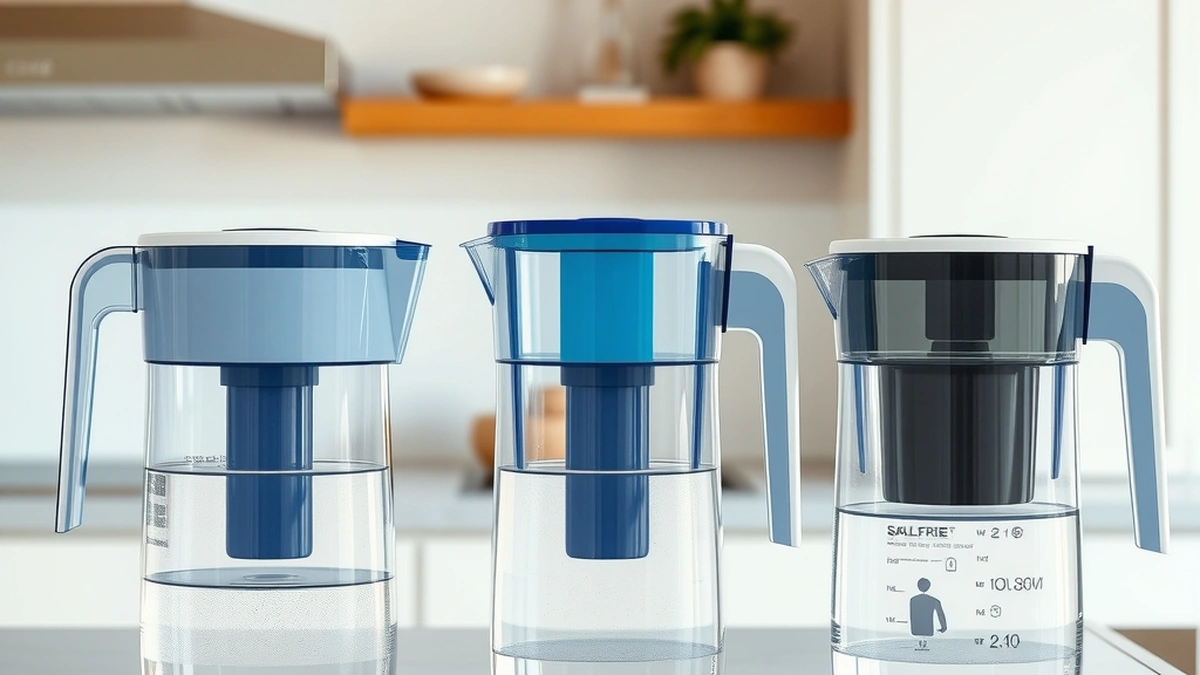
Pitcher reviews should compare certification, cost per gallon, reservoir size, and cartridge availability rather than taste alone. Expect $25 to $50 for the pitcher and $6 to $20 per cartridge, treating about 40 gallons at $0.15 to $0.30 per gallon.
- Pitcher
- $25 - $50
- Cartridge
- $6 - $20
- Per gallon
- $0.15 - $0.30
- Cartridge volume
- About 40 gallons
- Certification
- NSF/ANSI 42 and 53
Some links on this page are affiliate links.If you buy through them we may earn a commission at no extra cost to you. We do not accept payment for rankings. Read the full disclosure.
Pitcher reviews usually rank taste, which is the least useful variable. Taste is subjective, changes with water chemistry, and is mostly a function of chlorine removal, which nearly every certified pitcher does. The variables that actually differ are certification, cost per gallon, reservoir size, and whether you can buy cartridges in two years.
What to Compare
Certification. NSF/ANSI 42 for taste and chlorine, 53 for health-related claims. The listing names the model. A brand-level claim is not a certification.
Cost per gallon. Cartridge price divided by rated gallons. This ranges from about $0.10 to $0.45 across the market.
Reservoir size. Six to ten cups for a standard pitcher, more for a dispenser. A family of four will refill a small pitcher four or five times a day.
Cartridge availability. Standard cartridges are sold in grocery stores and online. Proprietary shapes tie you to one seller.
Throughput. How long a full reservoir takes to filter. Two minutes is fine; six minutes is a bottleneck.
| Criterion | What good looks like | Why it matters |
|---|---|---|
| Certification | 42 plus 53 for the contaminant | Verifiable claim |
| Cost per gallon | Under $0.30 | Long-run cost |
| Reservoir | Matches household | Daily usability |
| Cartridge | Widely available | Future supply |
| Filter time | Under 3 minutes | Whether it gets used |
Cost per Gallon in Practice
A $8 cartridge rated for 40 gallons is $0.20 per gallon. A $15 cartridge rated for 60 gallons is $0.25. A $20 cartridge rated for 100 gallons is $0.20.
The pattern is not “expensive cartridge, expensive water.” It is cartridge price divided by volume. A premium cartridge with a long rating can beat a cheap one with a short rating.
Add the pitcher: $35 over five years is $7 per year, negligible.
A household using 300 gallons a year at $0.20 per gallon spends $60 on cartridges. At 2 gallons a day, which is 730 gallons, it spends $146. That is still far below bottled water at $730 or more.
The Models People Compare
Three product families dominate the shelf, and they differ in emphasis rather than category.
| Family | Strength | Trade-off |
|---|---|---|
| Standard carbon pitchers | Cheap, widely available | Basic chlorine and taste only |
| Carbon plus ion exchange | Some metal reduction | Shorter cartridge life |
| High-capacity dispensers | Fewer refills | Counter space |
A carbon-plus-ion-exchange model can reduce lead and copper if it carries the 53 listing. That is worth paying for if the report shows those metals. It is not worth paying for if the report is clean, because the extra media shortens cartridge life.
A high-capacity dispenser is the right choice for a family, not because the water is better but because the refill frequency is lower. A pitcher abandoned in the fridge because it is always empty is a worse purchase than a slightly more expensive dispenser that gets used.
Where Pitchers Stop Working
Hard water. No pitcher softens. Calcium and magnesium pass through, so scale and soap scum remain.
Nitrate. Not removed by carbon. A well with nitrate near 10 mg/L needs reverse osmosis.
Bacteria. Not a microbiological barrier.
Volume. Above four people, refilling becomes a chore.
If two or more of those apply, the honest recommendation is not a better pitcher. It is a different format: an under-sink carbon filter at $150 to $500 for volume, or under-sink RO at $300 to $900 for dissolved contaminants.
There is also a durability question that reviews rarely cover. Hinges, lids, and spouts break before the filter does, and a pitcher with a cracked reservoir is replaced rather than repaired. Look at the warranty and whether the reservoir is sold separately. A model with a replaceable reservoir outlasts one that has to be thrown away for a broken lid.
How to Read a Review
Most pitcher reviews are taste tests conducted on one water supply. That tells you how the filter performed on that water, not on yours.
Read for the numbers instead: certified models, cartridge price, rated gallons, reservoir capacity, and filter time. Those are comparable across reviewers and stable over time. Taste rankings are neither.
Ignore scores that aggregate “value” without stating the cost per gallon. A $45 pitcher with a $20 cartridge rated for 40 gallons is more expensive to run than a $30 pitcher with a $10 cartridge rated for 50 gallons, and the star rating will not tell you that.
Five Steps to Choose
- Read the water report and list what must be removed.
- Check the certification listing for the specific model.
- Calculate cost per gallon from price and rated volume.
- Count daily refills for your household size.
- Confirm cartridge availability at a store you actually use.
Maintenance
Change on the gallon rating, not on the indicator light alone. Many lights are timers that assume average use.
Rinse the reservoir weekly. Store the pitcher in the fridge if you prefer cold water, but keep it out of direct sun.
If the flow slows before the rating is reached, the cartridge is loading faster than expected, which usually means sediment in the water. A sediment pre-filter or a different format is the fix.
Keep the manual, if there is one, and note the model number inside the lid. Replacement cartridges are matched by model, and a pitcher bought five years ago may take a cartridge that the current shelves no longer stock. Buying one spare at the time of purchase avoids that problem entirely.
For the buying framework, see best water filter pitcher. For the step up in capacity, under sink water filter covers the alternatives, and bottled water versus a filter covers the cost comparison.
Frequently asked questions
Which water filter pitcher is best?
The best pitcher is the one certified for the contaminants in your water, with a reservoir that fits your household and cartridges that are easy to buy at a reasonable cost per gallon.
How much do pitcher filters cost per year?
A household using 300 gallons a year at $0.20 per gallon spends about $60 on cartridges, plus the pitcher amortized over several years.
Do all pitcher filters remove lead?
No. Only models certified to NSF/ANSI 53 for lead reduction do, and the certification listing names the specific model rather than the brand.
How often should pitcher cartridges be replaced?
Roughly every 40 gallons or two months for an average household, and sooner if flow slows noticeably or taste returns.
Are expensive pitchers better?
Not necessarily. Price often reflects design and brand rather than media quality, so the certification and the cartridge cost per gallon are better guides.
Can a pitcher filter improve hard water?
No. Pitchers do not remove calcium and magnesium, so hardness, scale, and soap scum remain regardless of the model.
Sources
Some links are affiliate links.If you buy through them we may earn a commission at no extra cost to you. We do not accept payment for rankings. Read the full disclosure.